Get Full Government Meeting Transcripts, Videos, & Alerts Forever!
Get email alerts on the Tax Policy topic
No spam. Unsubscribe anytime.
Ways and Means advances tax-conformity bill but decouples costly corporate bonus depreciation
Summary
The committee fast-tracked Senate Bill 212, adopting most federal conformity provisions but removing a corporate bonus-depreciation provision estimated to cost Indiana $244 million over three years; proponents said the move balances competitiveness with fiscal responsibility while critics urged restoring social-service cuts funded from reserves.
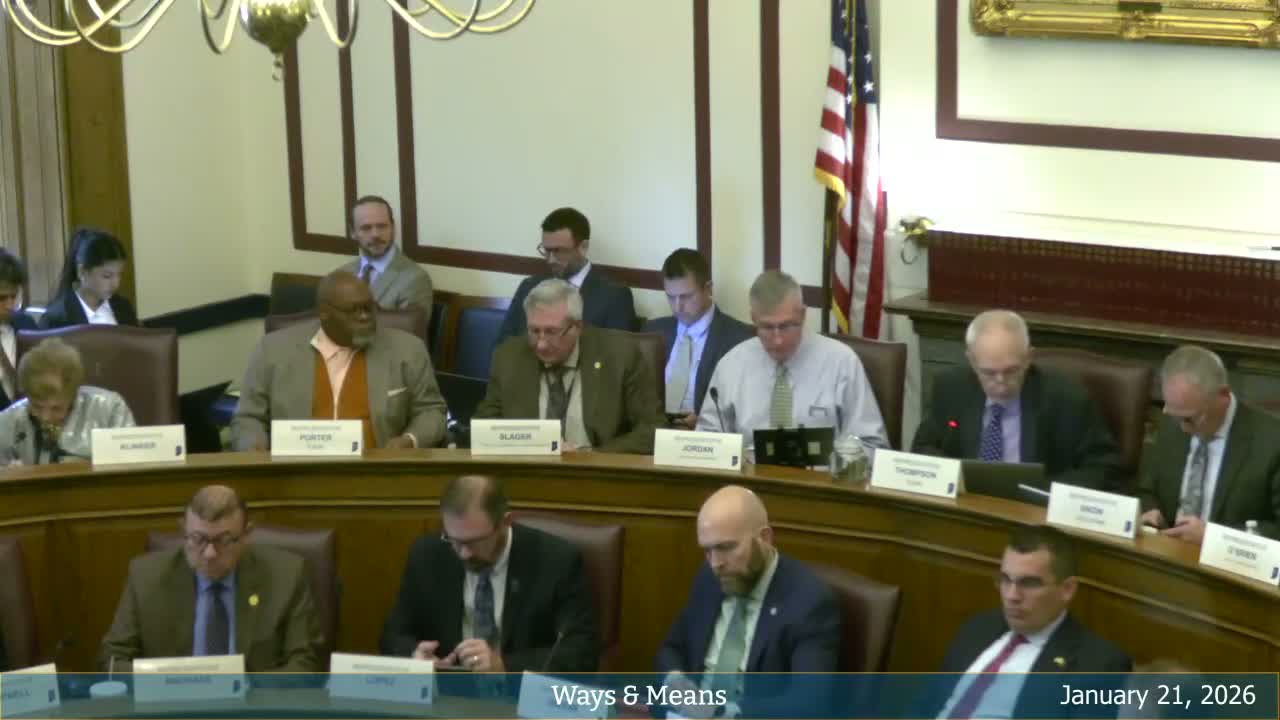
Senate Bill 212 moved out of the House Ways and Means Committee after a detailed presentation and then a recorded vote of 20–3. Sponsor Senator Holman said the bill packages several federal tax changes — including an enhanced adoption credit, recognition of tribal identification of special-needs children, a permanent telehealth deduction safe harbor and the termination of certain energy-property cost recovery — but that the Senate chose to decouple one large corporate provision.
"The section has to do with corporate returns — bonus depreciation on allowance for qualified production property — and the three-year cost to the state of that is $244 million," Senator Holman told committee members, explaining why the Senate did not adopt that federal change wholesale. He asked the committee for support to fast-track the bill so it could reach the governor quickly.
Representative Delaney pushed for caution, proposing an amendment to freeze the state’s conformity decisions until lawmakers could consider all provisions together and to use identified funds to restore pre‑K, childcare and public-health cuts. "I think we've made a big mistake last year based on bad information as to the size of our surplus," Delaney said, arguing that some changes should wait for a full budget review.
Andrew Berger of the Indiana Manufacturers Association testified as neutral and urged careful review of fiscal impacts on manufacturing. "The focus on the qualified production property deduction ... would be expensive for Indiana," Berger said, recommending further examination of the state-level fiscal modeling.
Supporters of decoupling said it preserves benefits for individuals while avoiding a large near-term revenue loss caused by permitting 100% bonus depreciation for certain corporate property. Dissenting members warned the state should use any surplus to restore services rather than fund tax changes now.
After debate and the amendment exchanges, the committee voted to advance the bill to the next stage by voice and recorded votes. The measure was reported out of committee 20–3 and will proceed to the next House floor step.