Get Full Government Meeting Transcripts, Videos, & Alerts Forever!
Get email alerts on the Cannabis Hemp Regulation topic
No spam. Unsubscribe anytime.
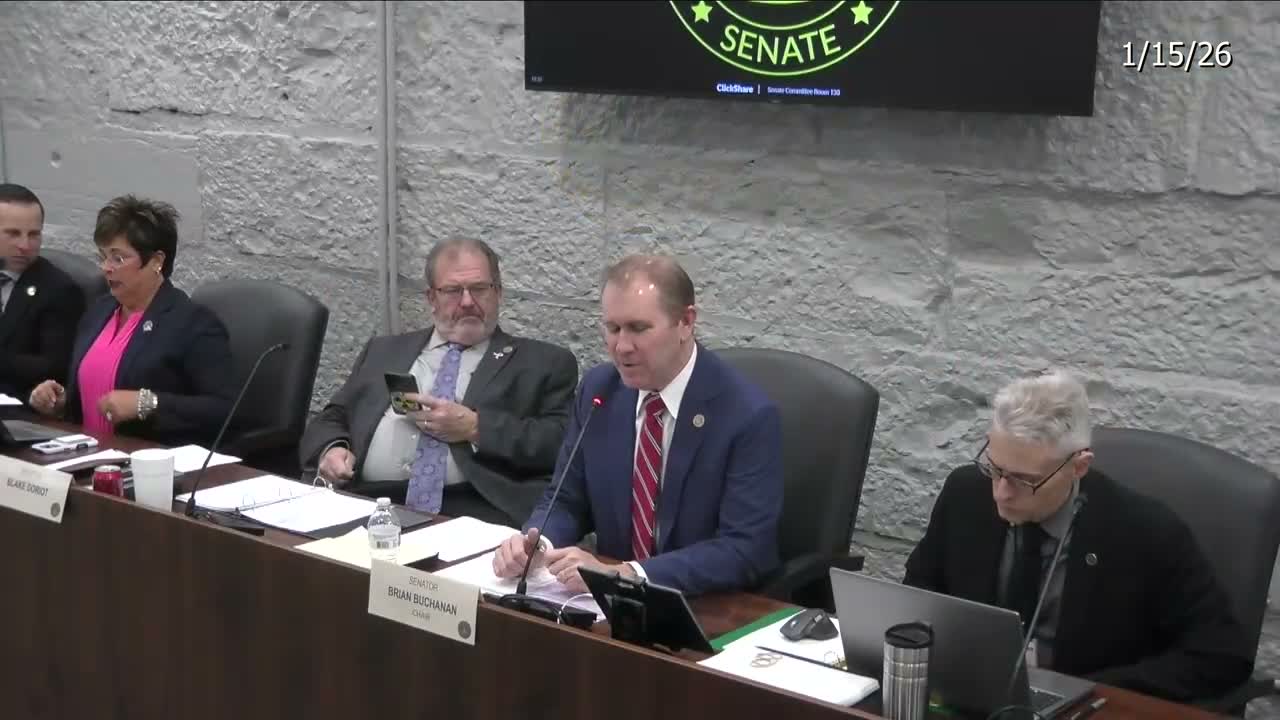
Senate Commerce and Technology Committee advances SB 250 to Appropriations after hours of debate on hemp-derived THC products
Summary
The Senate Commerce and Technology Committee voted 7-2 to recommit Senate Bill 250 to Appropriations. Supporters said the bill closes a federal "farm bill" loophole and improves enforcement; industry witnesses warned it would wipe out lawful hemp cannabinoid commerce and harm small businesses.
Senate Bill 250, a proposal to change Indiana's legal definition of hemp and restrict sales of THC-containing hemp products, cleared the Senate Commerce and Technology Committee on a 7-2 vote Tuesday and was recommitted to the Appropriations Committee.
Senator Freeman, who sponsored the bill, told the committee SB 250 "updates our definition of hemp and closes the farm bill loophole," sets a minimum purchasing age of 21 for products that contain THC, creates a new licensing scheme under the Alcohol and Tobacco Commission, and prevents Indiana from automatically following any future federal marijuana reclassification. "At the end of the day, it does 4 things," Freeman said, urging colleagues to support a measure he described as the most practicable fix.
Supporters said the bill responds to the uncontrolled proliferation of high-potency hemp-derived cannabinoids such as delta-8 and delta-10. Chris Daniels of the Indiana Prosecuting Attorneys Council said the 2018 Farm Bill left a gap the industry exploited, producing products that law enforcement and public-health officials are struggling to regulate. "When you ask our drug recognition officers what's the difference between somebody who's on high-potency THC and somebody who's on LSD, there is no difference," Daniels told the committee, saying ER visits and impaired-driving cases with THC present have increased.
Industry witnesses and hemp producers urged a regulatory approach rather than the bill's de facto prohibitions. Justin Swanson, representing 3Chi and the Midwest Hemp Council, said SB 250 would "decimate the cannabinoid marketplace" and disproportionately advantage large alcohol-industry actors by layering permits, banning online sales and imposing distribution controls. He urged the committee to pursue a framework of age limits, uniform testing, labeling and packaging instead of recriminalization.
Dave Colt, cofounder and CEO of Sun King Brewing Company, described the economic stakes. Colt said Sun King's hemp beverage line had grown rapidly and provided a critical revenue stream as alcohol sales have declined. "This bill harms Indiana businesses like ours by limiting consumer choice and forcing folks to go to bordering states to buy alternative products," Colt said, adding that the company invested more than $100,000 in equipment and relies on the new product line to retain employees.
Those supporting the bill argued the state must align with recent federal changes. Corey Harris of the American Trade Association for Cannabis and Hemp (ATTACH) said a federal measure signed into law in November replaces the delta-9 percentage test with a per-container total-THC limit (testimony described that threshold as 0.4 milligrams per container) and that Indiana must update its statutes to avoid becoming a de facto legal cannabis market after the federal change takes effect.
The committee debated whether the bill would unfairly impede farmers, small processors and hospitality businesses or whether it would restore clarity and enable law enforcement to pursue illicit operators. Several senators said they supported stricter rules to protect children and public safety but raised concerns about the bill's effect on commerce and small businesses. Senator Hundley said she would vote no on this version but sought work with sponsors to craft a more acceptable approach.
After closing remarks from Senator Freeman, the committee approved a motion to "do pass and recommit to Appropriations as amended." The roll call returned a 7-2 tally in favor, and the chair announced SB 250 would move to the Appropriations Committee for further review.
Next steps: SB 250 will be considered by the Appropriations Committee; no floor action has yet been scheduled.