Get Full Government Meeting Transcripts, Videos, & Alerts Forever!
Get email alerts on the Home Based Food Regulation topic
No spam. Unsubscribe anytime.
Representative Hunter Smith presents sweeping overhaul of home- and small-farm food rules; committee holds bill for amendment
Summary
House Bill 14-24 would expand what home-based vendors and small farms can sell, raise the gross-sales threshold for exemption and remove several local/inspection requirements while adding labeling for uninspected food. Supporters said it will grow local economies; critics raised food-safety concerns. The committee held the bill to allow clarifying amendments, including protections for farmers markets and training options.
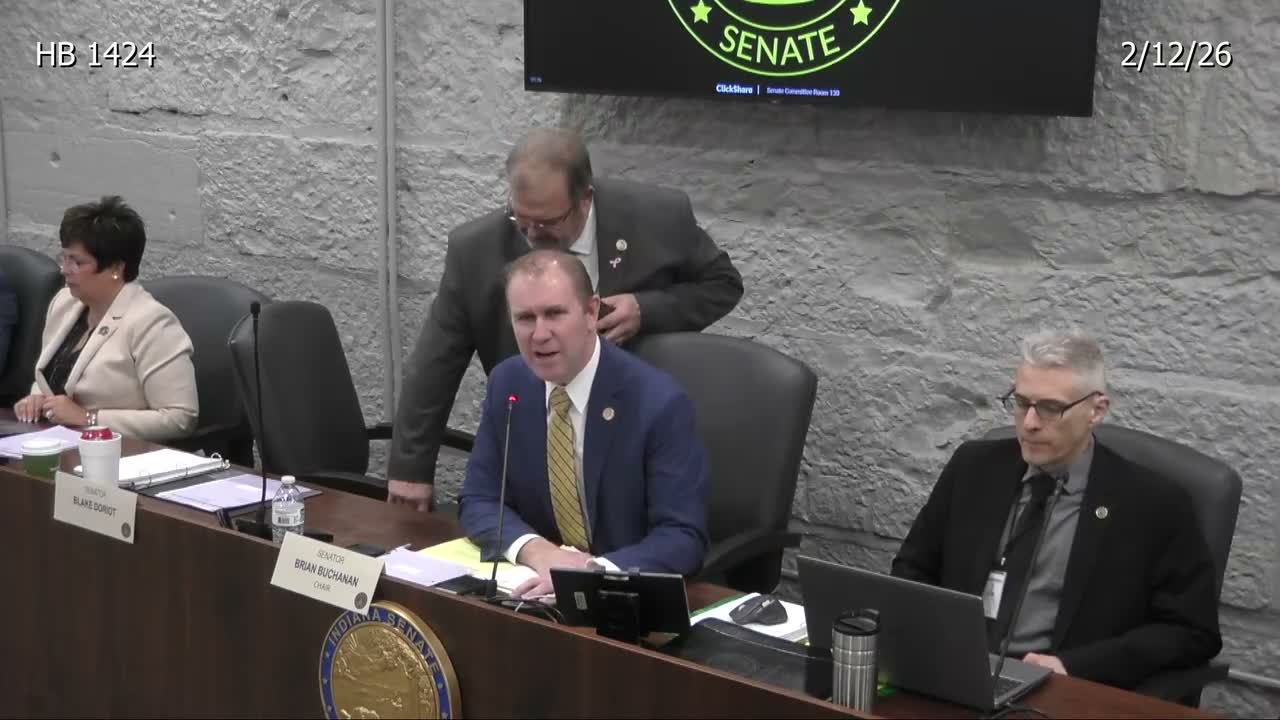
Representative Hunter Smith told the Senate Commerce and Technology Committee that House Bill 14-24 would “offer a responsible deregulation of Indiana's home and small farm food production landscape” by clarifying which homemade foods may be sold, permitting sales from outbuildings and raising the current gross-sales threshold that determines who is regulated.
Smith and witnesses said the measure aims to help family farms and home-based vendors expand income and improve local food access. “This measure better enables Indiana's farmers to develop small businesses, grow food, sell food, and preserve farmland,” Smith said, adding the bill includes labeling requirements that notify buyers when a product comes from an uninspected producer.
Supporters — including parents, veterans, small-business owners and advocacy groups — described real-world impacts. Jordan Vondersaar, a mother and local business owner, told the committee she mills flour at home and buys directly from farmers because she values transparency; she said the bill protects consumer choice and local economies. Joe Ricker, a retired Army colonel who runs veterans-in-farming programs, said the bill would make Indiana more attractive for service members seeking agricultural careers. Several home producers described losing sales after local health departments applied guidance from Purdue University that they said went beyond state law.
Opponents and safety-minded witnesses urged caution. Senator Lising questioned the bill's removal of ServSafe training and the proposed elimination of time-temperature controls for certain foods; Representative Smith acknowledged the bill reduces some statutory requirements while saying the intent is to limit needless bureaucracy and rely on labeling and consumer awareness. Rebecca Yoneshkhan of the Indiana State Poultry Association said removing time/temperature controls ‘‘introduces a vulnerability’’ and could harm commercial producers’ reputation in the event of outbreaks.
The legislation also raises a numerical threshold that drew scrutiny. The bill would replace a current $10,000 annual-sales ceiling with a $1,500,000 gross-sales threshold; Smith said the larger figure was chosen so ‘‘90% of Indiana's farms fit below 1,500,000’’ and to allow multi-generational family farms room to expand. Several senators asked whether the measure should instead focus on sales of the newly exempt categories rather than total farm revenue.
Several witnesses asked the committee to amend the draft to explicitly preserve the current ability of home-based vendors to sell directly to consumers anywhere in the state (in person, by phone or online) and to ensure farmers markets are not inadvertently restricted. Institute for Justice counsel asked the panel to add language mirroring existing law for direct-to-consumer sales so established home-based vendors are not put out of business.
Representative Smith said he will file an amendment to restore home-based vendor protections for farmers markets and to clarify direct-to-consumer sales, and the committee voted to hold the bill for amendment and return for an amended vote.
What happens next: the committee will consider sponsor and public input on the amendment language before an amended vote is scheduled next week.