Get Full Government Meeting Transcripts, Videos, & Alerts Forever!
Get email alerts on the Police Oversight topic
No spam. Unsubscribe anytime.
Senate committee advances bill to make civilian police general-orders boards advisory
Summary
A state Senate committee voted to convert civilian-majority general-orders boards from binding decision-makers to advisory bodies, a change sponsors say would restore chiefs’ ability to set department policy while supporters cite delays and vacancies at Indianapolis’ boards.
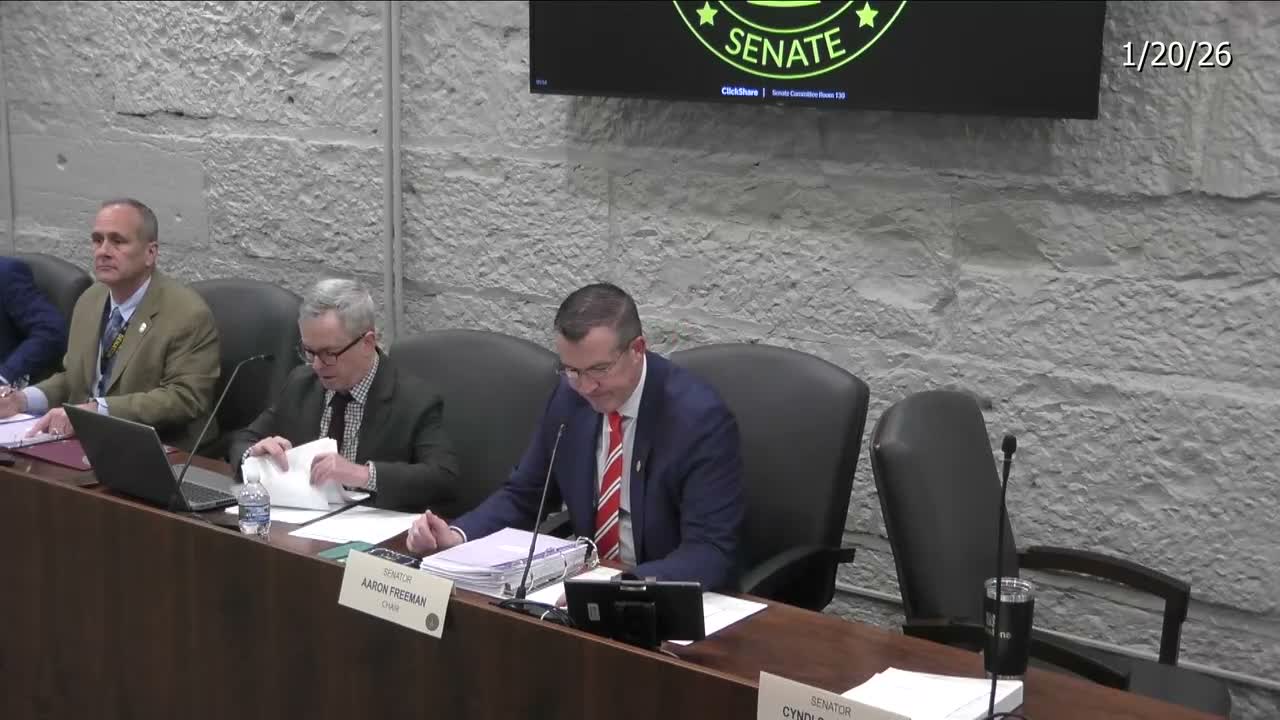
A Senate Corrections and Criminal Law Committee advanced legislation on Thursday that would strip binding policy-making authority from civilian-majority general-orders boards and make such boards advisory.
Senator Carrasco, sponsor of Senate Bill 284, told the committee the measure is meant to ensure police chiefs and sheriffs remain the single point of responsibility for departmental policies. "Police chiefs and sheriffs should have operational control and responsibility for policies in their agency," she said during opening remarks.
Rick Snyder, president of the Indianapolis Fraternal Order of Police, testified the change would address what he described as 45 overlapping levels of review at Indianapolis Metropolitan Police Department (IMPD), some with civilian oversight that can delay critical updates. "This hamstrings the chief of police in being responsive and timely with needed updates that govern the actions of officers in life-and-death situations," Snyder said.
Supporters argued the bill preserves civilian input but removes the ability of some boards to issue binding directives. Councilor Josh Behn, who represents Indianapolis’ southwest side, cited long vacancies and a lack of quorum on the current general-orders board and said that has impeded routine policy changes. "We've also seen vacancies on that go from November to May," Behn said, arguing that inconsistent membership can prevent timely policy passage.
Opponents raised concerns about broad statewide application. Senator Gulick warned SB 284 could sweep in many local boards that "may have an active and positive impact on their communities." Senator Crosskill and others asked whether the bill would unintentionally weaken disciplinary or investigatory functions; sponsors repeatedly said merit boards and investigatory mechanisms would remain in place.
After debate and brief remarks by committee members, the committee moved the amended bill and approved it on a 6-2 roll call. The committee record shows the motion carried, with the chair recording the bill as "passes 6 to 2." The bill will proceed to the next legislative stage for further consideration.
The bill was presented as an attempt to balance civilian oversight with chief-level accountability. Sponsors said they developed the proposal after consulting law enforcement leadership and the Indianapolis chief of police, who they said raised staff-retention and policy-update challenges tied to the existing structure. Opponents urged caution to avoid undoing effective oversight in other jurisdictions and said they would work on amendments to limit unintended consequences.
The committee accepted a clarifying amendment that applies the bill’s criteria to boards already in existence as well as future boards. No final vote on second reading was recorded during the hearing; the committee’s approval advances the bill for further action.
Action: SB 284 as amended advanced by committee (vote 6-2).