Get Full Government Meeting Transcripts, Videos, & Alerts Forever!
Get email alerts on the Education Testing topic
No spam. Unsubscribe anytime.
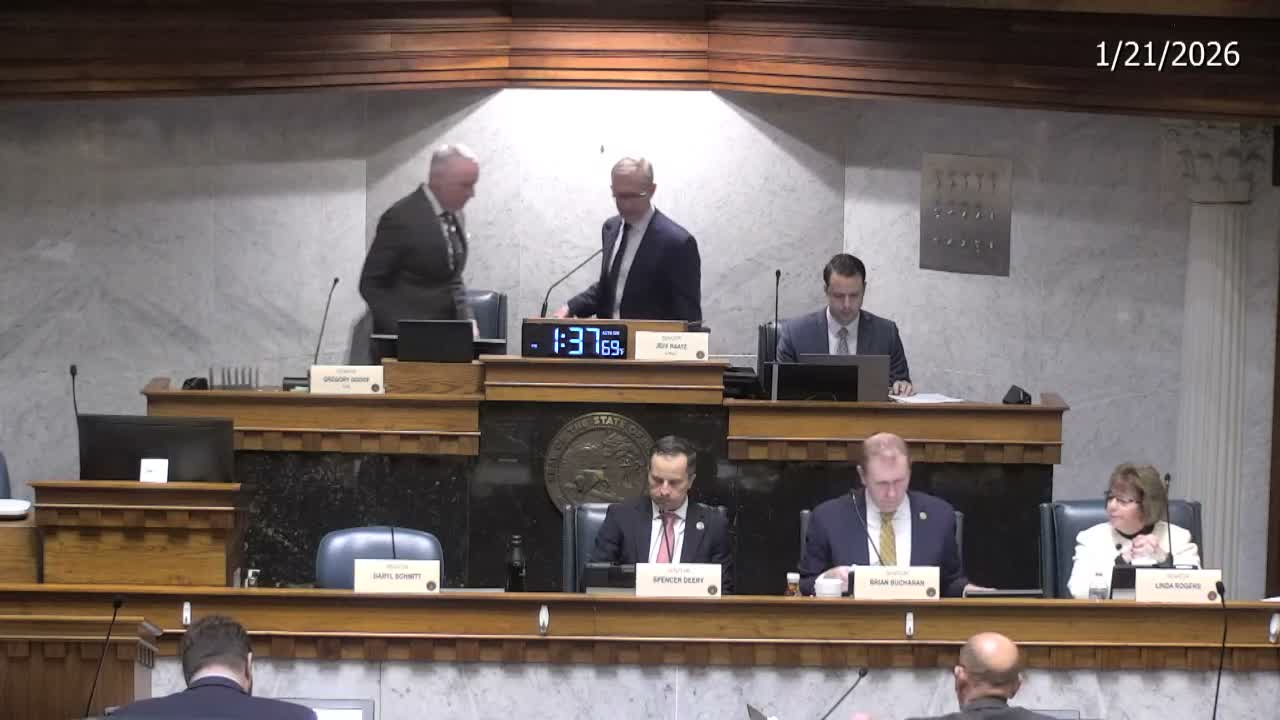
Senate committee advances SB 88 adding CLT to college admissions, rejects amendments to remove marriage guidance
Summary
A Senate education committee voted to pass SB 88 as amended to allow the Classical Learning Test (CLT) for college admissions and permit it for certain administrative assessment uses; multiple amendments—including ones to remove language recommending waiting until marriage to begin having children and to require comprehensive sex education—failed after debate and public testimony for and against the bill.
A Senate education committee on Tuesday advanced Senate Bill 88 in amended form, adding the Classical Learning Test (CLT) as an accepted college entrance exam alongside the ACT and SAT and approving limited flexibility on teacher‑licensing assessments. The committee defeated several amendments that sought to remove portions of a "good citizenship" provision, including language recommending students "wait until marriage to begin having children." The chair declared the bill passed as amended during the committee roll call.
Sponsor Senator Byrne, who walked the committee through Amendment 1, said the amended bill "really, as amended, just does really 3 simple things"—allow the CLT for admissions and statewide administrative assessment purposes, add the CLT as an option alongside the ACT and SAT for licensure consideration, and adjust teacher licensure pathways for certain applicants. He told senators the CLT "is already accepted by 320 colleges nationwide and used by a quarter million students annually," and argued that adding the exam would provide "greater opportunity and flexibility in pursuing higher education." (Testimony in the hearing named several Indiana institutions that accept the CLT.)
Opponents and multiple public witnesses urged caution. Joel Hand of the American Federation of Teachers of Indiana warned the committee that the bill removes language requiring trauma‑informed, evidence‑based social and emotional instruction for teacher candidates and said research raises concerns that the CLT "has baked in prejudices that would make students who come from less diverse backgrounds appear to have done better than students from more diverse backgrounds." Cecilia Pointer of MadVoters argued the bill "tramples on the separation of church and state," objecting to earlier versions that would have required instruction on the Ten Commandments and to restrictions on classroom discussion of sexism, racism and classism.
Civil‑rights and community advocates did not wholly reject the bill but urged changes or caution. Gwendolyn Kelly of the NAACP's state conference said the student‑success goals are "reasonable," but she objected to turning private life guidance into required instruction and warned of constitutional risk depending on how material is taught. The Indianapolis Urban League's Mark Russell said portions of the text mirror model legislation from outside think tanks and urged the committee to reject language that could narrow curriculum or exclude discussion of the state's difficult history.
Supporters from classical schools and homeschool organizations urged passage to expand testing options for students taught in classical curricula. Nathaniel Pullman, headmaster of Redeemer Classical School in Fort Wayne, said the CLT gives his students a "more accurate assessment" of what they are taught. Several private and independent college representatives were cited during testimony as already accepting the exam.
The committee considered multiple amendments that would have altered curriculum guidance and testing language. Amendment 6 (which would have struck a section that included instruction on waiting until marriage before having children) and Amendment 4 (which would have removed that same line from the civics list) both failed on roll calls recorded in the transcript as 4–7. An amendment that would have struck named standardized exams in favor of a generic "nationally recognized assessment" also failed 4–7. Public testimony focused heavily on the marriage language and on the CLT's alignment with classical pedagogy and concerns about bias or inadequate evidence.
After public testimony and debate, the committee voted to pass SB 88 in its amended form. The transcript records the committee vote and the chair's announcement that the bill "passes as amended." The committee then moved on to the next item on the docket.
What happens next: SB 88 will move to the full Senate calendar if the sponsor pursues further action; the committee record shows an engaged public comment period with organized testimony both for and against the CLT provision and for changes to teacher‑preparation language.