Get Full Government Meeting Transcripts, Videos, & Alerts Forever!
Get email alerts on the Building Codes Energy topic
No spam. Unsubscribe anytime.
County staff propose streamlined residential energy path and home‑hardening rules amid cost concerns
Summary
Coconino County staff proposed adopting the 2024 building-code suite with a simplified, five‑item prescriptive energy path for residential builds and targeted home‑hardening rules in the wildland‑urban interface, saying the approach balances safety and affordability while participants raised questions about costs, snow loads and electrical capacity for future electrification.
County staff presented proposed amendments to local building codes that would adopt the 2024 model-code suite broadly while keeping the county on a simpler, largely 2018‑based approach for most requirements and adding a county-specific prescriptive path for residential energy compliance.
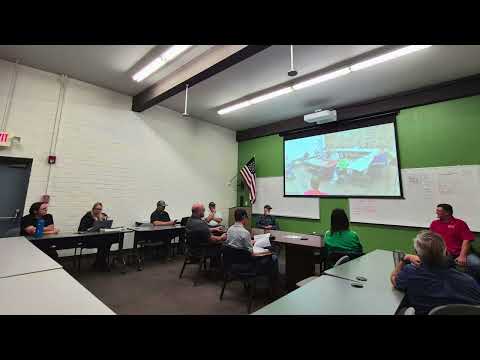
At a meeting of the county’s building‑code advisory group, the staff member leading the presentation said the county would offer a five‑item prescriptive package "that these are the five things you need to meet" so owner‑builders and small contractors do not have to navigate the 2024 code’s 51‑option compliance path. The staff member said the package is "easily attainable, relatively inexpensive" and estimated a typical townhome would gain about 13% in efficiency with about a $100 increase in permit fees on the example they priced out.
The nut graf: staff said the narrower path is designed to keep inspections and compliance simple for county reviewers and to avoid large up‑front costs for homeowners that, they argued, could make housing less affordable. "We're not doing stretch code. We're not doing net 0," the presenter said, adding the county’s approach seeks a balance between energy improvements and construction cost.
Pat, introduced during the meeting as the county’s contract building official, described technical items the county would keep or add, including requirements to maintain the thermal envelope, increased attention to duct tightness and certificates for duct‑work testing, and a move to require higher furnace efficiency. Pat and the presenter also flagged new commercial provisions, notably more stringent fire‑suppression language for storage classifications that involve lithium‑ion batteries; the presenter said recent local permits for battery storage have already required enhanced suppression measures.
The presentation also emphasized home‑hardening measures targeted to parcels inside the wildland‑urban interface. Staff listed measures including ember‑resistant vent openings (the presenter estimated about $45 per opening in their example), a requirement for noncombustible or fire‑resistant treated decking materials where decks are installed, and about 6 inches of noncombustible substrate beneath exterior siding. The presenter said most of those measures are already standard among local builders and would apply only on parcels the county identifies via its parcel viewer.
Participants pressed staff on a range of practical questions. One attendee, who said they had rebuilt houses after a local wildfire, described ember intrusion through attic vents as the main cause of structure losses; another asked whether a standard 200‑amp electrical panel is adequate for future electrification and accessory dwelling units. Pat recommended plan‑level load calculations during review and said staff is building the in‑house capacity to assess panel and circuit loads.
On costs, participants and staff discussed different estimates: the presenter cited the city’s analysis that a full stretch/net‑zero approach could add roughly $35,000 to the model cited, while builders in the meeting suggested higher numbers in some cases; staff maintained the county’s prescriptive approach would be materially less costly. The presenter also said the county would remove an existing "Innovative Materials Systems" pilot from the building code and re‑establish it as a standalone program, noting including it in the code was confusing and possibly improper.
The meeting closed with staff promising to post slides and materials online and to follow up with stakeholders. No formal vote or action was recorded at the meeting.