Get Full Government Meeting Transcripts, Videos, & Alerts Forever!
Get email alerts on the Housing topic
No spam. Unsubscribe anytime.
Ventnor City planning board adopts housing element and fair-share plan to meet state's fourth-round deadline
Summary
The Ventnor City Planning Board voted to adopt a fourth-round housing element and fair-share plan on June 30, 2025, a move staff said preserves the city's protection against builder's-remedy lawsuits; the plan relies on existing credits, two vacant parcels and an overlay zone for future large developments.
The Ventnor City Planning Board voted on June 30 to adopt a housing element and fair share plan aimed at meeting New Jersey's fourth-round affordable-housing requirements and preserving the city's protection against builder's-remedy lawsuits.
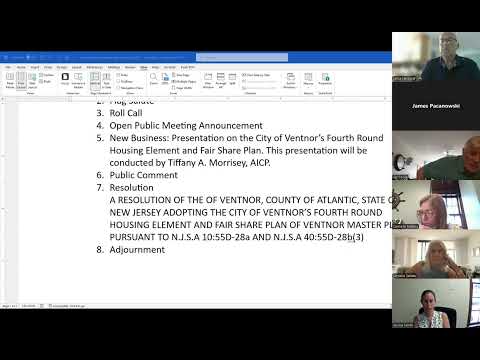
Tiffany Morrissey, a licensed professional planner who was sworn in and accepted as an expert for the record, told the board the plan must "be adopted and uploaded to the state portal by the end of the day today" to secure the statutory protections and meet the program deadline.
Morrissey told the board the city's cumulative obligation for the period 1987 through 2035 is 60 affordable-housing credits (she emphasized credits, not necessarily new units). She said the city has a rehabilitation (present-need) obligation of 24 credits and that a large, age-restricted development referred to in the presentation (Shalom Towers) and two existing group homes provide a substantial share of prior-cycle credits. Using the state's fourth-round formulas and a vacant-land analysis at an assumed 10 units per acre, Morrissey said the team identified two vacant parcels (one on Cornwall and the Boardwalk and a city parking lot on Newport Avenue) that provide a realistic development potential of roughly 2.3 affordable units, conservatively rounded to 3 credits for the plan.
To address the remaining unmet need without rezoning specific parcels immediately, Morrissey recommended a citywide overlay zone that would require any new or rezoned multifamily development of 10 or more units to include a 20% affordable set-aside. "The overlay area is citywide," she said, adding the requirement would apply whether a project relied on existing zoning, a use variance or a future rezoning.
Morrissey also recommended adopting a municipal development-fee ordinance so the city can retain the 2.5% assessed-value development fee that otherwise would go to the state; those local funds could be used for mortgage or rent assistance, buydowns, consultant fees and administration if the city collects enough money.
During a public-question period, resident Tony Morgano asked for clarification about the overlay area; Morrissey reiterated that the overlay would apply citywide to projects of the stated scale and that redevelopment projects subject to existing redevelopment agreements would not automatically be subject to the 20% set-aside.
Board members then moved to adopt resolution number 17 (the planning-board resolution to make the housing element and fair share plan a component of the municipal master plan). The board conducted a roll-call vote and carried the resolution; staff were directed to sign and transmit the adopted resolution to the state affordable-housing program the same afternoon to meet the filing deadline. The board chair closed the public portion and adjourned the special meeting.
Why it matters: Adoption keeps Ventnor City in the fourth-round process and, if accepted by the state program, preserves the municipality's ability to control local zoning and land-use outcomes rather than cede control to a developer pursuing builder's-remedy litigation. The plan combines credits from existing affordable housing, identified vacant-parcel potential and program options (transitional-housing and development-fee mechanisms) to reduce a previously larger unmet obligation to a more manageable figure.
What's next: Morrissey told the board that required implementing ordinances do not have to be adopted until March 2026, or until the state completes its review; the adopted resolution will be signed and filed with the state program immediately, and any future zoning or ordinance changes would follow the normal municipal process.