Albert Lea task force backs a stepwise plan that would put 7th grade into high school to curb declining enrollment
Loading...
Summary
A district task force recommended a least‑disruptive, multi‑year plan that would convert Albert Lea High School to a 7–12 model while holding most elementary sites, citing transportation, special‑education continuity and roughly $550,000–$600,000 in potential annual savings per closed site as key factors.
A task force convened by the Albert Lea Public School District reviewed three facility‑reconfiguration options and coalesced around a stepwise plan that would convert the comprehensive high school to a 7–12 building while maintaining most elementary sites for the near term.
The task‑force presenter (Speaker 1) said the group’s guiding goals are to ‘‘use space as efficiently as possible,’’ limit disruption and stage changes over multiple years tied to enrollment trends. ‘‘We established a task force to look at the facilities and operational cost aligned with current and future educational needs,’’ the presenter said, summarizing the group’s charge.
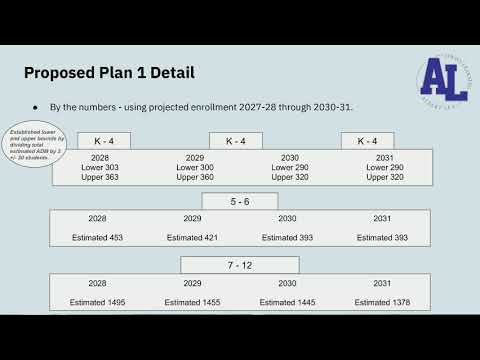
Why it matters: District leaders told the task force they face declining enrollment and an enrollment ‘‘bubble’’ in lower grades from pandemic‑era shifts. The panel weighed three options: (1) a conservative step model (three K–4 elementaries, a 5–6 intermediate at Southwest and 7–12 at the high school); (2) an aggressive grade‑banding model that consolidates single grades into single sites (with higher transportation and student‑move frequency); and (3) a hybrid that mixes banding and consolidation. The presenter said Plan 1 was generally seen as the least disruptive and a reasonable first step with the ability to revisit later.
Transportation, special services and costs played central roles in the debate. Ben, a representative of the district’s bus company (speaker 4), told the group the least‑disruptive model is also ‘‘the least expensive’’ for transportation and warned that tiered routing and longer routes quickly add costs and complexity. Task‑force members estimated that closing a single elementary site would save the district on the order of ‘‘550,000, 600,000’’ dollars annually, though they emphasized the final figure depends on which building is closed and other variables.
Special‑education staff and task‑force participants cautioned that some models spread special services across multiple buildings and could require services to ‘‘follow the students,’’ creating staffing disruptions. The presenter said staff favored options that preserved proximity for level‑specific programs and that any plan should include clear protections so middle‑school students receive an age‑appropriate experience even if housed in a 7–12 facility: separate wings, different bell schedules and clearly defined middle‑school advisories.
Enrollment projections also shaped recommendations. The presenter walked the group through class‑size and cohort counts, noting a temporary pandemic-related bump in some lower grades and projecting high‑school enrollment to hover around the 900–1,000 range in coming years. Those projections underpinned the rationale for a staged approach that prioritizes lower disruption now while leaving room to adjust if enrollment declines continue or reverse.
What happens next: Task‑force members agreed to present a data‑rich summary to the school board and to continue community listening sessions. A board work session date was mentioned in the meeting as ‘‘the twentieth at 05:00’’ for next presentation preparation. The task force emphasized that site‑specific analysis, boundary redraws and more detailed transportation routing will be required before any formal board recommendation or school‑closure decision.
The task force chair closed the meeting by thanking participants for the extensive community input and noting that final slides and corrected projections will be prepared for the board presentation.