Get Full Government Meeting Transcripts, Videos, & Alerts Forever!
Get email alerts on the Historic Core Plan topic
No spam. Unsubscribe anytime.
Tempe preservation advisers outline downtown core plan; commissioners press for deeper engagement
Summary
Presenters proposed lower building heights, design guidelines and edge parking hubs to protect Mill Avenue’s street wall; commissioners urged more inclusive outreach, tribal consultation and clearer maps before the plan advances to the development review commission and city council.
Presenters for the downtown historic core plan told the Tempe Historic Preservation Commission the intent is to preserve Mill Avenue’s continuous street wall while accommodating growth by locating larger, longer-term parking hubs at the edges of the core and directing downtown visitors to ‘park once’ areas. The presenters argued that keeping surface lots away from Mill Avenue will maintain the walkable, historic retail character that defines downtown Tempe.
“Allow short-term parking along Mill Avenue … to continue providing clear wayfinding to direct people to the strategically located parking areas,” the presenter said, adding that the strategy should reduce cruising for spaces and improve pedestrian comfort through shade and a continuous tree canopy. The presentation also proposed sustainability measures such as low-impact stormwater systems and leveraging the downtown refresh program to set a consistent public-realm standard across the historic core.
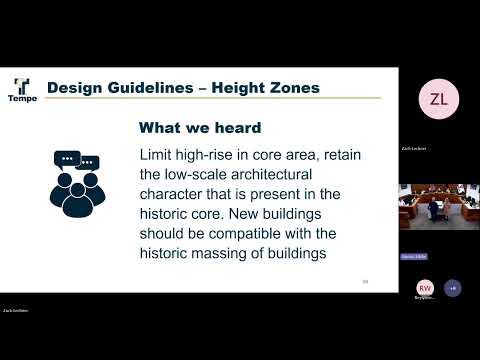
The plan’s draft design guidelines recommend façade conservation programs, careful infill design that respects adjacent historic fabric, incentives for rehabilitation (grants, tax incentives, transfer of development rights) and a cautious approach to building heights. Presenters showed a new map that recommends maximum heights significantly lower than a 2006 concept study and flagged the Hayden Flour Mill area for separate, site-specific planning to avoid blocking that landmark’s views.
Commissioners welcomed many of the goals but pressed staff on how the plan was developed and how the commission and broader public were involved. Commissioner Lerner said the commission is too often presented near-final drafts rather than engaged in earlier, deliberative review; she asked for a roundtable workshop with the Tempe Historic Preservation Foundation and local property owners so the commission’s professional perspective can shape earlier stages of design. “We are not really integrated into the process as a commission,” Lerner said.
Vice Chair Fackler asked staff to provide a list of stakeholder meetings—participants, meeting dates and formats—and flagged about 15 “near-term” properties on Mill Avenue that she identified as historically eligible but not clearly represented on the plan’s maps. Commissioner Kuruka requested clearer visualizations (three-dimensional renderings) so the public can understand what a 50–100-foot height allowance would visually mean on the street.
Staff acknowledged those concerns and said the project team will provide a stakeholder list and is planning additional community and targeted outreach. The presenters also said they expect to hold more community meetings in late spring, complete a draft downtown historic core plan in late spring or early summer, return to the development review commission, and then forward the plan to the city council for adoption later this summer; no adoption date was specified.
Why it matters: The draft is intended to guide private development and public streetscape investments in Tempe’s historic core. Commissioners said early, concrete input on boundaries, historic-resource mapping, tribal consultation and incentives will determine whether the plan protects the character they were appointed to steward. The commission asked staff for specific next steps, earlier opportunities to weigh in on design contracts, and written documentation of stakeholder outreach and funding assumptions.
The commission concluded its discussion with staff agreement to circulate meeting participant lists and to pursue more integrated in-person or roundtable engagement to reconcile competing developer, preservation, and community priorities as the plan advances.