Get Full Government Meeting Transcripts, Videos, & Alerts Forever!
Get email alerts on the Housing Cip topic
No spam. Unsubscribe anytime.
Committee reviews housing and community development CIP preview, defers major housing decisions
Summary
Council staff and DHCA presented the community development CIP (including facade and White Oak projects) and the six‑year housing CIP preview. Staff recommended deferring final housing recommendations tied to the operating budget; the committee accepted staff recommendations (3‑0).
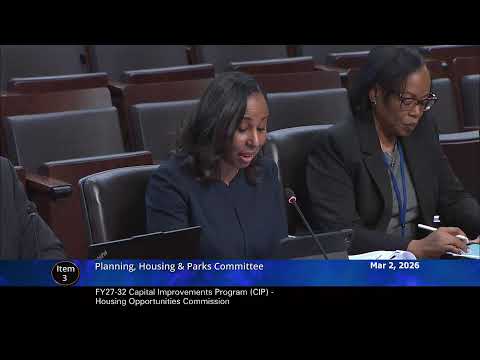
Council staff and Department of Housing and Community Affairs officials briefed the Planning, Housing and Parks Committee on March 2 on two CIP subcategories administered by DHCA: community development projects and housing‑related CIP projects.
Mister Mia, council staff, said the executive recommended $6.3 million for the community development subcategory (a $2.1 million reduction from the prior CIP largely due to completed projects) and presented a housing subcategory recommendation that aggregates to roughly $160 million over six years, a figure the staff described as appearing lower mainly because one‑time funds have been shifted out of the six‑year CIP window.
On community development, staff described three subprojects: the Countywide Facade Improvement Program (six‑year funding level $3.4M), White Oak commercial area improvements ($2.2M over six years), and a facility‑planning level‑of‑effort project ($125,000 per year). Mark D'Ocampo, manager for neighborhood revitalization (DHCA), said the facade program is popular with more applicants than available funds and will prioritize projects near the Purple Line corridor and older shopping centers; the program also received a reported $600,000 state grant.
On the housing side, staff reviewed four CIP projects: the traditional affordable‑housing acquisition/preservation CIP (remaining funding level $22M per year, $132M over six years, funded via taxable HIF bonds and loan repayments); the Affordable Housing Opportunity Fund (AHOF) (six‑year funding level $15.5M); the nonprofit preservation fund (original $50M seed largely committed/dispersed); and a revitalization program for troubled common‑ownership communities (six‑year funding level $10.5M) that uses a revolving loan fund (0% interest, up to $500,000 cap, typical 10‑year repayment).
Director Scott Bruton noted a modest federal reduction in CDBG funding tied to recent federal appropriations, estimating roughly a 4% cut or "about $200,000," and asked staff to assess the program impacts for the committee. Bruton and council staff described a robust pipeline of projects: staff said 23 development projects are in the tracker requesting nearly $400M, and analysts have identified about 10 projects most likely to close next year but funding will not cover the full list.
Given interdependence with the HIF operating budget and many current‑revenue items, staff and the committee followed the usual practice of deferring final recommendations for many housing CIP items until the county executive issues the operating‑budget recommendations. The committee accepted staff recommendations on the housing items by a recorded 3‑0 vote.
Next steps: staff will provide follow‑up details requested by council members — including the effect of federal CDBG changes and pipeline analysis — and the committee will revisit items when the executive's operating‑budget recommendations are available.