Maine economist says Census QWI and administrative data give small states clearer, less volatile employment measures than surveys
Loading...
Summary
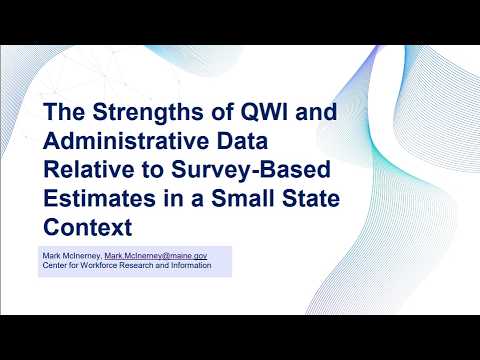
At a March U.S. Census Bureau LED webinar, Mark McInerney of Maine's Department of Labor argued that the Quarterly Workforce Indicators (QWI), built from administrative records, produce more representative and smoother employment measures for small states than household surveys such as the CPS, and showed how QWI can be linked to evaluate workforce programs (WIOA).
Mark McInerney, director of the Center for Workforce Research and Information at the Maine Department of Labor, told a U.S. Census Bureau LED webinar that administrative data powering the Quarterly Workforce Indicators (QWI) are generally more representative than household surveys for small states and help create steadier, more detailed measures of employment.
"For Maine specific residents, the Current Population Survey includes about 800 households in a typical monthly survey," McInerney said, citing small CPS sample sizes and falling response rates (about 60–65%). He contrasted that with state unemployment‑insurance wage records used in LED partnerships, which typically cover roughly 650,000 distinct workers in a quarter, and therefore provide broader coverage in a small‑state context.
Why it matters: For policymakers and workforce professionals tracking local trends or program outcomes, small survey samples can yield volatile estimates that make it hard to see subgroup patterns. McInerney said QWI’s administrative basis reduces year‑to‑year volatility and lets analysts drill into industries and demographic groups with greater confidence.
McInerney illustrated differences with several examples. For the 45‑to‑54 age group, QWI employer‑reported series showed a stronger employment recovery after the pandemic and a smoother upward trend through 2022–24, while CPS household‑based measures displayed a bumpier pattern with a decline in 2023. He emphasized the two sources measure related but different concepts: CPS captures household respondents (including self‑employment) while QWI reflects jobs located by employers and may miss some self‑employment earnings.
On methods, McInerney described how QWI techniques attempt to overcome administrative gaps. One key approach is the "full‑quarter" employment indicator — identifying employment relationships that exist in the quarter before and after a reference quarter — which helps distinguish continuous employment from partial‑quarter records. He also referenced a Bailey and Spitzer method to infer multiple‑job holding versus job‑to‑job transitions.
Using administrative records for program evaluation: McInerney described work linking QWI‑style measures to Workforce Innovation and Opportunity Act (WIOA) participant records. He said the team used three outcome measures: (1) any matching employment record in a year, (2) the QWI full‑quarter employment measure, and (3) an earnings‑based proxy for likely full‑time work (in Maine using the state minimum wage and a 32‑hours‑per‑week earnings threshold). Across these measures, he reported employment‑rate increases of about 16 to 18 percentage points after participants completed WIOA services, and larger median earnings gains for those with stable full‑quarter employment.
Limitations and tradeoffs: McInerney acknowledged administrative data can lack elements (hours worked, pay rates, or complete self‑employment earnings) that surveys collect, and that confidentiality restrictions prevent states from receiving combined microdata across sources. He recommended combining QWI, OnTheMap commuting products, and housing‑market indicators from other sources when researchers want to study retention, commuting, or housing pressures.
On timeliness and detail, he said state wage records and QWI publications are lagged — typically four to six months from collection to state publication and roughly six months or a bit longer for QWI releases. Webinar staff noted that NAICS 5‑ and 6‑digit industry detail has recently been added to the QWI Explorer.
During Q&A, McInerney recommended analysts compare CPS and QWI where possible, use multiple sources to get a more complete picture, and apply QWI tools where representativeness matters (for small states or fine demographic/industry slices). He closed by reminding attendees that slides and the recording will be posted to the Census Academy site and that the next LED webinar is scheduled for April 15.