Pinal County urged to speed siting of solar and battery projects to meet surging electricity demand
Loading...
Summary
Craig McFarland of Pinal Partnership told county officials that Arizona’s rapid growth in semiconductors and data centers is driving unprecedented electricity needs — including projects that may require hundreds to thousands of megawatts — and urged faster siting and collaboration to deploy solar, storage and other resources.
Craig McFarland, president and CEO of Pinal Partnership, told a Pinal County study session that Arizona’s electricity demand is growing "at an unprecedented rate" and warned the state must build power resources quickly to capture incoming economic opportunities.
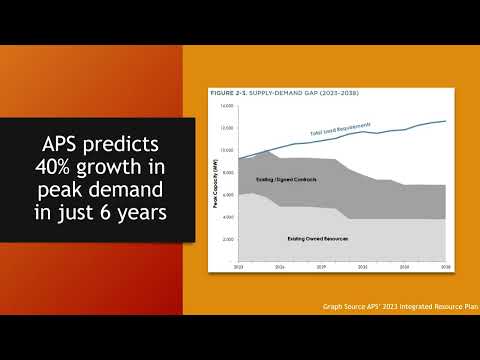
McFarland said major recent investments — including semiconductor and data center projects — are already straining capacity. "For example, the Taiwan Semiconductor manufacturers alone requires 1,200 megawatts," he said, and he cited APS forecasts showing several thousand megawatts of new capacity will be needed to meet projected peak demand.
The presentation emphasized that no single technology can meet near-term needs. McFarland urged "an all of the above resource mix" with solar supplying daytime energy, battery storage and pumped hydro shifting output to evening hours, and flexible natural gas (and existing nuclear plants such as Palo Verde) providing fast ramping and baseload reliability. He noted that next-generation nuclear and other long-lead technologies are unlikely to be available at scale until the 2030s–2040s, meaning near-term solutions must be deployable now.
McFarland explained that transmission ownership and service territories shape where projects can connect to the grid and why developers cluster in areas with existing infrastructure. He said Pinal County’s land availability and planned transmission make it a likely host for many projects, and he described pipeline and transmission developments — including a TransWestern pipeline with a Phoenix lateral that would terminate in Pinal County — as opening additional opportunities.
The presentation also described local economic benefits energy projects can bring: community benefit payments, property taxes and jobs. McFarland cited SRP’s community-benefit practice, saying SRP now requires "$1,500 per megawatt" for new projects, and gave examples that included an earlier 100-megawatt solar project that "has already paid several millions" in property taxes and a "$512,000,000 battery project" that he said would pay about "$13,400,000 in property taxes over 20 years" (figures presented by the speaker).
At the same time, McFarland acknowledged community concerns and siting challenges. He said projects must locate near transmission, producing concentrations of activity in places such as Coolidge and Eloy, and that residents have raised safety questions about batteries and some unease about natural gas. He recommended best practices for "responsible development," including site selection that avoids sensitive areas, early and transparent community engagement with landowners, neighbors, schools and first responders, and coordination with state and national partners on battery safety.
During a brief question period, a council member asked whether SRP’s work to identify sites for new nuclear capacity meant expansion in Pinal County or simply growth at Palo Verde. McFarland said the siting process "could be anywhere in Arizona" and that Palo Verde is one potential site; he also confirmed a roughly 300-megawatt gas plant is in permitting and is expected to be sited west of Picacho Peak in Pinal County.
The presentation concluded with McFarland saying, "Arizona needs more power," and urging county decision-makers to work collaboratively to allow projects that are appropriately sited and limited in local impacts. The study session closed without a vote or formal action recorded.