Court hears argument over whether res ipsa loquitur allows negligence inference in Russell v. MultiCare
Loading...
Summary
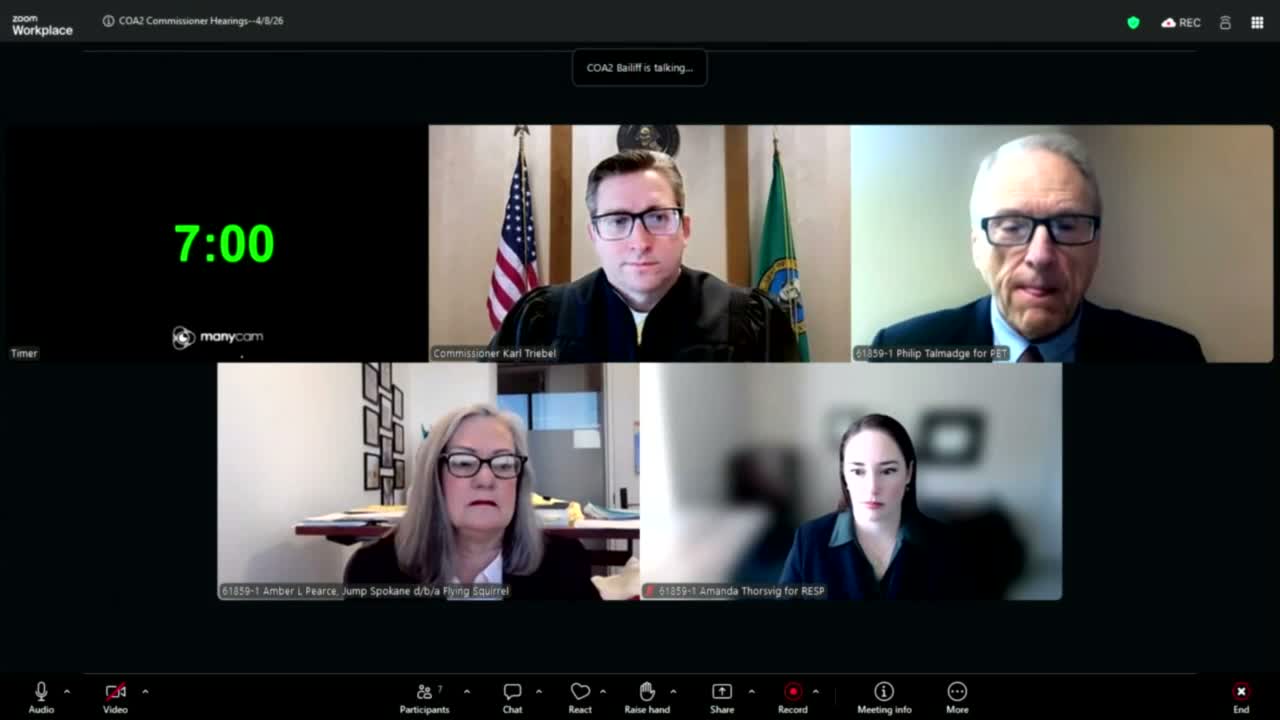
At oral argument in Division 2, counsel for Elise Russell told the court the jury should decide causation after a patient allegedly fell from an operating table; respondents urged denial, saying res ipsa does not establish causation for complex injuries without expert testimony. The court took the matter under advisement.
The Division 2 panel of the Washington State Court of Appeals heard argument in Elise Russell v. MultiCare on a motion for discretionary review, focused on whether the doctrine of res ipsa loquitur permits an inference of negligence that reaches causation and complex injuries without expert testimony. The petitioner, Phil Talmadge, urged the court to grant review and reinstate the negligence claim after the trial court dismissed it on summary judgment.
Talmadge, representing the Russells, said the record shows the required elements of negligence—duty, breach, causation and harm—and that res ipsa loquitur applies because Russell was unconscious on the operating table and the circumstances were under defendant control. "The bottom line is that the Russells got to the jury on those issues based on the testimony of those well qualified experts," Talmadge said, arguing that specific elements of damages are matters for the jury, not for summary dismissal.
Respondents disputed that approach. Amber Pierce, counsel for nurses Ashley Fidan and Rainier Anesthesia Associates, told the court the trial judge properly exercised discretion when modifying prior orders and applying the rules of evidence, and argued that automatic inferences about causation for complex injuries may require ER 702 expert proof. "The court should deny discretionary review for four reasons," Pierce said, urging the panel to defer to the trial court's evidentiary rulings.
Counsel for MultiCare, Amanda Thorzvig, pressed a related procedural point, saying the record lacks direct evidence of corporate negligence against MultiCare and that the appellants blurred vicarious nurse liability with direct corporate liability. "The issue of corporate negligence was never raised below," Thorzvig said, and she asked the court to deny review and let the case proceed under the trial court's rulings.
The panel's questioning focused on an evidentiary distinction the commissioner framed as whether res ipsa looks to the observable event—the fall from the table—or to the downstream, complex injuries such as traumatic brain injury or post-traumatic stress disorder. Counsel differed: Pierce said the court should look at the fall as the observable event; Talmadge argued Washington precedent (citing Horner, Ripley and Ziebarth) supports a broader application of res ipsa that permits the jury to infer negligence and leave proof of specific damages for trial.
In rebuttal, Talmadge reiterated that Washington cases permit a res ipsa inference in hospital settings and that corporate negligence can be addressed under that doctrine; he asked the court to grant review so the negligence claim can reach a jury.
After argument, the commissioner said "the matter was well argued, and this court will take it under advisement and issue a ruling as soon as practical." No ruling was announced from the bench.
The court will issue a written decision addressing whether the trial court erred in applying res ipsa loquitur and in dismissing the negligence claim at summary judgment, and whether interlocutory review is appropriate under the appellate rules cited at oral argument.