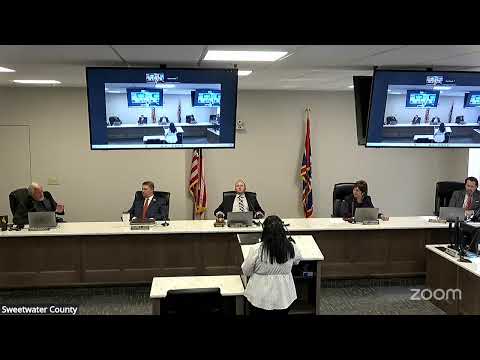
Sweetwater County approves HHS building reconfiguration; commissioners warned of large FY27 shortfall
Loading...
Summary
After a months‑long planning process, the Sweetwater County commission voted unanimously to implement Option 2 for the county Health & Human Services building — consolidating public‑facing county services on the main floor and locating WIC on the second floor — while staff and commissioners said a projected FY27 revenue shortfall (roughly $10M) will require difficult budget choices.
The Sweetwater County Board of County Commissioners on April 7 voted unanimously to implement Option 2 for reconfiguring the county Health & Human Services (HHS) building, a plan county staff said balances the need for confidential public‑health services with the convenience of high‑volume county operations.
During a lengthy staff presentation, public works director Gene Ligurski and HR director Gary McClain described three layout alternatives for the HHS building after family‑planning functions vacated the site. Option 2 “aggregates the county operations in that area” by placing the treasurer and one‑day clerk services in a service‑window suite on the main floor, while locating the Board of Health offices and clinical programs nearby to preserve private exam space, Ligurski said. The proposal also shifts WIC (Women, Infants and Children) into a second‑floor suite with four offices and a breastfeeding area to limit disruption to WIC clients.
Kim Lionberger, director of the Board of Health, told commissioners she “would strongly advocate for option 2 or 3” because Option 1 would force clients receiving STI/HIV testing and counseling to move through public space and risk violating confidentiality. “Option 1 as submitted would cause significant disruption to our day‑to‑day operations in regards to providing discreet confidential services,” Lionberger said.
After discussion on privacy, queueing and elevator traffic, Commissioner Richards moved to approve Option 2 and authorize staff to work with the county attorney and WIC on agreements and implementation; the motion passed unanimously.
At the same meeting the commission approved a set of routine financial and procurement items: three budget transfers inside capital projects to repurpose funds for (1) a courthouse elevator ($84,658), (2) a youth‑home remodel feasibility study ($8,200) and (3) a detention‑center dishwasher replacement ($12,000); and awarded feasibility and maintenance contracts for the Justice Center parking lot seal coat ($60,374.99 to R & D Sweeping), Rock Springs Youth Home remodel study ($92,610 to Trainer Consultants) and Green River Courthouse veranda enclosure study ($75,344 to EDA Architects). All votes were unanimous.
Commissioners also heard a quarterly ambulance update from Castle Rock Hospital District CEO Bailey Doctor, who said 9‑1‑1 calls and long‑distance transports have declined (he reported a roughly 15–20% revenue reduction year‑to‑date). The district reduced night staffing by about 11% (one ambulance each in Rock Springs and Green River overnight) and expects to request the contract maximum subsidy from the county under its contract; Doctor said the district will monitor operations closely and use backup hours as needed.
The meeting closed with a two‑hour pre‑budget workshop in which staff presented preliminary FY27 revenue estimates. Finance staff said carryover is lower than in prior years and that projected revenues (including a roughly $1M decrease in PILT) leave a working shortfall in the neighborhood of $10.4–10.5 million under current assumptions. Commissioners discussed plug scenarios for personnel cost adjustments, including sample cost‑of‑living increases of 0–3% for non‑elected staff and higher placeholders for elected officials (statute requires elected‑official salaries be set on a fixed schedule). Several commissioners suggested using part of the county’s ARPA/PILT reserve (approximately $3.48M available) as a bridge while staff prepare options to close the remaining gap.
Commissioners asked staff to return with updated revenue numbers (including recent mineral tax receipts), comparative county salary data, and multiple budget scenarios (including 0%, 1.5% and 3% COLA models and a constrained spending baseline) ahead of the next workshop. The board also approved invoices and proclamations, heard federal‑agency updates from BLM and the Seedskiddie Refuge and received remarks from U.S. Rep. Liz Cheney (note: congresswoman referred to in transcript as the member present; staff recorded directed funding activity and federal project support). The commission added and convened an executive session for potential litigation and, after returning, authorized terms of an employee agreement discussed in closed session.
What happens next: Staff will produce refreshed revenue projections (to incorporate recent mineral tax payments) and a set of budget scenarios for commissioners to consider; implementation timing for the HHS building move will depend on agreements with WIC and the county attorney’s office, and staff will provide a timetable as remodel or minor construction costs are refined.
Quotes from the meeting (selected): “Option 1 as submitted would cause significant disruption to our day‑to‑day operations in regards to providing discreet confidential services,” Kim Lionberger, director, Board of Health. “This amendment transfers $84,658 from the canceled parks and rec parks study to the elevator project, allowing us to use existing capital funds to complete the priority project,” Rebecca Romero, accounting specialist. “We experienced about a 15 to 20% reduction in that revenue; we looked at least‑busy shifts and cut back hours about 11%,” Bailey Doctor, CEO, Castle Rock Hospital District, on ambulance revenue trends.
Note on attribution: All direct quotes are taken from speakers identified in the meeting transcript. Statements not attributed to a named or role‑identified speaker are summarized as discussion points.