Get Full Government Meeting Transcripts, Videos, & Alerts Forever!
Get email alerts on the Budget topic
No spam. Unsubscribe anytime.
TUSD projects multi-year deficits as state ADA protections end; board approves higher developer fees
Summary
Torrance Unified officials presented a proposed 2024-25 budget showing deficit spending in coming years driven by the end of COVID-era ADA mitigation, modest COLA effects, rising retirement costs and step-and-column salary increases. The board approved a resolution raising developer fees to statutory maxima.
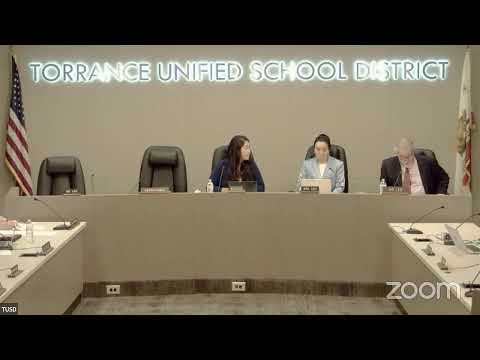
The Torrance Unified School District on Tuesday heard a multi-part budget presentation that projects deficit spending over the next several years as temporary state protections for ADA phase out and long-term costs rise.
Dr. Butler and district budget staff told the board the proposed 2024-25 budget uses California Department of Education and School Services of California assumptions but shows a revenue dip in 2024-25 largely because the COVID ADA mitigation protection expires. "Our district is expected to, operate on a deficit spending line, for the next few years," Mr. Diaz said during the presentation, citing lower effective COLA revenue and the recurring cost of step-and-column salary movement.
Staff walked the board through key assumptions: projected average daily attendance (ADA) and enrollment trends, the district's actual TUSD-funded COLA (which differs from statutory COLA based on ADA), and rising employer costs tied to CalSTRS and CalPERS. Dr. Butler added that the district will continue to set aside committed funds for maintenance, professional development, TK and dual-language facilities, and energy-efficiency projects such as solar shade canopies, which staff said may generate electricity by October 2025.
The presentation also flagged one-time and committed fund balances set aside for declining enrollment mitigation and site needs such as a South High School concrete and asphalt project. "We had set aside these funds, not necessarily in this year, but a combination of the past few years," a staff speaker said, describing the district's fiscal-conservative approach to smoothing facility and maintenance costs.
Board members asked about long-range factors that could affect the budget, including TK expansion, housing-driven student generation and future negotiating settlements. Staff noted that TK is included in LCFF ADA calculations while state preschool is a separate funding stream and that new housing approvals could add students in coming years.
Separately during the meeting the board approved a resolution to increase developer fees for new residential and commercial/industrial construction to match state-statutory rates, which staff said rose about 8% over the past two years to reflect higher construction costs. Staff told the board the adjustment would allow the district to collect amounts the state allows for school-site construction and reconstruction.
What happens next: the board will consider adoption of the budget at its special meeting (staff indicated an adoption action is scheduled for the meeting the following day). Unaudited actuals will be reported later in the summer and the district will continue refining revenue and enrollment assumptions.