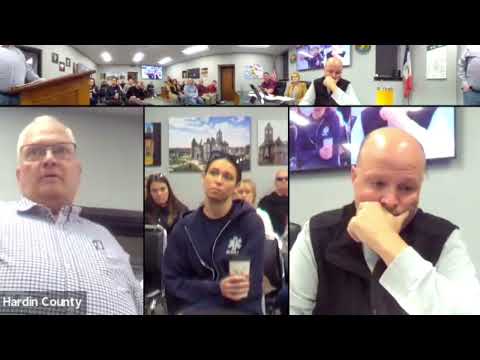
Hardin County advisory board urges supervisors to place 75¢‑per‑$1,000 EMS levy on November ballot
Loading...
Summary
An advisory board told Hardin County supervisors it needs a stable revenue source to sustain ambulance and first‑responder services and recommended designating EMS as an essential service and placing a property‑tax referendum for 75¢ per $1,000 on the November ballot; supervisors asked for clearer ballot language and oversight details before final approval.
Hardin County’s Essential Services Advisory Board recommended that the Board of Supervisors designate emergency medical services (EMS) as an essential county service and place a referendum on the November ballot authorizing an annual property‑tax levy of $0.75 per $1,000 of taxable valuation to support EMS across the county.
The advisory board’s presenter, representing the Hardin County Essential Services Advisory Board, told supervisors the county’s EMS system is struggling financially and that reimbursement rates from insurance programs and Medicare are inadequate. “We are running an average $1,166,327.26 short,” the presenter said, summarizing two‑year shortfalls and arguing that the levy would preserve buildings, equipment, staffing and training that keep ambulances available.
Why it matters: Advisory board members and EMS leaders told the supervisors the levy would provide a predictable revenue stream for ambulance services that operate countywide and in municipalities, helping cover durable medical equipment, training, fuel and personnel costs that currently fluctuate and leave some services unable to meet expenses.
During the presentation the advisory board outlined a proposed distribution formula for revenue from a $1,000,000 illustrative fund: 70% to advanced life‑support (ALS) services, 20% to basic life‑support (BLS) services and 10% to first‑responder entities. One panelist noted these percentages “don’t wipe out deficits” but would “give some cushion” and improve sustainability.
Supervisors pressed for details on ballot language, oversight and how funds would be distributed and audited. One supervisor asked, “What are we asking for? What am I voting for? What are you going to spend?” The presenter said the board would return with precise referendum wording and agreed the county would act as trustee to collect the tax and distribute funds back to EMS service areas based on where the revenue was collected.
Board members and EMS participants also discussed timing and implementation. If the referendum passes this year, the presenter estimated assessments would begin 07/01/2026 with first distributions in the next tax cycles. The advisory board said it would require recipients to account separately for levy funds and provide audits or reports to the county supervisors regularly.
Contested points and further steps: Supervisors asked for detailed written guidance on what is reimbursable, whether large capital purchases such as trucks would be allowed, and whether the county should include a sunset clause; options discussed ranged from a five‑year review to the statutory maximum (participants noted state code allows up to 15 years). Supervisors also raised accountability concerns about changing boards over time and recommended explicit ballot language and a transparent reimbursement process.
Public engagement and related issues: Several local EMS leaders and municipal representatives said they had been consulted and were generally supportive, though some supervisors and commenters said communication with all townships and municipal elected officials could have been clearer. Panelists noted pending state legislation (referred to in the meeting as SSB 3009 / 2431) that could affect township structures and urged the supervisors to monitor state actions while finalizing local plans.
Next steps: Supervisors did not vote to place the measure on the ballot at the meeting. They asked the advisory board to return with written referendum language and details about eligible expenditures, accounting procedures and auditing plans; the advisory group scheduled follow‑up work sessions to finalize the details before the supervisors consider formal approval.
Quote: “The tax levy isn’t to pay for the ambulance coming on a call. It’s to pay to make sure we have the infrastructure,” the advisory board presenter said, urging supervisors to approve the concept so the committee can finalize ballot wording.
Ending: The board kept the matter in discussion and asked the advisory board and EMS experts to return with concrete ballot language, reimbursement rules and audit procedures before taking formal action.