Lifetime Citizen Portal Access — AI Briefings, Alerts & Unlimited Follows
Coral Gables leaders tell neighbors they will negotiate to limit impact of county rapid‑transit zone
Loading...
Summary
At a neighborhood meeting, Coral Gables officials said they will press a developer to accept a smaller, city‑controlled alternative to Miami‑Dade County’s Rapid Transit Zone after the county added a waterfront parcel to the RTZ; residents raised concerns about height, traffic, the waterway and loss of local impact fees.
City officials told a packed Coral Gables neighborhood meeting that their best option for limiting the scale and local impacts of a proposed redevelopment on the waterfront is negotiation, not litigation, after Miami‑Dade County placed the parcel in the county Rapid Transit Zone (RTZ).
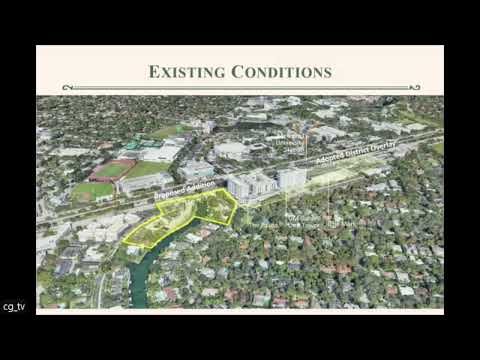
The meeting centered on the MARC/university‑station site that the county added to its RTZ in September. City staff described a proposed Coral Gables overlay that would allow multifamily development while keeping stepped heights, larger setbacks and design review under city control. The county RTZ, officials said, sets a single 150‑foot height with minimal setbacks and no equivalent local design or signage controls.
Why it matters: officials said a project built under the county RTZ would bypass many Coral Gables rules and send impact fees to Miami‑Dade County instead of the city, reducing money available for local parks, police, fire and mobility improvements. Residents said the proposed increases — in some places from the current neighborhood scale up to eight to 11 stories — would harm property values, worsen traffic and alter the character of nearby blocks.
“We will no longer have any power over the issue,” said the city manager, identifying the problem as a county RTZ matter and explaining the county’s parcel‑by‑parcel approach. The manager said the city had negotiated concessions with the developer and that the option officials prefer is an “RTZ Lite” or a project kept under city review to secure setbacks, signage rules, Mediterranean‑style design oversight and impact fees.
Mayor (identified in the meeting as Coral Gables’ mayor) told residents bluntly that legal challenges are costly and unlikely to succeed. “Anybody that tells you here that we have an opportunity to change the RTZ is lying to you. It’s a lie,” the mayor said, adding that the city’s practical choice was to negotiate to reduce the project’s scale and preserve as many local controls and fees as possible.
Commissioner Melissa Castro, who said she lives nearby, told the meeting she would vote against any measure she believed did not protect residents. “I will vote no for this … I will fight for you guys,” she said.
Officials and staff summarized the technical differences: the city’s proposed overlay would mirror the county RTZ density (about 125 units per acre) but add design controls, a 20‑foot setback on US‑1, a 10‑foot setback along the waterway, a 25% open‑space requirement and an upper‑story stepback of 25 feet adjacent to single‑family homes. The city’s floor‑area‑ratio cap is 3.5 and the city would allow Transfer Development Rights to encourage historic preservation. The county RTZ has no FAR limit and can permit a 150‑foot “box” lot‑line to lot‑line with much smaller sidewalks and no local signage limits, speakers said.
Residents raised environmental and traffic concerns. One asked whether the waterway would become a marina; staff replied that the waterway portion is dedicated to the city and would not be permitted for commercial boat rentals, although private docks for residents or condominium owners could be included. Neighbors also pressed staff on traffic, parking and sidewalk gaps; officials said parking and traffic impacts are evaluated at the site‑plan stage and that the overlay legislation emphasizes pedestrian and bike connections to nearby transit.
Several residents questioned why the city did not prevent the RTZ designation earlier. Officials responded that county and state preemptions — including the county’s RTZ authority and Florida’s Live Local statute — significantly limit local options and make lawsuits expensive and uncertain. City staff said they had met with the developer repeatedly and had asked the county to incorporate modest protections when the RTZ parcel was designated; some requests were adopted and others were not.
What’s next: city staff said the commission will consider legislation (text and map amendments) at second reading next week that would expand the Coral Gables overlay and allow the owner to apply under city rules; any actual site plan would be reviewed in a later process. Staff offered to share the neighborhood presentation and a recording, and encouraged residents to contact Miami‑Dade Commissioner Raquel Regalado with questions about the county’s RTZ process.
The meeting featured heated exchanges between residents and elected officials, repeated requests for records of outreach and negotiations, and several calls for the city to press harder at the county level. City leaders emphasized that, given the current legal landscape, they consider negotiation to be the most realistic way to limit height, secure local design review and recover impact fees for Coral Gables.