Get Full Government Meeting Transcripts, Videos, & Alerts Forever!
Get email alerts on the Fair Housing topic
No spam. Unsubscribe anytime.
Proyecto Centenal presenters outline renters' fair-housing rights and reasonable accommodations in Spanish workshop
Summary
At a Spanish-language workshop hosted by Proyecto Centenal in Mountain View, presenters reviewed protected classes, examples of housing discrimination, how to request reasonable accommodations and modifications, anti-retaliation rules, documentation tips and agency contact information; an attendee asked who must notify tenants about rules for children.
Presenters from Proyecto Centenal led a Spanish-language community workshop explaining renters’ fair-housing protections, how the agency helps with complaints and what tenants can do if they face discrimination.
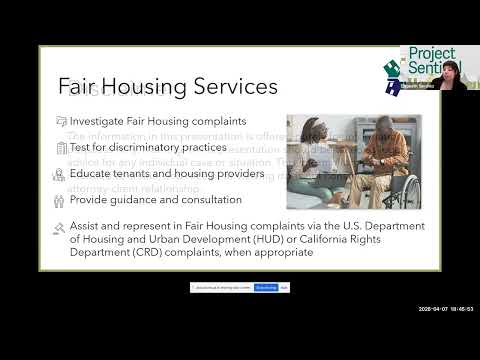
The presenter introduced the nonprofit’s services, saying the agency handled “más de 1000 contactos iniciales” and “más de 350 quejas de vivienda justa,” and distributed thousands of educational materials. She described three departments—fair housing investigations, tenant/landlord dispute resolution and federally certified housing counseling—and emphasized that services are free.
The presentation defined housing discrimination as illegal differential treatment in advertising, sale, rental, terms or termination based on protected categories such as race, color, national origin, religion, disability, familial status and sex. The presenter warned that policies appearing neutral can have a disparate impact, giving the example of strict criminal-history policies that disproportionately affect some groups.
On national-origin and language-based issues, the presenter noted that practices tied to accent, name or assumed immigration status can be discriminatory and clarified that “en California no es ilegal que un proveedor de vivienda le alquile a una persona” independentemente de su estatus migratorio. She also discussed sexual harassment and domestic violence as housing-related harms and said documentation such as police reports, agency letters or protection orders can support a claim.
The workshop spent substantial time on disability protections. The presenter defined disability broadly and explained reasonable accommodations—changes to rules or policies that enable equal use of housing—and reasonable modifications, which are physical unit changes. Examples included emotional-support animals and service animals, adjusting a rent due date to match benefit payments, transferring a tenant to a more accessible unit and installing grab bars or lowering cabinets. She said documentation may be required when the disability or need is not obvious but that obvious needs (for example, a guide dog for a person who is blind) typically do not require extra paperwork.
The presenter outlined three legitimate reasons a landlord could deny an accommodation request: (1) an undue administrative or financial burden, (2) a request that fundamentally changes the housing provider’s program (for example, asking the landlord to perform tasks beyond housing management), or (3) a health or safety risk tied to the accommodation (for instance, an animal that has bitten a neighbor). She added that landlords must explain why a denial is necessary and that in many cases modest costs will not justify refusal.
On reasonable modifications, the presenter said tenants typically pay for physical changes unless the housing receives federal funds; she noted agencies can help determine funding responsibility. She also covered familial-status protections—pregnancy, households with children under 18 and custody situations—warning against rules that isolate families to inferior spaces or impose unduly strict occupancy limits.
The presenter warned that retaliation—eviction threats, harassment or other adverse actions taken because a tenant asserted fair-housing rights—is illegal and that documentation (emails, texts, photos, application copies) is crucial when filing a complaint. She recommended tenants prepare a concise "tenant resume" with contact information, rental and employment history, references and supporting documents to strengthen future applications or complaints.
For follow-up, the presenter shared agency contact options and intake instructions: callers should leave a detailed voicemail at the agency numbers provided and expect a callback within 48 hours to begin the intake process. The presenter posted the agency’s website and asked attendees to complete an evaluation in the chat.
During a brief Q&A, an attendee identified as Mercedes asked, “¿Quién es el responsable de informarle a los inquilinos las reglas del comportamiento de los niños?” The presenter replied that managers or owners ordinarily enforce lease terms but reminded tenants to review lease language and to seek help if rules single out children or families in a discriminatory way.
The session closed with the moderator thanking “Grace and Elizabeth” for the workshop. The presentation emphasized practical next steps for tenants—document interactions, request reasonable accommodations in writing, and contact the agency via the posted phone numbers or website for individualized help.