House committee hears widespread testimony urging relief for small businesses after 'Operation Metro Surge'
Loading...
Summary
The Minnesota House committee heard testimony supporting House File 4477, which would deliver targeted grants and forgivable loans to small businesses the authors say were harmed by recent federal immigration enforcement operations. Dozens of mayors, foundation leaders and business owners described steep revenue losses; members pressed for clearer eligibility, fraud deterrence and award formulas.
The House Workforce, Labor and Economic Development Finance and Policy Committee on March 26 heard hours of testimony on House File 4477, a proposal the bill's authors say would provide emergency stabilization grants and forgivable loans to small businesses statewide after what witnesses called the economic fallout from recent federal immigration enforcement operations.
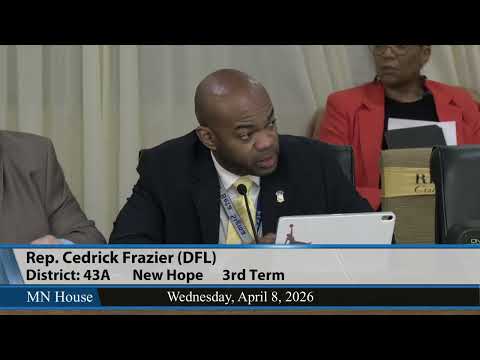
Authors Chair Frazier and Chair Zhang described HF 4477 as a merged proposal that combines multiple sponsors' ideas and stakeholder input, and said the bill is being laid over for negotiation on dollar amounts and program details. "This bill is about stabilizing small businesses, supporting our workforce, and recognizing that when one part of our economy is disrupted, it affects the entire state," Chair Frazier said.
Researchers and intermediaries told the committee the economic impacts are substantial. Aaron Rosenthal, research director for North Star Policy Action, said his organization's analysis links operation Metro Surge to reduced hours and job losses and estimated at least $106 million in lost wages in the Twin Cities alone during January 2026. "Over the last several months, fewer Minnesotans have gone to work and those that did worked shorter hours," Rosenthal said, urging lawmakers to match relief to the scale of harm.
Local officials and business owners described similar, often personal, losses. Julie Deshler, mayor of Crystal and a representative of Cities for Safe and Stable Communities, said coalition cities counted direct costs from police overtime and emergency responses and had already allocated emergency grant support. Mayor Jacob Frey of Minneapolis said the city estimates roughly $205 million in total impacts, including tens of millions in lost wages and business revenue, and outlined a planned $7 million municipal response for license relief and promotional programming.
Foundations and community financial institutions said they have experience moving emergency dollars quickly. Joanne Staitley of the Minneapolis Foundation and Shonda Smith Baker of the Saint Paul & Minnesota Foundation described prior rounds of rapid grantmaking and told the committee the foundations could help administer state funds. Carl Swanson of the Minnesota CDFI Coalition and other intermediary leaders urged using trusted local partners and program designs similar to pandemic-era emergency programs but with stronger fraud safeguards.
Small business owners provided first-hand accounts of revenue declines they said often ranged from 40% to more than 70%, business closures or temporary shutdowns, reduced staff and lost customer confidence. "We are not asking for a handout," said Stephanie Lopez of Spurs Grill and Bar in Wilmer. "We're asking for a fair chance for our businesses to recover from something we did not cause."
Committee members focused on program design and accountability. Representative Wayne Johnson asked whether the Promise Act or other existing programs could be used instead of creating a new program; authors said the needs differ and continued negotiation was expected. Representative Schultz repeatedly criticized language tying assistance specifically to "federal enforcement activity," questioned fairness for taxpayers in other counties and raised concerns about fraud and a perceived lack of spending limits. Authors and supporters countered that doing nothing would risk permanent business closures, loss of jobs and longer-term damage to local tax bases.
Key program details discussed include a proposed grant range of roughly $5,000 to $25,000 per business, eligibility criteria with a proposed 20% revenue-loss threshold, use of the Minneapolis and Saint Paul foundations as administrative partners, and fraud-deterrent measures including referrals to law enforcement.
The committee adopted the DE2 amendment to merge sponsor proposals and incorporated eligibility and administration language for further negotiation. Members did not vote on final adoption of the bill; authors said the measure would be laid over for additional work on funding levels and eligibility formulas.
Next steps: HF 4477 will remain under negotiation in the House committee; supporters and authors said they expect further conversations about award formulas, the geographic split of funds and specific fraud-prevention language before the bill returns for future action.