Lifetime Citizen Portal Access — AI Briefings, Alerts & Unlimited Follows
Senate committee advances SF 4638, sending omnibus higher-education bill to finance committee
Loading...
Summary
A Minnesota Senate committee adopted an a1 delete-all amendment and voted to refer Senate File 4638, an omnibus higher-education and supplemental budget bill, to the finance committee after fiscal staff detailed $131 million in state grant funding and witnesses urged support for direct admissions and student-persistence investments.
A Minnesota Senate committee advanced Senate File 4638, an omnibus supplemental budget and higher-education bill, after adopting an a1 delete-all amendment and referring the measure to the finance committee.
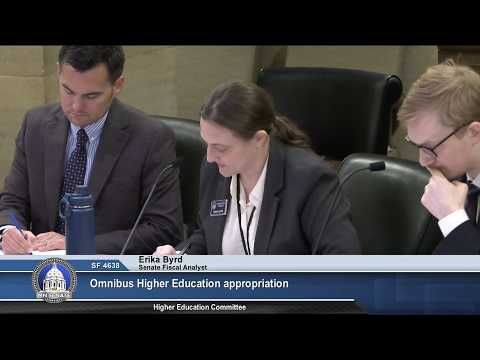
Fiscal analyst Bridal Byrd reviewed a spreadsheet of the bill’s line items and said the largest single appropriation is a one-time $131,000,000 request for the state grant program in fiscal year 2027 (article 1, section 1, subdivision 3). Byrd also outlined other provisions and amounts: a $1,500,000 appropriation for the Minitex program beginning in 2027 (with tails in 2028–29); funding tied to direct-admissions legislation with a $253,000 ongoing appropriation to administer the program starting in 2027 and a policy provision in article 2 that would make participation the default for school districts and charter schools unless they adopt an opt-out resolution; a $1,060,000 ongoing appropriation for the Minnesota P-20 Educational Partnership; and a one-time student-persistence grant appropriation slated for 2027. Byrd also flagged University of Minnesota items, including a $150,000 one-time appropriation to hire a staff member for farmer-lender mediation and a policy extension of the Farmer Lender Mediation Act through June 30, 2032, which authorizes continued availability of about $214,000 annually from the U of M extension appropriation, she said.
The bill drew supportive testimony from students and education advocates. "This funding would be incredibly consequential in supporting Minnesotans as they study so they can give back to our state's people and our economy," said Maxwell Field, a University of Minnesota student who testified in support of the state grant appropriation. Josh Crossen, executive director of Ed Allies, urged the committee to back the bill’s direct-admissions provisions, saying the Office of Higher Education has tracked higher postsecondary enrollment, increased FAFSA completion and improved in-state retention tied to direct admissions; Crossen cited that 19% of University of Minnesota Rochester applicants entered via direct admissions and said institutions such as Augsburg have streamlined applications for those students.
Paul Cirkrenick, president of the Minnesota Bridal College Council, described the impact of restoring the state grant program for roughly 88,000 students who rely on the aid. BG Tucker, executive director of College Possible Minnesota, praised the student-persistence grant, saying targeted coaching and navigation assistance can help ensure that enrollment leads to degree completion.
Some members raised fiscal concerns about adding new recurring programs in a non-budget year. "I don't understand why we're putting money into new programs when the program that already exists could use those funds," said Senator Farnsworth, noting the state grant program’s shortfall and saying she worried new programs would create future budget pressures. Senator Duckworth said she appreciated the committee’s attempt to address the grant shortfall and urged continued collaboration between the House and Senate to find sustainable funding.
Procedurally, the committee adopted the A1 amendment by voice vote after Senator Putnam moved it, then Senator Kupak moved that SF 4638 as amended be recommended to pass and be referred to the finance committee; the committee approved the recommendation by voice vote and the bill was sent to finance. The committee adjourned with no further business.
Next steps: SF 4638 will be considered by the Senate finance committee, where budget targets and tradeoffs are expected to narrow the request, according to committee members and staff.