Subcommittee advances bill to expand state veterans cemetery eligibility to National Guard and reservists
Loading...
Summary
A Minnesota Senate veterans subcommittee adopted an amendment and laid over Senate File 4172, which would allow honorably discharged National Guard members, reservists and Air National Guard service members (and eligible dependents) to be interred in state veterans cemeteries; MDVA warned the change could accelerate capacity timelines at Little Falls.
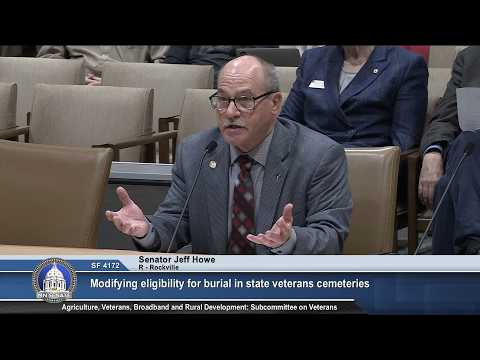
Senate File 4172, sponsored by Senator Mark Howe, was advanced Wednesday by the Minnesota Senate subcommittee on veterans after the panel adopted an A1 amendment that adjusts eligibility language and authorizes certain honor-guard elements.
Senator Mark Howe, the bill sponsor, told the committee the measure corrects an inequity that keeps some Minnesota National Guard and reserve members from being eligible for internment in state veterans cemeteries. "If you lived in North Dakota, you could be buried in a state Veteran cemetery, but because you live in Minnesota and a member of the Minnesota National Guard or the reserves, you cannot," Howe said, arguing the difference should not be determined by whether a service member was federalized for a specific number of days.
Glenn M. Pence, testifying on behalf of discharged Minnesota Army National Guard members, described his service and urged the subcommittee to recognize state service with cemetery eligibility. "I served for 6 years and completed my duty time honorably," Pence said, adding that internment with other military members would be an important recognition of state and national service.
David Swantek, director of memorial affairs for the Minnesota Department of Veterans Affairs (MDVA), told the panel the bill would expand eligibility across the four state veteran cemeteries and that roughly half of any additional internments would likely occur at the Little Falls cemetery because of its proximity to Camp Ripley. Swantek said current estimates show Little Falls has a projected exhaustion timeline of about 48 years; the department estimated the bill’s expanded eligibility could reduce that timeline to approximately 30 years, an 18-year acceleration, and said the department may return to the committee in the future with requests for additional funding or capacity planning.
Committee members questioned agency staff about plans for additional cemetery sites and the timing of any impact. Senator Kunish asked whether Minnesota has plans for another veterans cemetery; MDVA responded that other cemeteries have capacity and that a fifth site has been authorized for consideration in the Bemidji area, while Little Falls remains the primary near-term concern.
After discussion the subcommittee laid SF4172, as amended, over for likely inclusion in a veterans and military affairs finance omnibus bill.