Lawmakers hear farmers and advocates on wolf, elk depredation grants and compensation; funding bills laid over
Loading...
Summary
Committee heard bipartisan testimony supporting a wolf livestock conflict prevention grant program and additional funding for depredation accounts; senators questioned whether proposed amounts would be sufficient and whether federal action is needed for hunting options.
Lawmakers heard testimony April 8 on funding and grants intended to prevent and compensate for wolf and elk depredation losses to Minnesota farmers and ranchers.
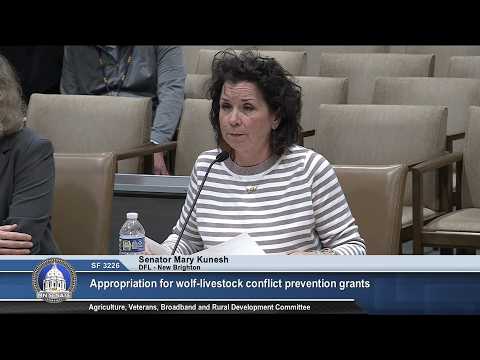
Senate File 3226 would appropriate funds for nonlethal measures — including livestock guardian animals, veterinary costs, fencing, fladry, deterrent lighting and shelters — to reduce wolf predation on livestock. Senator Kunish said the grant program is designed to protect both livestock and wolves by expanding nonlethal options.
Jill Fritz, senior managing director for wildlife protection at Humane World for Animals, told the committee that research and practice show nonlethal methods can be effective. "These grants assist livestock owners in wolf range with implementing those nonlethal techniques," Fritz said, citing a University of Minnesota project where a fence completed in 2023 eliminated repeated conflicts for that ranch.
Justin Stofford of the Minnesota Farmers Union described how livestock guardian dogs and other measures can prevent losses but said costs — especially veterinary and fencing — can be a barrier. "When Hannah has talked to other producers about livestock guardian dogs, costs are often the barrier she hears about, particularly veterinary costs," he said, describing a producer who has gone seven years without depredation while using guardian animals.
Some senators pressed on whether a $45,000 appropriation (discussed in committee) would be sufficient for fencing and whether the grant program’s structure (including applicant cost-share) would meaningfully reduce depredation. Senator Holstrom cited a cost estimate saying that an 8-foot, dig-proof fence could run about $40 per foot; "At $45,000, it gets you about 1,200 feet, which is enough for about an acre and a half," he said, arguing the sum may not help many producers if used solely for fencing.
Witnesses and lawmakers also described the state’s depredation compensation accounts: Caitlin Root of the Minnesota State Cattlemen’s Association and Miles Kruskal of the Minnesota Farm Bureau said accounts for wolf and elk depredation have been exhausted early and that verified claims can be time-consuming to process. Peter Ripka and other producers urged additional funding so verified claims can be paid promptly.
Lawmakers discussed hunting and federal authority: committee members noted that reestablishing a state wolf hunt would require a change in federal protections. A committee member said the state Department of Natural Resources has a plan if wolves are delisted, but that delisting is handled at the federal level.
The committee adopted the A2 amendment to Senate File 3226, heard testimony on related funding bills intended to replenish wolf and elk depredation accounts, and laid the bills over for possible inclusion.