Get email alerts on the Local Government Regulation topic
No spam. Unsubscribe anytime.
Middletown committee approves five solicitor-code changes, including 'do-not-knock' registry
Summary
A Middletown committee approved five amendments to Chapter 3-53 governing door-to-door soliciting: a do-not-knock registry, codified background checks via vendor, hours tied to sunset, removal of photo requirement, and higher fees for nonresidents; the package goes to the full council.
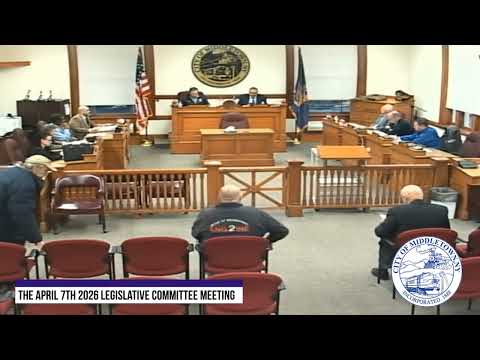
The Middletown committee voted 4–0 to approve five amendments to Chapter 3-53 of the city code that change how door-to-door solicitors are licensed and regulated. The package, which includes a new "do-not-knock" registry and other licensing updates, will be forwarded to the full council for final consideration.
Assistant Corporation Counsel said the most significant change "is establishing a do not knock registry." Under the proposal, residents who do not want door-to-door solicitors would register on the city's website and could pick up a decal to place on their door. Solicitors would receive a printed list of addresses — the counsel emphasized the list would include addresses only, not names — of properties they are prohibited from soliciting.
The counsel told the committee the idea follows practices in nearby municipalities and has been "well received by their residents." He also said the registry and permit rules would not apply to political candidates or religious organizations, noting their speech is "protected by the First Amendment."
The amendments also codify the city's existing practice for background checks (amendment 2.2). Rather than requiring fingerprint-based checks, the code change would explicitly allow the city to use a commercial background-check vendor (the counsel cited Intellicorp) as part of the license application process. Under the described application steps, applicants submit identifying information, pay a $300 fee and consent to the background check; if cleared, the city issues a photo ID card listing the applicant's permitted goods and authorized hours.
Amendment 2.3 revises hours of operation so soliciting is allowed until sunset rather than ending at a fixed 5 p.m., the counsel said, aligning the language with existing city rules for park hours to ensure activity stops before dark. Amendment 2.4 would eliminate the separate passport-photo requirement, reflecting the city's current use of an electronic ID machine. Amendment 2.5 raises licensing fees for applicants who live outside Middletown while keeping resident fees unchanged as an incentive to prioritize local workers.
Committee members asked whether similar registries reduced solicitation; the counsel said they had seen positive results in other jurisdictions. The counsel also cited increased complaints about door-to-door solicitations from companies such as Spectrum and Frontier and noted police and social media complaints had informed the changes.
Chair moved to approve items 2.1, 2.2, 2.3, 2.4 and 2.5 "as discussed;" the motion was seconded and passed on a 4–0 vote. The committee forwarded the package to the council and then adjourned.
The council will next consider the ordinances; the committee did not set an implementation date in the meeting record provided.
AI generated
The text on this page is AI generated. Summaries, highlights, analysis, and video transcripts are all produced from the original source material.
AI can make mistakes, so if you spot one, and we will fix it for everyone.
Note: the source content is unaltered by us. Any content source we link to, be it a video, an audio recording, or a document, is presented exactly as its publisher released it. That publisher is usually a government body, sometimes an individual official or another organisation.