Senate Energy Committee approves 3-year biosolids pilot study after heated debate over PFAS and timelines
Loading...
Summary
The committee passed a committee substitute for HB 3,403 to create a three-year pilot study of biosolids land application and phased rollbacks starting in 2027; debate centered on conflicting implementation dates, testing for PFAS/pharmaceuticals, and the adequacy of the study plan.
The Oklahoma Senate Energy Committee voted to advance House Bill 3,403 after an extended exchange over the scope and timing of a required pilot study of biosolids land application.
The committee substitute reduces the originally proposed five-year timeline to three years and includes phased reductions in land application beginning Dec. 1, 2027, with additional steps in 2028 and 2029. Senator Rader and other senators said the bill contains conflicting language that could force rollbacks before the pilot study is complete; Rader urged that the study be carried out by Oklahoma State University as originally intended and not under a substitute that he said altered the bill’s original intent.
"I would like to debate the committee sub...the committee sub is far different than what was the original bill," Senator Rader said during debate, arguing that the substitute might prevent the scientific study he sought. Proponents, including Senator Green and the bill’s author, Senator Stewart, said the committee sub allows the study to move forward and provides a plan so the work does not become open-ended.
Chris Browning, Utilities Director and General Manager of the Oklahoma Water Utilities Trust, testified on operational realities for municipal utilities. "We provide services to about 750,000 people every day. We generate about 400 tons per day of these biosolids," Browning told the committee, explaining that EPA and DEQ application-rate regulations govern current practices and that health-effect standards for certain contaminants (for example, PFOS/PFAS) have not yet been established for biosolids. He said larger utilities are moving away from land application because of logistical challenges and are investing in post-drying facilities to allow landfill disposal.
Committee members asked whether current municipal testing routinely includes PFAS or pharmaceuticals. Browning said the utility has been testing for PFAS voluntarily for three years but that testing for pharmaceuticals is not currently required. Senators raised the cost and technical complexity of testing (mass spectrometers and related equipment), the potential effects on small farmers who use biosolids as a lower-cost fertilizer, and the broader public-health implications of unknown contaminant uptake through the food chain.
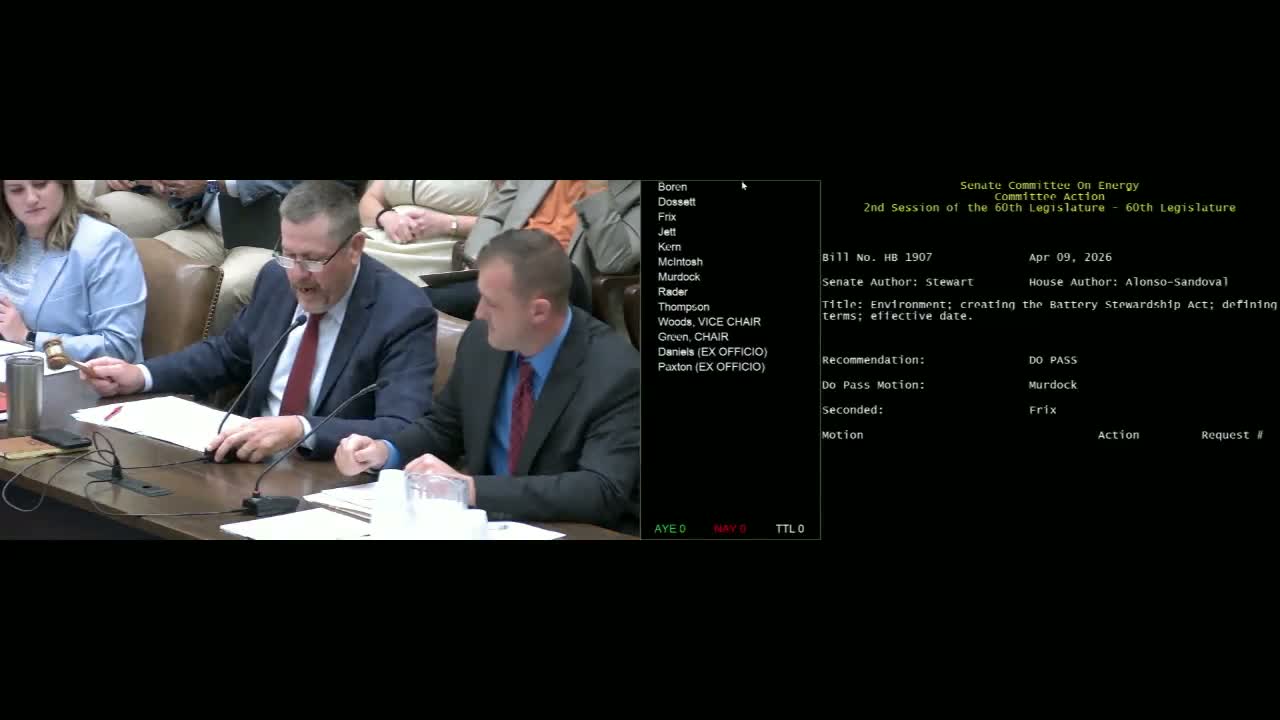
After debate and roll-call votes on the committee sub and subsequent motions, the committee recorded 8 ayes and 2 nays and declared the substitute-paired bill passed.
Ending: The committee advanced HB 3,403 with the committee substitute; the bill tasks DEQ and the selected research team with annual reporting and a three-year pilot study, and it includes phased implementation steps while studies proceed.