Senate Energy Committee advances battery stewardship bill to expand recycling, cite fire prevention
Loading...
Summary
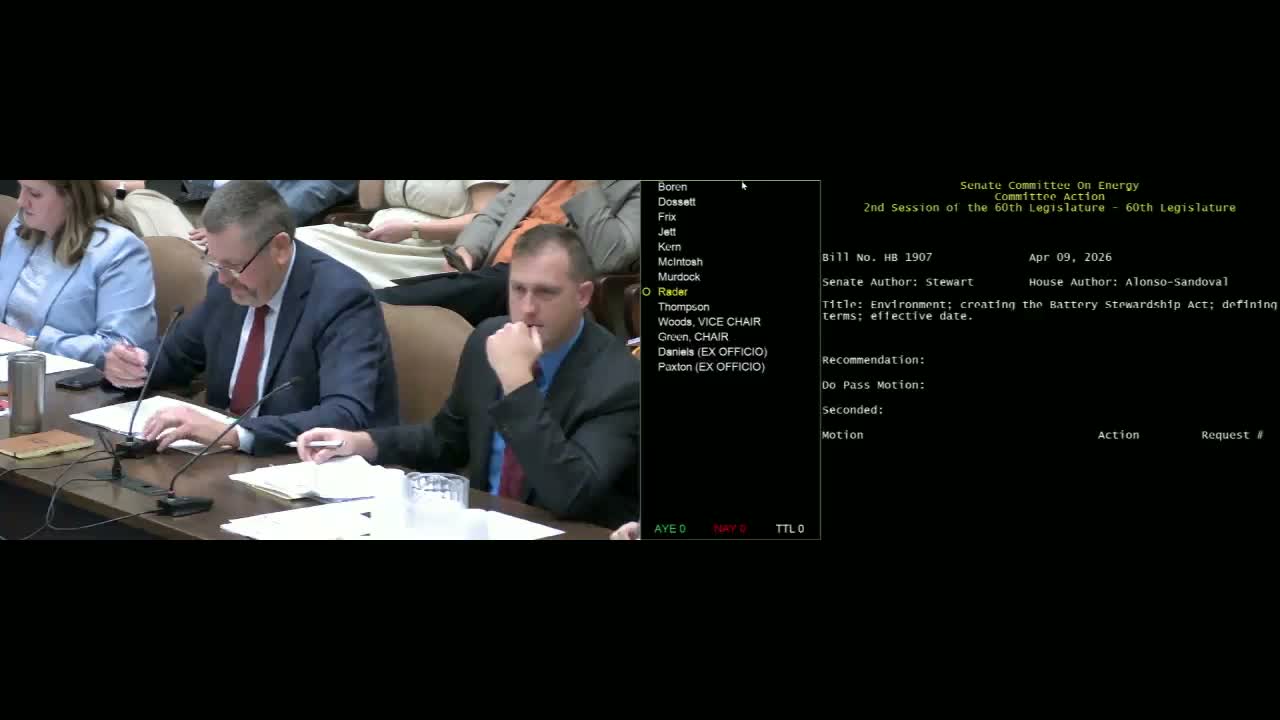
The Senate Energy Committee advanced House Bill 19-07, the Battery Stewardship Act, directing the Oklahoma Department of Environmental Quality to set up a manufacturer-funded collection and recycling program for small and medium batteries; committee vote was 8–3 after extended questioning about costs and regulatory burden.
House Bill 19-07, the Battery Stewardship Act, cleared the Oklahoma Senate Energy Committee after senators debated who would carry program costs and how collection would work. Senator Stewart, the bill’s author, said the measure directs the Oklahoma Department of Environmental Quality to set up a statewide battery collection and recycling program for small and medium lithium batteries and extends recycling infrastructure to every county.
"More batteries are causing more fires — fired in garbage trucks and landfills," said Senator Stewart, who urged a yes vote and framed the bill as a public-safety and environmental measure. He told the committee the scheme would place most operational requirements on producers and manufacturers rather than retail merchants.
Senator Jett pressed the author on fiscal assumptions, noting the fiscal analysis lists a net zero impact to state appropriations while also naming a single FTE at $100,603 in salary and benefits. "So can we talk a little bit about the net zero to the state as the fiscal impact?" Jett asked. Stewart replied the program anticipates an annual fee to producers that would offset administrative costs and allow DEQ to administer the program without drawing on state appropriations.
Other questions focused on consumer and small-retailer burdens. Senator McIntosh and others warned the bill’s definition of "producer" includes manufacturers, brand owners, importers and sellers, creating possible obligations for small local merchants. Stewart said producers would bear most responsibility and that DEQ would develop implementing rules, including collection-site options such as community drop-off events and potentially providing fireproof containers.
Opponents argued the law effectively shifts regulatory costs to private businesses and can add to the state’s regulatory burden. "When we have a fiscal impact that says 0, and then we read in the fine print and it says it's a $100,000 cost, it costs the people that are actually out there producing the jobs," said a senator opposing the bill.
Supporters said existing problems — landfill and truck fires caused by improperly discarded lithium batteries and low current recycling rates — justified state action. The author and supporters pointed to two Oklahoma recycling firms already operating in Bartlesville and Atoka and projected recycling rates could rise from roughly 5% now to 65–70% under the program.
After debate and a roll call, the committee recorded 8 ayes and 3 nays and declared House Bill 19-07 to have passed the committee. The measure will move forward for further consideration.
Ending: The committee advanced the bill to the next stage; DEQ will draft rules if the measure becomes law, and senators said they expect additional implementation details during the administrative-rulemaking process.