Senate committee advances helmet requirement for under-18 e-bike operators with outreach and data amendments
Loading...
Summary
The Senate Transportation Committee advanced SF3236 to require helmets for electric-assisted bicycle operators under 18, adding amendments to create an e-bike safety coordinator, require crash reporting, fund public education and align helmet definitions with federal standards; opponents warned about inequitable enforcement and limited effectiveness of mandatory laws.
The Senate Transportation Committee on April 8 recommended Senate File 3236 to pass as amended, a bill that would require operators of electric-assisted bicycles under age 18 to wear a bicycle helmet that complies with federal standards. Senator Johnson Stewart, the bill author, said the proposal aims to increase youth safety and build public awareness following a MnDOT/DPS study that documented growing youth e-bike use and data gaps. "Using a helmet while cycling is associated with a 51 percent reduction in the odds of head injury and a 65 percent reduction in fatal head injury," she said while urging action.
The committee adopted a suite of amendments before forwarding the bill: A1 creates an e-bike safety coordinator at the Department of Public Safety to educate law enforcement and maintain a manufacturer database; A8 (adopted as a friendly amendment) directs funding from the active transportation account; A2 requires mandatory reporting of injury crashes involving e-bikes and motorized bicycles to improve data; and A5 funds a public information campaign. An A7 change clarified helmet language to reference bicycle helmets that comply with federal regulations and deleted a specific fine amount (counsel explained that without a specific fine the violation would remain a petty misdemeanor subject to existing statute, with a maximum fine up to $300).
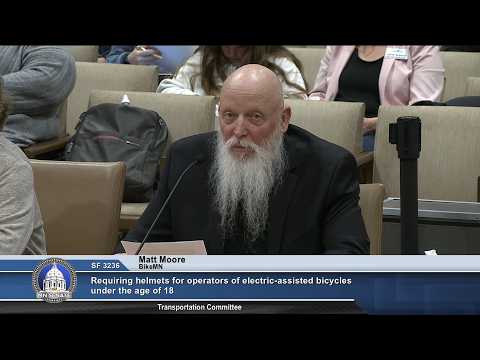
Testimony split along advocacy lines. BikeMN (the Bicycle Alliance of Minnesota) and other bike advocates urged helmet use and distribution programs but opposed mandatory helmet laws, saying they can discourage ridership and lead to inequitable enforcement; Matt Moore of BikeMN said helmet requirements "would burden operators of legal electric bicycles with potentially unequal enforcement" and would not address injuries tied to illegal high-powered devices. Brian Martinson, a Saint Paul resident and Met Council advisory representative, urged removal of a mandatory helmet clause, warning that it could give law enforcement a pretextual reason to stop young riders.
Senators supporting the bill said the combination of a coordinator, education campaign and data collection addresses equity and enforcement concerns and that outreach would help parents and law enforcement understand existing age limits (the presenters noted some statutes prohibit operation below certain ages). After amendments, the committee voice‑voted to recommend SF3236 as amended and referred it to the Finance Committee for further consideration.