Get Full Government Meeting Transcripts, Videos, & Alerts Forever!
Get email alerts on the Cannabis Security Patrols topic
No spam. Unsubscribe anytime.
West Hollywood panel memorializes council ordinance removing roaming neighborhood security-patrol requirement for cannabis businesses
Summary
The Business License Commission voted to memorialize a City Council ordinance removing the neighborhood security patrol requirement from cannabis license conditions while retaining on-site security and the commission's ability to reimpose patrols for specific businesses if supported by evidence.
The West Hollywood Business License Commission voted Dec. 2 to memorialize a City Council ordinance that removes a previously imposed roaming neighborhood security-patrol requirement from the conditions of approval for cannabis business licenses while leaving in place on-site security and security-plan requirements.
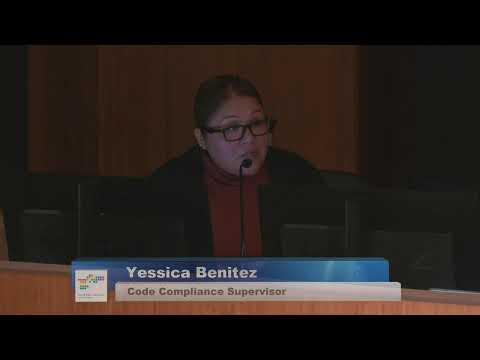
Danny Reedus, the city's director of community safety, told commissioners the municipal code amendment adopted by council applies citywide to 14 licensed cannabis locations (12 currently operating) and does not eliminate on-site guards or mandatory security plans. Reedus said the change rescinds the additional roaming patrol condition that had required some licensees to patrol adjacent residential areas within a roughly two-block radius. "This does not remove the entire security guard requirement or the security plan that each and every single cannabis business is required to adhere to," he said.
The staff report, Reedus said, traces the code amendment's origin to a March request from Emerald Village, an association representing cannabis businesses, and subsequent council direction to city staff and the city attorney to prepare the ordinance. Reedus also said staff conducted outreach beyond the legal minimum: the ordinance was published in the Beverly Press and the agenda was posted, and staff sent a mailer to residents and businesses within a 500-foot radius of each location as an "above and beyond" step.
Several commissioners pressed staff on procedure and evidence. Commissioner LeBron Boyd asked who initiated the proposal; staff said Emerald Village requested the change and council ultimately directed the code amendment. Commissioners repeatedly asked whether staff or council had reviewed police or incident data before adopting the ordinance; the city attorney and staff said they reviewed materials provided to council, but the specific police-report packets were not in the commission's meeting packet.
Public speakers expressed mixed views. Victor Olmechenko, a longtime resident, urged clearer, timelier agenda posting and questioned whether evidence supported the council's decision. Lynn Hoopinggarner, who said she lives within 500 feet of a cannabis business, said she has not observed neighborhood patrols in practice and warned that removing patrols without a replacement could leave residents less protected. "Lack of evidence is not evidence," she said. Richard Eastman delivered an emotional appeal citing safety concerns and urged further investigation.
Vice Chair Berry moved to memorialize the resolution consistent with the council's ordinance; the motion was seconded and, after further discussion about process and potential for future monitoring, the commission voted to approve the memorialization. The roll-call vote recorded commissioners voting in the affirmative and the motion passed. Staff noted that any action to challenge the decision must be filed within 15 days of the mailing date.
Commissioners and staff discussed safeguards going forward: Reedus said the Business License Commission retains authority to reimpose roaming-security requirements on an individual license if staff documents recurring, corroborated nuisance or public-safety incidents tied to a specific business and the business fails to gain voluntary compliance. Reedus outlined typical triggers for such action: repeated calls for service, observed loitering or public consumption linked to a business, failure to comply with directives, and a documented pattern requiring enforcement action. He also noted a city security-ambassador program that patrols commercial corridors and can respond to neighborhood complaints.
Commissioners also noted the estimated cost burden on operators associated with security requirements. Reedus said the range staff has heard from businesses is "anywhere from $15,000 to $20,000 a month" for security costs in some cases, though he framed that as an approximate range.
The commission discussed follow-up options, including requesting periodic summaries or a future staff report about incidents at cannabis businesses so the commission can revisit license conditions for individual operators if evidence warrants. Reedus suggested staff could return with a receive-and-file update if the commission requests it.
The commission adjourned the meeting and announced its next regular meeting for Jan. 6, 2026, at 6 p.m.