Get Full Government Meeting Transcripts, Videos, & Alerts Forever!
Get email alerts on the Electric Portfolio topic
No spam. Unsubscribe anytime.
Holland City energy team reaffirms 70% carbon-intensity cut by 2030, pushes local solar pilots and new REC strategies
Summary
The Community Energy Plan Strategic Development Team kept its 70% carbon‑intensity reduction target for Holland Electric by 2030, reviewed progress (about 56% achieved), and prioritized local solar/storage pilots, REC purchases and tailored renewable products for large customers to bridge near‑term gaps.
HOLLAND CITY — The Community Energy Plan Strategic Development Team on Sept. 10 reaffirmed its 2021 target of achieving a 70% reduction in carbon intensity for Holland Electric by 2030 and discussed a suite of near‑term strategies to reach it, including local solar and battery pilots, renewed REC purchases and product options for large corporate customers.
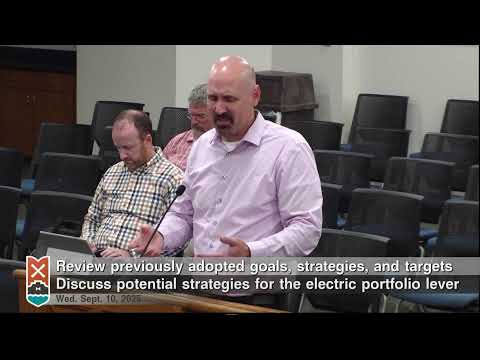
Joel Davenport, who led the presentation, told the committee the target remains "achieving 70% reduction from 2005 levels in carbon emissions from electric production by 2030," and said the utility has reached roughly a 56% reduction to date. Davenport said incoming solar projects and Bell River’s planned conversion from coal to natural gas are expected to help narrow the remaining gap, but he warned that factors outside local control — MISO queue timelines, federal tax‑credit changes and the timing of the Campbell resource retirement — make the final stretch uncertain.
"I think it's an achievable goal," Davenport said, adding that the utility may need to rely on disassociated renewable energy certificate (REC) purchases to bridge shortfalls while bigger projects clear development queues.
Committee members pressed for clarity on measurements and comparators. Davenport proposed aligning reliability benchmarking (Target 2) with broader datasets such as the Energy Information Administration or APPA statistics to reduce variability caused by small municipal samples. On affordability (Target 3), the team confirmed the aim to keep retail rates at or below 90% of the neighboring investor‑owned utility for each customer class — a metric members said supports local economic recruitment.
On strategy, Davenport reported the utility has added about 30 megawatts of solar to its portfolio (not all yet online) and described active work to issue requests for proposals for local solar and storage pilots. He said the BPW has executed multi‑year forward REC contracts to position the utility for Michigan’s renewable standards and that the REC purchases are one available mechanism to manage near‑term shortfalls.
The committee also explored product changes to grow elective renewable programs. Davenport said the elective renewable rate has been lowered in recent years (from about 1.5¢/kWh historically to under 0.5¢/kWh) through hedging and scale and that staff are considering premium offerings — such as registry‑level green eRECs — to meet large customers’ corporate decarbonization requirements.
Attendees raised hurdles to expanding distributed generation: low retail rates that lengthen residential solar paybacks, permitting and interconnection complexity, and market constraints for utility‑scale wind in the region. Multiple members suggested the SDT keep a formal focus on "distributed energy" questions and capture potential actions the BPW and city can pursue together, even when some constraints lie outside municipal control.
Committee members also recommended documenting a monitoring role for emerging low‑carbon technologies — small modular nuclear, carbon‑capture retrofits and hydrogen pathways — so those options can feed into the next integrated resource plan if and when they become cost‑competitive.
The committee approved the Aug. 13 minutes earlier in the meeting and adjourned after the discussion. The board will continue the series with building energy consumption and transportation topics at the October meeting and education and offsets in November.