Get Full Government Meeting Transcripts, Videos, & Alerts Forever!
Get email alerts on the Paid Parking Program topic
No spam. Unsubscribe anytime.
San Bruno staff report six-month paid-parking update as kiosks stabilize; council asks for more data
Summary
City staff told the council that programming faults, battery and siting problems — compounded by vandalism and user errors — largely drove kiosk outages; finance staff reported early deficits and recommended more months of reliable uptime before rate changes while council asked staff to study shorter increments, Sundays/holiday rules, El Camino Real kiosks and app alternatives.
City staff presented a six-month update on San Bruno’s downtown paid-parking program on Nov. 12, detailing persistent kiosk failures at launch that staff now attributes to controller programming errors, battery and solar siting problems, vandalism and operator mistakes.
“Only as of a couple of weeks ago, we came to the conclusion that some programming that was put on the controllers in the kiosks was faulty,” said Bridal Drazen, the staff presenter, explaining that technicians reprogrammed all 83 kiosks and the vendor is replacing batteries at its expense. Drazen said staff believes the primary power and interoperability problem has been resolved but recommended monitoring uptime before making policy changes.
Nick Figueroz, the city’s administrative services director and chief financial officer, gave the fiscal picture. He said the program posted a roughly $140,000 deficit for the portion of FY24 that it operated and projects an approximate $180,000 deficit for the current fiscal year on the best available months of data. Figueroz cautioned that the five-year forecast showing a cumulative deficit of about $1.76 million is driven largely by the repayment of a $2 million loan from the general fund and by limited seasonality data.
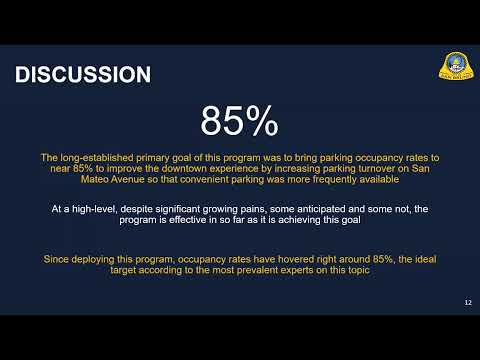
Staff emphasized why the city set an 85% peak occupancy objective — a commonly used benchmark to balance turnover and business access — and said occupancy on San Mateo Avenue is now closer to target during many peak windows. Staff also presented transaction data showing most payments occur at on-street kiosks, that El Camino Real accounts for under 3% of purchases, and that roughly 85% of transactions use credit rather than coin.
Presentation slides and council discussion named several causes of mistaken citations: license-plate entry errors, video evidence showing some motorists never approached kiosks, and isolated cases of falsified receipts. Drazen said staff has dismissed many appeals where evidence did not support the claim and that one alleged repeat vandal has been arrested and charged.
Council members and numerous public commenters raised the program’s impacts on merchants, seniors and residents. Several speakers urged free Sundays and holidays, later enforcement cutoff times, simpler kiosk screens and a more user-friendly mobile-pay solution. "The meters were too expensive for a single time frame allotment… We really shouldn't charge on Sundays," said a downtown business representative, Carlos Martin, during public comment.
Staff outlined options for council direction: shorter on-street time increments (staff already added a 75¢/20-minute option), hour-by-hour dynamic pricing for peak windows, additional short-term “green zone” options, a possible “pay once and move” lot linkage, removal or relocation of low‑use El Camino Real kiosks, improved wayfinding signage, and exploring a different mobile-pay vendor.
Figueroz recommended collecting more reliable months of kiosk uptime (ideally 12–24 months) before adopting structural rate changes to capture seasonality and steady-use behavior. He said one path to budget balance would be a substantial fee increase but that staff preferred waiting for stronger data before proposing large adjustments.
Council members expressed broad agreement with awaiting additional reliable months of operation and directed staff to return with more focused analyses—specifically on holiday/ordinance language, the mobile-pay app alternatives, short‑interval feasibility for lots, and an El Camino Real kiosk study. Several members also supported forming an ad hoc group or returning the topic to a future agenda for deeper review.
No formal votes or ordinance changes were taken during the study session; staff will bring more data and fiscal analysis back to council at a future meeting.