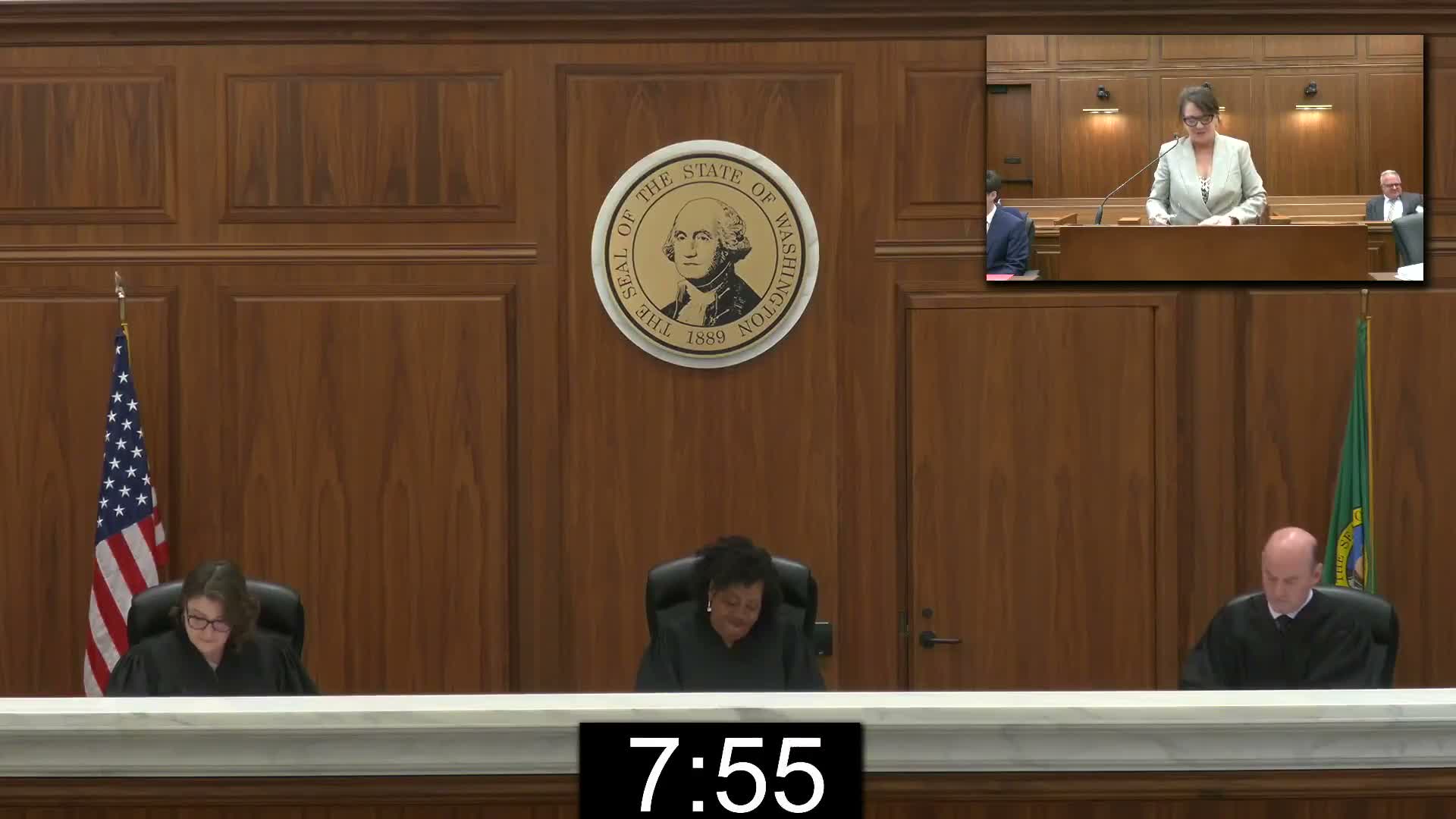
Court hears dispute over whether post-accident evidence can prove Performance Contracting Inc. violations
Loading...
Summary
In oral argument, Performance Contracting Inc. appealed two Department of Labor and Industries citations, arguing evidence discovered after an accident cannot substitute for pre-incident proof; the department said blueprints, prior inspection reports and post-accident photos together support constructive knowledge and the adequacy findings for PCI's site-specific accident-prevention plan.
The court heard argument in Performance Contracting Inc. v. Department of Labor and Industries over whether the agency proved two workplace-safety citations with legally sufficient pre-incident evidence. Counsel for Performance Contracting Inc. told the panel the appeal turns on whether evidence obtained after the accident can be used to establish what a reasonable inspection would have revealed beforehand.
The assistant attorney general, Christopher Choi, representing the Department of Labor and Industries, urged the court to view the record as a whole. Choi pointed to blueprints that showed openings, PCI inspection reports showing hole hazards since July, observations three days before the accident of plywood-covered openings in a row on the 5th floor, and a post-accident photograph showing a damaged hole cover roughly 15 yards from the scene. "Viewed together," Choi said, the evidence supports a finding of constructive knowledge and the board's citation.
Why this matters: the panel is applying a substantial-evidence standard on appeal, meaning it asks whether the record contains evidence adequate to support the board's findings, not whether the court would have reached the same factual conclusion. The outcome could affect how courts and agencies treat post-accident forensic findings when reviewing employer knowledge of hazards.
During questioning, PCI's counsel argued the indented or damaged hole cover was 45 feet from the decedent's immediate work area and asserted inspectors are expected to examine the hazards in the area where workers were assigned that day rather than spaces not targeted for work. Judges pressed both sides on whether visibility from below should trigger a duty to inspect from above and whether the blueprints' general depiction of openings amounted to notice of a hidden, load-bearing cover hazard.
The department also urged the court to affirm a separate citation that PCI's site-specific Accident Prevention Program (APP) was inadequate. Choi cited WAC 296-155-110(2) and argued that for a project of the scale at issue—about 1,500,000 square feet—holes were a recurring hazard that the site-specific APP should have addressed rather than leaving the matter to a general APP or relying on the general contractor. Choi also invoked Washington law (RCW 49.17.060(2)) and cases the department said confirm an employer's nondelegable duty to protect its own employees on a multi-contractor worksite.
Claims and dispute: PCI argued the record lacks findings that PCI employees saw the specific buckouts before the accident and characterized post-accident discovery as insufficient to establish constructive knowledge; the department argued repeated references in inspection reports, the plans, and visible damage near the accident show multiple opportunities to discover and remedy the hazard.
The court submitted the matter at the close of oral argument. No decision was announced at argument; the panel will issue a written opinion applying the substantial-evidence standard to the record.