City staff warn property-tax exemptions are yielding limited rent reductions; council urged policy changes
Loading...
Summary
City staff told the council that Denton foregoes an estimated $15 million in annual tax revenue in exchange for roughly $1.2 million in rental reductions, and recommended shifting incentives toward deeper affordability (30%–50% AMI); council members pressed staff on monitoring and whether indefinite exemptions should be revisited.
City staff on April 7 told a joint meeting of the City of Denton and the Benton ISD board that existing property-tax exemptions for multifamily housing produce limited rental savings for renters and that the council should favor deeper affordability in future deals.
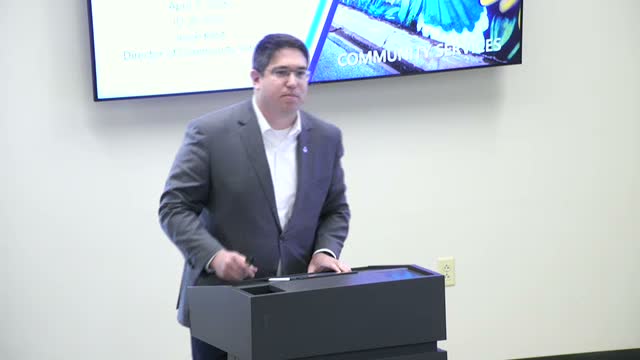
"About 1 in every 3 renting household... is severely cost burdened," Jesse Kin, the city’s director of community services, told council and trustees during a presentation on tax exemptions and multifamily affordable housing. He explained that Denton is measured against the Dallas Fair Market region for Area Median Income (AMI) and reviewed typical AMI bands used in federal and state programs (30%, 50%, 80%).
Kin cited local figures and said the city currently shows "22 properties with tax exemptions" plus additional developments under construction. He presented an estimate that the community is "foregoing about $15,000,000 annually in revenue in exchange for $1,200,000 in rental reductions," noting the estimate is based on the available, incomplete data.
Kin described the financing tools and granting authorities that produce exemptions—public facility corporations (PFCs), housing finance corporations (HFCs) under Chapter 392 of the Texas Local Government Code, community housing development organizations (CHDOs), and nonprofit exemptions—and said the city’s public facility corporation is not active on projects currently. He said many tax-exempt deals occur without direct local jurisdictional votes and that recent state legislative changes have increased oversight for some transaction types.
Councilmembers pressed staff about monitoring and enforcement. Councilman Jesper asked whether there is a mechanism to revisit exemptions for properties that have few or no affordable units; Kin said some state actions now require municipal approval in certain cases and that other monitoring depends on the granting agency. "On the PFC deals... if you're going to provide a tax exemption through this method for acquisitions, you can only... ensure that 60% of the development provides an actual rental reduction," Kin said, noting state amendments that tightened requirements.
Members also asked whether rental caps and unit counts fluctuate with AMI adjustments. Kin replied that rent caps are tied to AMI (which changes by region) and that the number or share of units required is governed by the applicable law or contract under which the exemption was granted.
Kin said the council previously directed staff to revise the city's approach to housing incentives to prioritize 30% and 50% AMI units, because 60%–80% AMI restrictions often do not yield meaningful rent reductions in Denton's market. He said about 5,000 multifamily units are in development within the city and that roughly half are expected to seek a property-tax exemption.
Councilmembers recommended exploring whether the city should advocate for state-level changes or work with county partners to avoid indefinite, poorly monitored exemptions that remove properties from local tax rolls without delivering commensurate affordability. Kin and staff said they will return with policy recommendations and clarified that some monitoring is performed by state agencies for housing tax‑credit projects but that monitoring regimes vary by exemption type.
The presentation closed with staff standing for questions; no formal vote was taken.