Get Full Government Meeting Transcripts, Videos, & Alerts Forever!
Get email alerts on the Public Safety topic
No spam. Unsubscribe anytime.
San Diego Fire‑Rescue lays out staffing, equipment and community programs ahead of 2025 fire season
Summary
Fire‑Rescue briefed the City Council on staffing levels, apparatus and brush‑management programs ahead of an early 2025 fire season, urging public use of alert apps and warning that drones can ground aircraft during active responses.
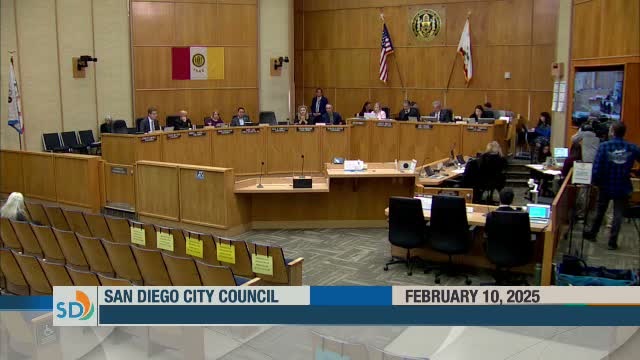
San Diego — San Diego Fire‑Rescue told the City Council on Feb. 10 that the department is entering a high‑risk fire year with near‑term plans to bolster equipment, staffing and community prevention programs.
Assistant Chief Dan Eddy told the council that the department currently staffs 52 stations consistently and counts about 994 firefighters, with a recruit academy underway. "With our constant staffing, that means we have 53 engines, 13 aerial trucks... and 1 helicopter with the ability to up‑staff another helicopter if needed," Eddy said during an informational briefing (San Diego Fire Rescue Department, Item 200).
The department flagged a dry rainy season — roughly half an inch to date compared with an average of 5.5 inches — but said weather models show rain returning later in the week, which could provide temporary relief. Eddy recommended residents sign up for official alerts and preparedness tools, naming the city’s Ready, Set, Go guidance, the Genesys platform and Alert San Diego reverse‑911 for those without smartphones.
Why it matters: City officials said recent fires across the region and drone incursions that forced aircraft to land demonstrate both operational risk and the need for public cooperation. "Do not fly your drones," Eddy said, warning that drones can force aircraft to remain grounded until the hazard passes.
Fire Marshal Tony Tosca (introduced on the record by Eddy) outlined four defensible‑space and brush‑management programs targeting private and public parcels, vacant‑lot abatement, and encampment abatement tied to a new proactive program in very‑high hazard zones. He said the city has expanded agreements for more frequent brush treatment, is deploying EPA‑approved fuel treatments in evacuation corridors, and has acquired roughly $360,000 in grant funding for battery‑powered, emissions‑free equipment for park and field management.
Tosca also identified proposed staffing additions to support brush management and data analysis, including a program manager, an information‑systems analyst and a new wildfire‑prevention specialist classification.
Councilmembers and public commenters pressed department leaders on evacuation coordination, lessons from prior catastrophic fires, and on prioritization of encampment abatement. Assistant Chief Eddy said the department now runs three‑hour weather simulations and conducts after‑action reviews for each incident; Captain Morris of the San Diego Police Department told the council that PD and Fire have created a designated evacuation group for every incident and are emphasizing unified command and boots‑on‑the‑ground coordination.
Public input: Dozens of callers and in‑chamber residents shared experiences and suggestions. Some urged low‑cost or creative abatement approaches — one speaker described using goats to clear brush after her experience in the 2003 Cedar Fire — while others pressed for broader town‑hall outreach to residents who do not use smartphone alerts.
The briefing concluded with Council recognition of the department’s recent response efforts and a request that staff continue to report back as needed. The item was informational only; no council action was required.
Sources: San Diego Fire‑Rescue presentation to City Council, Feb. 10, 2025 (Item 200); public comments and council Q&A.