Get Full Government Meeting Transcripts, Videos, & Alerts Forever!
Get email alerts on the Zoning Amendments topic
No spam. Unsubscribe anytime.
Plymouth planning board forwards four zoning amendments to 2026 town meeting after ADU debate
Summary
The Plymouth Planning Board voted to place four zoning amendments on the 2026 Town Meeting ballot, including omnibus state-law compliance changes, revisions to accessory dwelling unit (ADU) rules and two overlay districts. Board members debated ADU occupancy and owner-occupancy provisions and heard testimony from the building inspector and a developer representative.
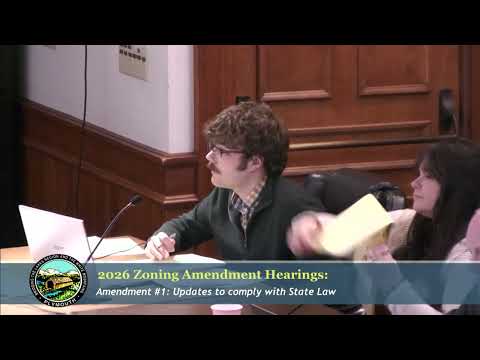
The Plymouth Planning Board voted to send four separate zoning amendments to voters for the 2026 Town Meeting after second public hearings and board discussion.
Joseph, the planner addressing the board, described the first amendment as an omnibus update designed to bring multiple articles of the zoning ordinance into compliance with recent state law changes. “The law that was passed basically removed the authority for towns to restrict occupancy any more than to 2 people per bedroom,” Joseph said, explaining why the draft removes several prior occupancy and related family-differentiation provisions.
Tom Newcomb, the town’s building inspector and code enforcement officer, told the board he supported housekeeping changes generally but warned that removing the ADU occupancy language entirely could open the town to non-owner-occupied detached ADUs and effectively expand multifamily-style occupancy across single‑family districts. “I would urge this board strongly to not move this forward,” Newcomb said, asking the board to consider retaining a two‑people‑per‑bedroom limit that he said would align with the state-level change as he understood it.
Board member John Crist and others pushed back that ADUs are treated differently in the zoning ordinance and that many of the changes are state‑mandated or mirror how the town already treats dwelling units for rental purposes. Crist said the board can revisit any unintended consequences after the changes take effect and that scheduling constraints make additional hearings difficult.
The board voted to place each of the four amendments before voters: Amendment 1 (omnibus state‑law compliance changes), Amendment 2 (removing owner‑occupancy requirement for primary or accessory dwelling units), Amendment 3 (creation of a Tenney Mount overlay district permitting optional planned unit developments), and Amendment 4 (creation of a Fairgrounds Road residential overlay). The chair announced each amendment “will be moved forward to Town Meeting.” The transcript records the motions, seconds and board votes but does not specify a roll‑call tally for each vote.
Developers and supporters spoke in favor of the Tenney Mount overlay. Brian McCann of North Country Development Group told the board the development team appreciated collaboration and urged the board to send the overlay to voters. An online commenter also expressed support for the overlay’s constraints and said it would be good for the town.
What happens next: the amendments will appear on the 2026 Town Meeting ballot for voter consideration. The board noted that, if problems arise after implementation, the zoning language can be amended in a subsequent year.
Authorities referenced in the discussion included recent state law changes affecting occupancy and local zoning; the transcript does not provide statutory citations. The board also referenced building and life safety codes (IRC and NFPA) and DES guidance on septic sizing in relation to bedroom equivalents as part of technical discussion about occupancy limits.