Get Full Government Meeting Transcripts, Videos, & Alerts Forever!
Get email alerts on the Redistricting topic
No spam. Unsubscribe anytime.
Senate elections panel advances mid-decade redistricting bill after marathon public testimony
Summary
After nearly four hours of public testimony from hundreds of Hoosiers, the Senate Committee on Elections voted 6-3 to advance House Bill 10-32, a proposal to redraw Indianacongressional districts mid-decade; opponents warned of legal risk, administrative cost and diluted minority representation.
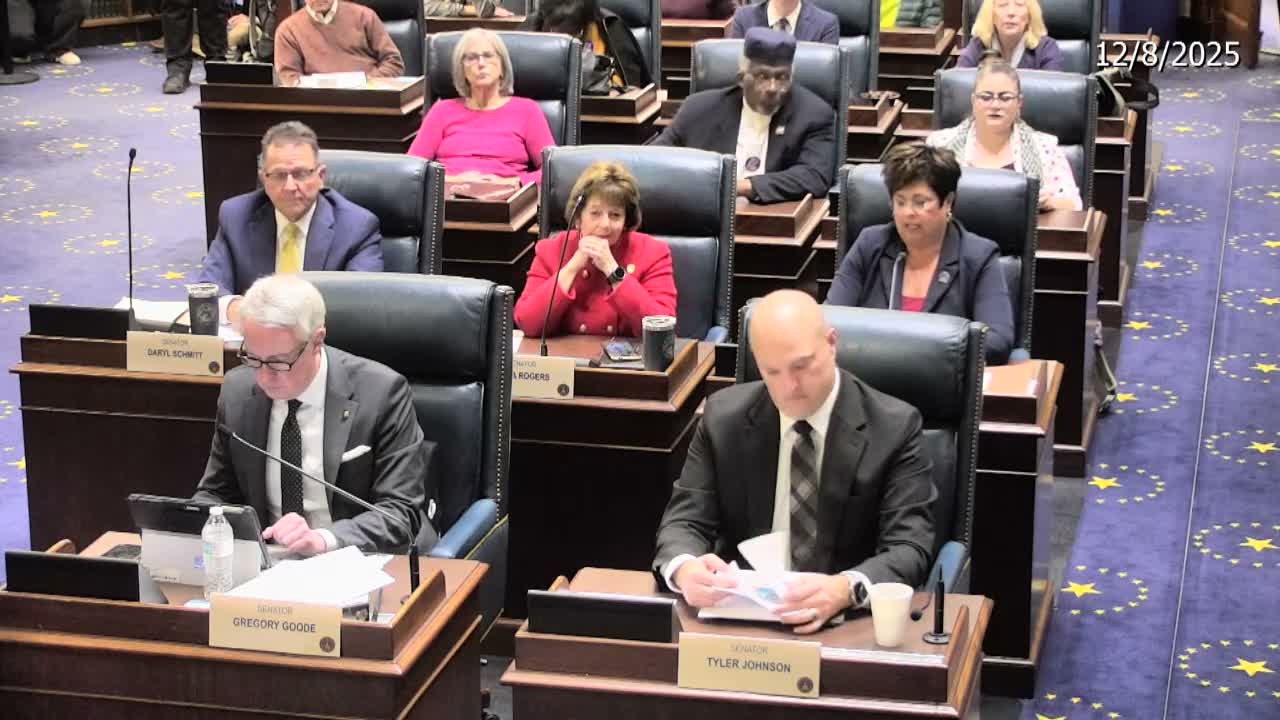
The Senate Committee on Elections voted to advance House Bill 10-32 on a 6-3 roll call after nearly four hours of public testimony that drew both sustained opposition and vocal support from communities across Indiana.
Chairman Mike Gaskell, who presented the bill as the Senate sponsor, said the proposal would authorize the General Assembly to amend congressional districts outside the decennial timetable and sets out timing, definitions and a new set of district descriptions. "All committee hearings in both houses of the Indiana General Assembly are open to the public to attend," Gaskell said in opening remarks as he outlined the bill and the hearing process.
Opponents argued the mid-decade redraw would undercut the principle of "one person, one vote," fracture communities of interest and expose the state to expensive litigation. "The right to vote is one of the most sacred civil liberties we hold as Americans," Samantha Bresnahan, senior policy specialist for the ACLU of Indiana, told the committee. She said the 2021 maps were enacted after public meetings and a census and that a mid-decade map "risks silencing communities, undermining fair representation, and eroding trust in our democratic process."
Local election officials raised immediate administrative concerns. Marion County Clerk Kate Sweeney Bell said the county faces significant costs and data gaps if the bill were enacted on the proposed timetable: "The conservative estimate for the cost for Marion County alone to redistrict at this time is at least $1,000,000," she testified, and warned that precinct names in the bill did not match county records and that some precincts appeared to be missing.
Bill proponents described the legislation as a lawful, necessary response to national redistricting efforts by other states and a way to ensure Indiana's congressional delegation better reflects statewide voting patterns. Supporters said the maps were drawn with legal precedent in mind and that the legislature has authority to redraw districts when warranted. "Redistricting is legal. It's necessary, and it's the right thing to do," one proponent testified.
Committee debate shifted to process and safeguards. Senator Lehi Kadora proposed Amendment 18 to move map drawing to a nonpartisan agency and create an advisory board; the amendment failed. Senator JD Ford proposed amendments to require hearings in each congressional district, financial disclosure about who drew the maps, and reimbursement to counties for implementation costs; those measures also failed.
Committee members were split on whether the bill should proceed. Supporters argued the move levels a national playing field; opponents said the bill short-circuits established processes and threatens communities already represented by majority-minority districts. Senator Lehi Kadora told colleagues he would "fiercely" oppose the bill on principle, while Senator JD Ford said he would vote no on the floor. Senator Greg Goode and others said the measure deserved full-chamber debate.
The committee ultimately approved a motion to send HB 10-32 to the full Senate by roll call. The sponsor reported the motion was moved by Senator Tyler Johnson and seconded by Senator Donato. The vote was recorded as 6-3 in favor of advancing the bill.
What happens next: HB 10-32 will be scheduled for floor consideration in the Senate, where the larger body will have the opportunity to debate amendments, hear further legal analysis and decide whether to pass the measure on to the governor. Several witnesses said they expect litigation if the bill becomes law.
Sources and next steps: The committee record includes more than 120 public testimonies submitted this session and written statements posted with the clerk; the bill text identifies district boundaries and procedural rules that would apply if enacted. The authors and several testifiers recommended additional public hearings and independent legal review prior to any final adoption.