Get Full Government Meeting Transcripts, Videos, & Alerts Forever!
Get email alerts on the Ndot Agency Bill topic
No spam. Unsubscribe anytime.
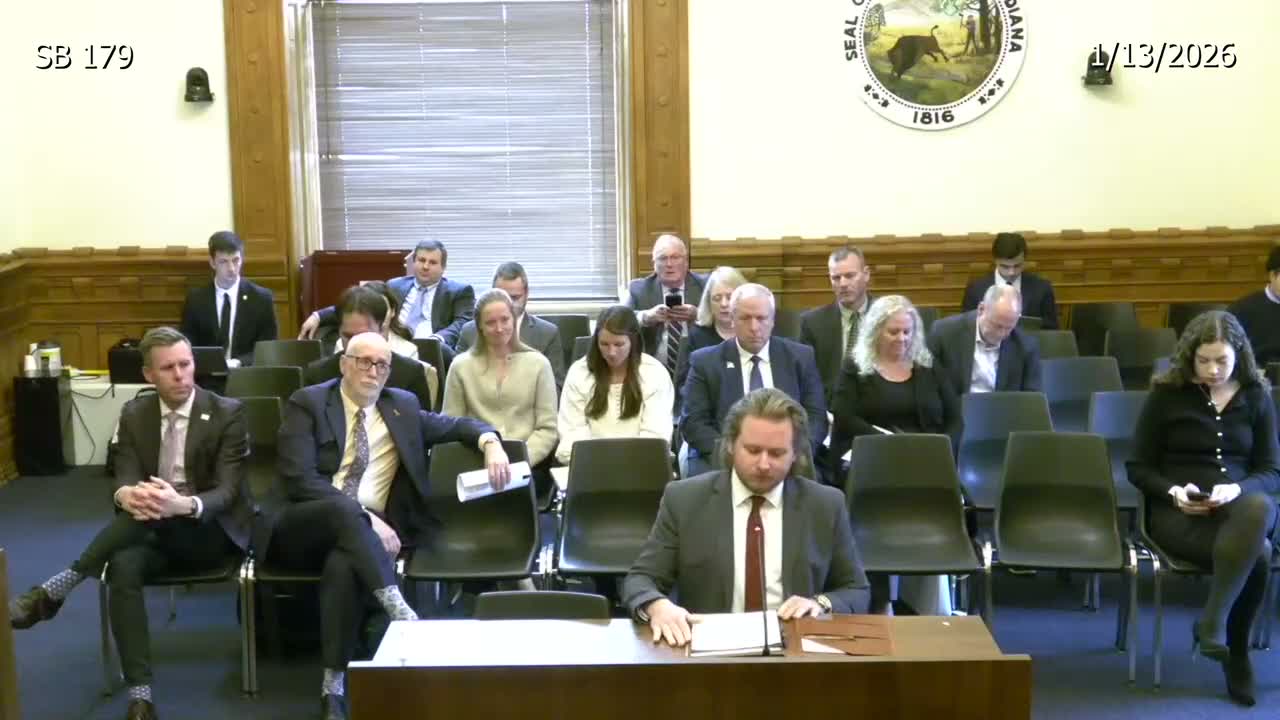
Senate panel recommits NDOT agency bill after debate over inspector immunity and grant, permit changes
Summary
Senate Bill 179, an INDOT/NDOT agency bill with technical corrections, a 5‑day single‑trip permit clarification, $75 million reallocation for Community Crossings applicants, and a provision enabling NDOT to apply for NEPA assignment, was discussed at length and recommitted to appropriations 9–0 after stakeholders raised liability and insurance concerns about a CEI immunity clause.
Senate Bill 179, a broad INDOT/NDOT agency bill that includes technical corrections, grant adjustments, permitting clarifications and statutory changes to allow NDOT to seek NEPA assignment, was recommitted to appropriations after extensive testimony and questions about a liability exemption for construction engineering inspection (CEI) firms.
NDOT legislative director Aaron Wainscott told the committee SB179 corrects drafting errors from last year, modernizes GIS and coordinate‑system language, clarifies that a single‑trip trucking permit expires five days after issuance, and reallocates $75,000,000 already in the Community Crossings account to applicants who were denied in the prior call. Wainscott said the bill also includes statutory authority and a limited waiver of sovereign immunity necessary for NDOT to apply for NEPA assignment, which the department and peer states say shortens environmental review timelines.
Why it matters: supporters said the changes would improve NDOT efficiency and help local governments access road and bridge matching funds more quickly; opponents and some contractors warned that section 4 — which would provide civil immunity for CEI firms in certain third‑party motor‑vehicle claims arising in work zones — could shift risk and defense costs onto prime contractors and erode accountability.
Details and debate: Wainscott described timeline benefits from NEPA assignment, noting categorical exclusions can take six to nine months, environmental assessments 18 to 24 months, and environmental impact statements multiple years; he argued enabling NDOT to assume NEPA responsibilities would speed federally funded project delivery. He also said NDOT is working with the bill sponsor to refine liability and other language to avoid jeopardizing federal funds.
Insurance and liability testimony came from several stakeholders. Kristen Walker, an insurance advisor and owner of Walker Professional Insurance, said CEI firms are increasingly named in third‑party work‑zone lawsuits and that other states’ civil immunity has helped stabilize insurance markets and preserve professional liability limits for designers. "CEI firms are not the correct party to have at the table," she told the committee, urging support with amendments that limit protection to observation and documentation functions.
Contractors objected to the liability waiver. Richard Hedgecock, president of Indiana Constructors Inc., said exempting CEI firms from liability effectively shifts risk to prime contractors that already indemnify the state and have no control over CEI employees. "Risk doesn't go away by the enactment of a law, risk has to go somewhere," he told senators and urged removing section 4.
Other provisions: the bill clarifies a single‑trip permit will expire five days after issuance to reduce misuse, and it accelerates lane‑mile distribution from the local road and bridge matching fund from June 30, 2027, to June 30, 2026; Wainscott emphasized the additional $75,000,000 for Community Crossings is money already in the fund being made available, not a new appropriation.
Vote and next steps: After testimony and back‑and‑forth about liability language, Chairman Kreider moved to recommit SB179 as amended to appropriations; the motion carried on a 9–0 roll call. Committee members said they will continue working with stakeholders and NDOT staff to refine the liability language and other technical provisions before the bill advances.