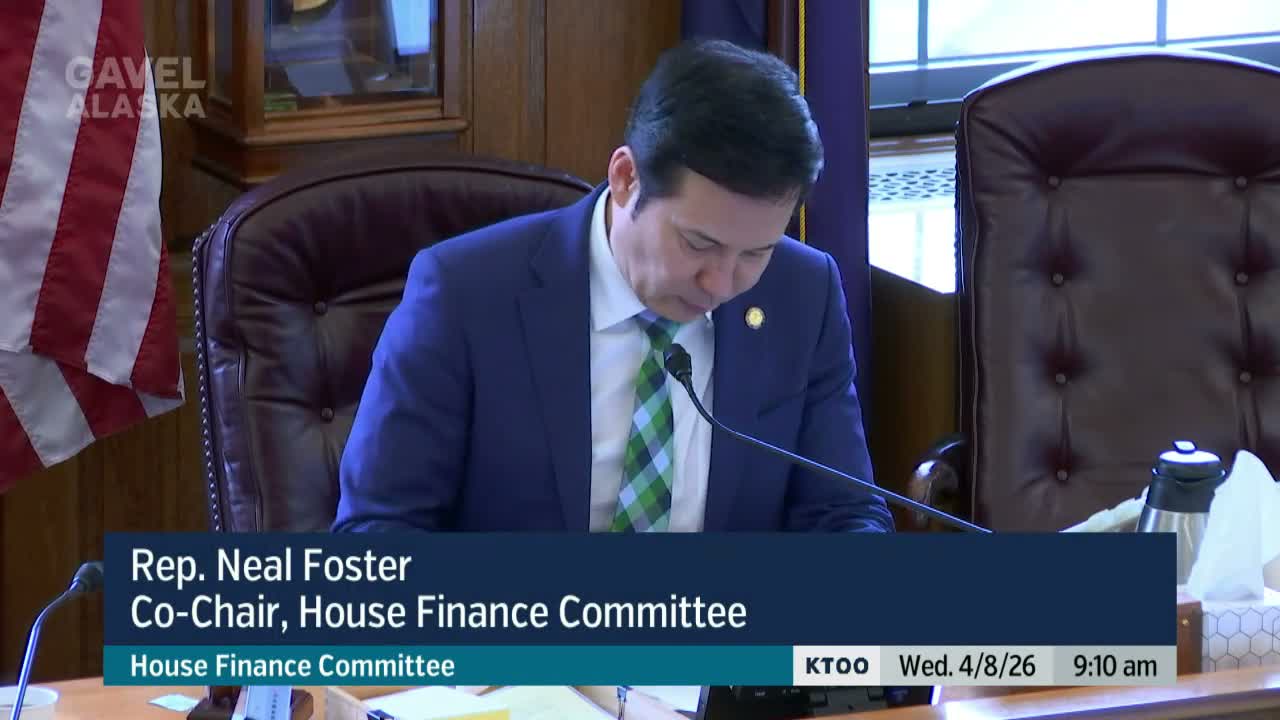
House Finance Committee holds first hearing on bill to boost funding for Special Education Service Agency
Loading...
Summary
At a first hearing on House Bill 246, the House Finance Committee heard that the Special Education Service Agency (CESA) needs an increase (about $3.76 per statutory unit) to hire staff, reduce a wait list for rural students with low‑incidence disabilities and offset losses tied to a dip in statewide average daily membership; the bill’s fiscal note is roughly $470,000. No vote was taken.
The House Finance Committee on April 8 held a first hearing on House Bill 246, a measure to raise the statutory funding multiplier for the Special Education Service Agency (CESA) to help serve students with low‑incidence disabilities in rural Alaska.
Representative Andy Josephson, sponsor of the bill, said the legislation would “increase the rate that exists for CESA and make an inflation adjustment,” and traced the agency’s statutory roots to Chapter 23, SLA 2013 and the federal Individuals with Disabilities Education Act of 1975. Josephson said CESA provides itinerant outreach and capacity building that many small districts cannot supply on their own.
Olivia Yancey, executive director of the Special Education Service Agency (CESA), told the committee that the agency provides services for autism, deaf and hard of hearing, deaf‑blind, vision impairment, emotional disabilities and multiple disabilities. “Last year we served a total of 522 students,” Yancey said, and she reported that the agency had served 3,374 teachers, administrators, paraprofessionals and self‑advocates as of April 6. Yancey said CESA currently serves districts statewide through a small team of specialists who travel to rural and remote communities.
Ken Alper, staff to Representative Josephson, summarized the bill’s fiscal mechanics and estimate. “The fiscal note of about $470,000 is just straight arithmetic of applying the new multiplier to the expected membership numbers,” he said, explaining the statutory formula is a fixed dollar amount multiplied by average daily membership (ADM).
Yancey told the committee that recent declines in statewide ADM reduced CESA revenue, costing the agency roughly $37,000 last year and an anticipated loss of about $40,000 for the current year. She said the bill’s requested increase — “$3.76 more” per unit, which she called not inflation proof — is intended to add staff to eliminate the agency’s wait list and to support travel and possible salary increases for specialists.
Committee members pressed staff and Yancey on whether federal grants or other revenue sources might cover the need. Yancey said the Alaska Deaf‑Blind Project is funded by a five‑year federal grant now in its third year and would not by itself meet the wait‑list need. She confirmed CESA is organized as a nonprofit and said it receives occasional donations and makes discretionary grant applications to the state Department of Education and Early Development and federal funders.
Members asked how CESA determines its wait list; Yancey said it is driven by workload limits for specialists (no more than 40 assigned students) and that the program covered by this statutory multiplier is aimed specifically at rural and remote districts — communities with small numbers of students in a particular low‑incidence area. She described the agency’s role in transition work with infant learning programs (ILP), noting CESA is not funded for birth‑to‑3 services but coordinates with ILP programs as students approach school age.
Committee members also raised workforce concerns. Yancey said turnover in rural districts forces CESA specialists to repeat training and to serve as the institutional memory for students, which increases her staff’s workload and contributes to the wait list.
Yancey summarized how the agency measures success: that students receive on‑site visits with actionable recommendations and that school teams report knowledge gains as a result of those visits. She noted privacy constraints limit the agency’s ability to share student‑level outcomes publicly.
The hearing was informational; there was no committee vote. Representative Josephson thanked the committee for its questions and Co‑chair Foster adjourned the hearing at 9:51 a.m., noting the committee’s next meeting later the same day. HB 246 received a first hearing and may be considered in future committee or floor action.