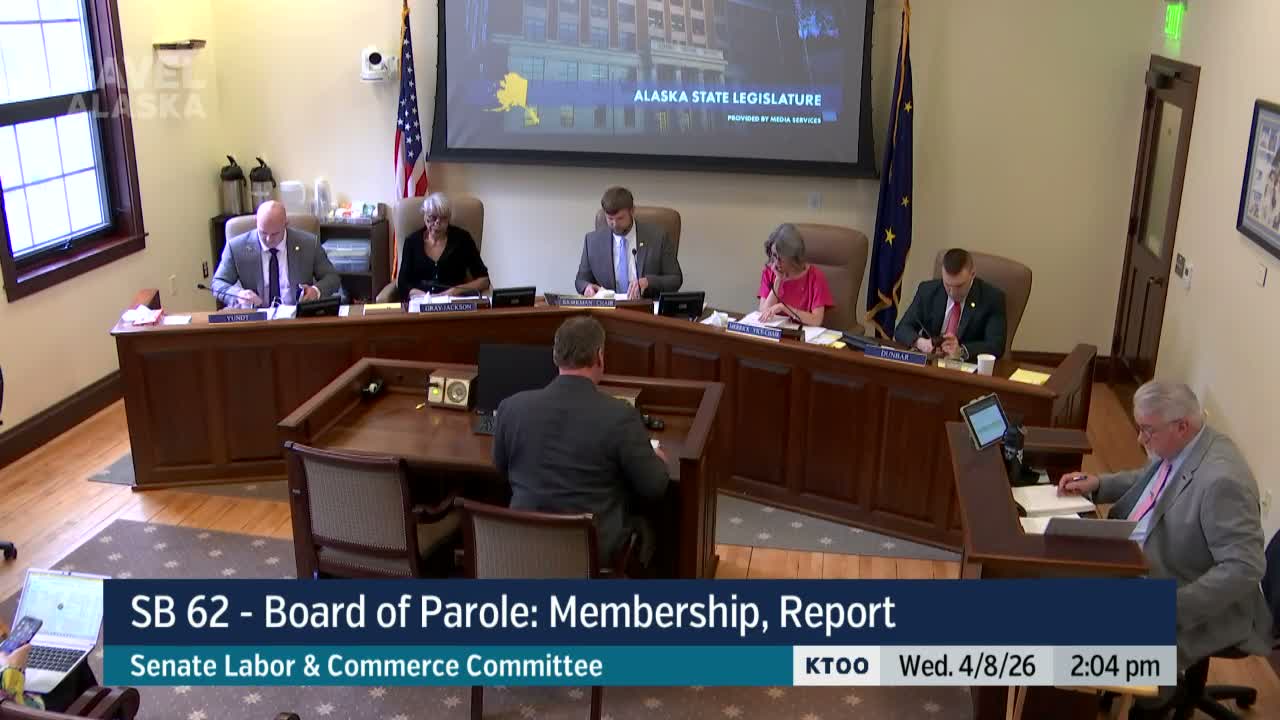
Bill would add tribal, clinical and victim representation to Alaska Board of Parole and require annual reporting
Loading...
Summary
Senate Bill 62, presented in its third hearing, would change Board of Parole composition to include a federally recognized tribal member, a clinician with substance‑use treatment experience, and a victim or victim‑advocate, and would require annual public reporting on parole operations and outcomes.
Staff to Sen. Lukey Gale Tobin, Louis Flora, described Senate Bill 62 as a measure to make Alaska’s Board of Parole more representative and accountable. Flora said the bill would reserve a seat for a member of a federally recognized tribe, require a member with clinical experience treating substance use disorders, reserve a seat for a crime victim, family member or victim‑advocacy representative, impose term limits (two five‑year terms) and require the board to issue an annual report to the Legislature.
Christina Shedura, Anchorage Reentry Coalition coordinator, testified in support and emphasized that the bill would modernize board composition, increase transparency and improve reentry outcomes by supplying data on hearings, grant and denial rates, reasons for denials and revocations. Shedura attributed several statistics to illustrate rationale for the bill: staff testimony earlier cited that Alaska Native people make up 40% of the incarcerated population while a later witness cited 42%; Shedura also said that roughly 80% of Alaska Department of Corrections inmates have an assessed substance‑use disorder. She testified that such data are essential for aligning treatment, supervision and community supports.
There was no committee motion recorded to advance SB 62 during this hearing; the bill remains under consideration pending further committee action.