Team Alaska asks state for $3.5 million to help bring Arctic Winter Games to Fairbanks
Loading...
Summary
Organizers told a Juneau luncheon hosted by Senator Cronk that Fairbanks could host the next Alaska-set Arctic Winter Games if the state provides roughly $3.5 million over two years; presenters said the games draw thousands of participants, volunteers and visitors and yield economic and cultural benefits.
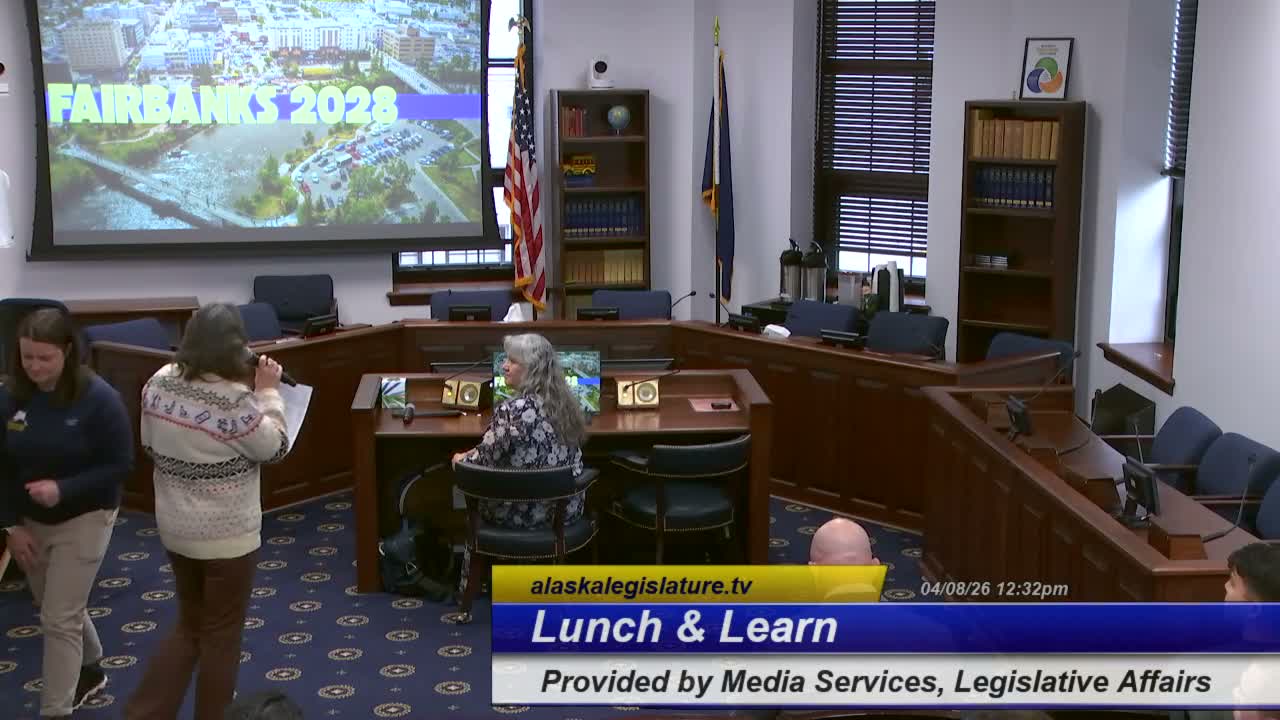
Team Alaska organizers told attendees at a Juneau luncheon that Fairbanks is prepared to host an Alaska-set Arctic Winter Games — but only with state funding. Karen Lane, who has managed past Fairbanks games, said the host community raised $270,000 in a week and that “we in the next 2 years, we need $3,500,000” to cover operating or capital needs for hosting.
The request came at an event hosted by Senator Cronk where executive director Sarah Frampton and board member and cultural director Nicole Johnson reviewed the organization’s work supporting athletes and cultural exchange. Frampton said Team Alaska sent more than 275 athletes to the 2026 Whitehorse games as part of a 355-person contingent that included staff and about 27 officials.
Organizers argued the games deliver economic activity and community benefits: Frampton said volunteers convert school classrooms into athlete villages, local businesses and lodging benefit from visiting families and supporters, and the event helps keep young Alaskans connected to cultural traditions. She also noted the games’ potential to bolster broader federal and civic initiatives — calling it a complement to the national focus on sport.
Frampton and Lane described obstacles to the usual host rotation: the international committee has tentatively pushed a set of games to 2029 because communities have not committed to host, and COVID-19 disruptions and recent fires in the Northwest Territories have complicated scheduling. Frampton also noted that some contingents have been suspended in recent years; “Yamal, Russia was another contingent. They were suspended after the war in Ukraine,” she said.
Organizers framed Fairbanks as well positioned to host again, pointing to existing facilities, school space for athlete housing and a strong volunteer base. Karen Lane said local leaders and the school district were “all on board” and that the host society handles the large logistics of registering participants and scheduling volunteers.
There was no formal vote or state action at the luncheon. Organizers asked legislators and attendees to consider the funding need as they plan budgets; Nicole Johnson closed by directing interested parties to teamalaska.org and offering contact emails for follow-up.
The next steps identified in the presentation were local fundraising, continued outreach to potentially interested contingents and formal commitments from state funding sources over the coming two years.