Alaska Marine Highway officials tell DOT panel they will seek $161M in federal ferry aid to bridge $78M shortfall
Loading...
Summary
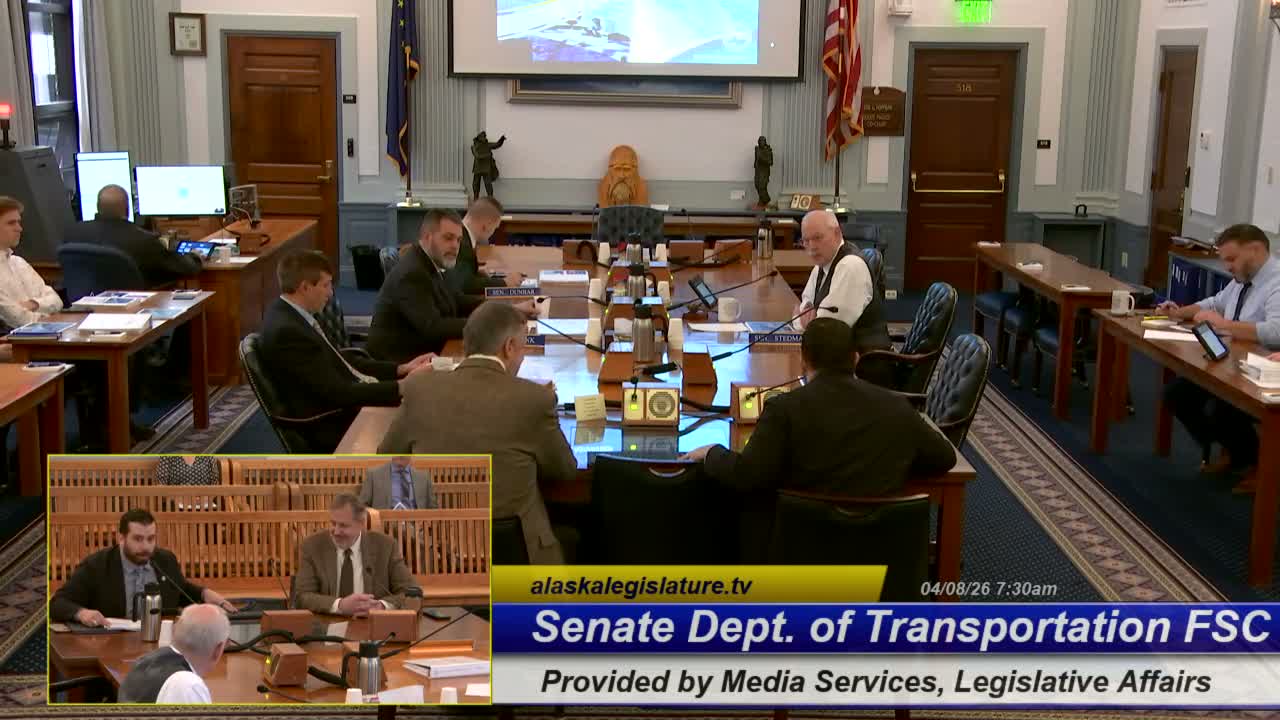
At an April 8 DOT Finance Subcommittee briefing, Alaska Marine Highway System officials said a $78,000,000 federal revenue shortfall leaves the system exposed and outlined plans to apply for $161,000,000 in operating assistance from a new FTA rural ferry grant program, propose a two-year fiscal alignment, and pursue immediate cost-savings.
On April 8, the DOT Finance Subcommittee heard that the Alaska Marine Highway System faces a federal revenue shortfall of $78,000,000 and plans to apply for $161,000,000 in operating assistance from the Federal Transit Administration's new rural ferry grant program, officials said.
An agency official told the committee, "Our current year budget has a federal revenue shortfall of $78,000,000," and said the department intends to pursue competitive FTA grants made available through a notice of funding opportunity that converts $410,000,000 in advanced appropriations into competitive awards. "The Federal Transit Administration did issue a notice of funding opportunity on Monday," the official added, noting eligibility for operating assistance, planning and capital projects and a condition that systems continue to provide 75% of the state funding average from 2017–2019.
Why it matters: AMHS provides critical surface connectivity for coastal Alaska communities and the shortfall, if unaddressed, could force service reductions or deeper dependence on one-time transfers. Department presenters told the committee they want to realign the system's budget from calendar-year appropriations to a two-year, fiscal-year-aligned appropriation that would give six months of padding before and after the calendar year and allow greater flexibility in managing labor cost adjustments.
How officials would bridge the gap: The department described a "waterfall" approach to temporarily swap federal funds and AMHS revenue between appropriations so the system can be kept whole while awaiting grant awards. The plan is to apply for $161,000,000 of operating-assistance funds to cover portions of calendar year 2026 and 2027, leaving about $250,000,000 of the $410,000,000 program for capital projects.
Immediate savings and fare changes: The presentation listed near-term cost reductions intended to stretch current funds while the grant application is processed. Officials said disposing of the Matanuska — currently used as a crew "hotel" in Ketchikan and costing roughly $800,000 a month — and shifting the Tazlina crew-quarters costs to capital would move crew time off the operating budget. "These two will save us about $1,150,000 a month," the agency official said. The department also noted a planned farebox tariff adjustment of about 2.1% scheduled to take effect on May 1, 2026.
Financial context and federal match: Presenters reported FY2025 AMHS revenues of $37,200,000, operating uses of $16,200,000 and capital overhaul spending of $22,200,000 (a net change of negative $1,300,000). They said AMHS has preliminarily earned $23,400,000 in toll credits to substitute for matching funds on federal grants and indicated the governor's FY2027 request includes $20,800,000 in operating and $27,500,000 in overhaul funding.
Projects and fleet issues: Director Craig Toronga (Alaska Marine Highways) described several capital and modernization priorities, including extensive work on the Kennecott (hull blasting, steel replacement and new anodes after electrolysis issues), a planned Columbia modernization (previously replaced the fire-main system in 2024), and the Tustamina procurement, which has lost bidders as firms pursue other federal contracts. Toronga said the department has $9,000,000 earmarked to design mainliner replacement vessels and is working on diesel-electric shuttle ferry design and other vessel projects.
Operations and workforce: Toronga reported that AMHS hired 64 crewmembers and had 67 separations in 2025, said system uptime was approximately 98.55% (total downtime under 2%), and described recruitment programs (cadet pipelines, scholarships, pilotage incentives) aimed at improving retention and licensing pathways for Alaskans.
Next steps: Officials said FTA has committed to an expedited award schedule, with grant awards likely by late July–early September if timelines mirror the prior NOFO. Committee members asked for written follow-ups on ship sailings and load-traffic comparisons to 2019, details on a reported shipyard labor dispute, and the Army Corps' status on Cascade Point and related economic studies. The committee adjourned with staff directed to provide those written answers.