Donor family recounts partner’s gift as Life Center Northwest urges Alaskans to register
Loading...
Summary
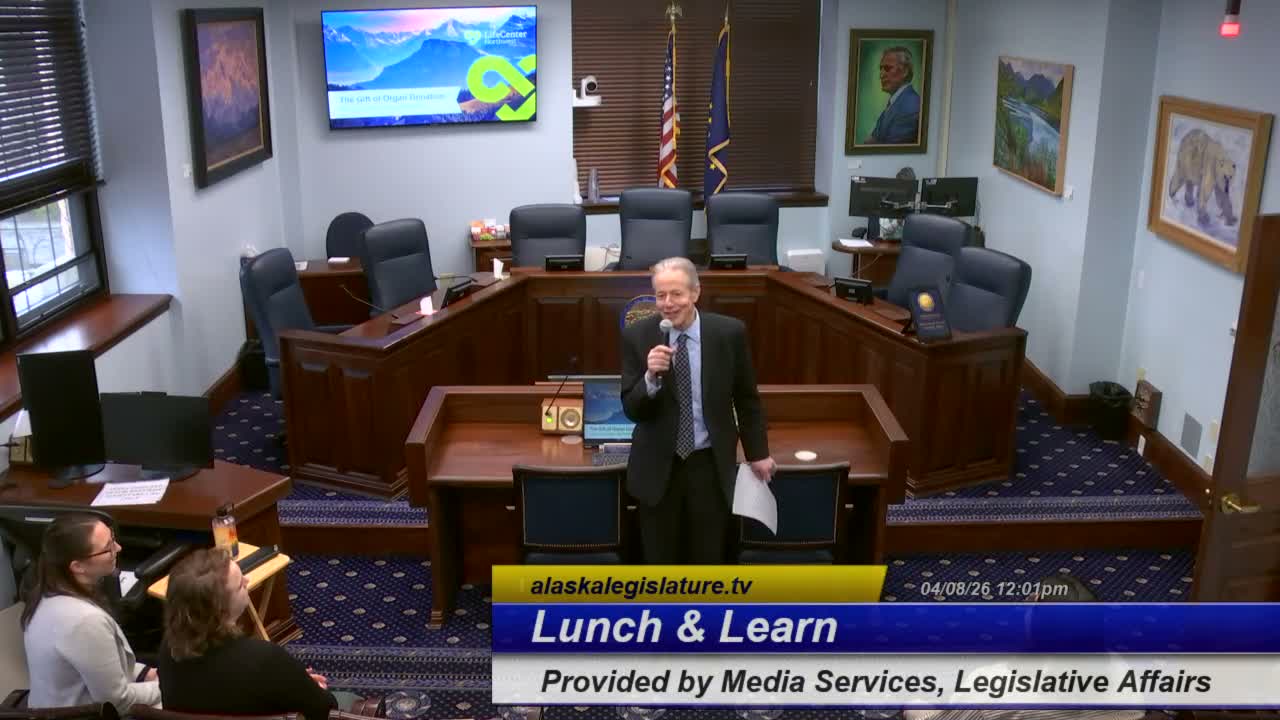
At a lunch-and-learn hosted by Sen. Clayman, Life Center Northwest described how organ donation works, cited national and local waiting-list figures, and a donor family member, Courtney Pickett, shared her partner Aaron’s story to highlight the importance of family conversations and registry sign-ups.
Sen. Clayman opened an annual “lunch and learn” session and introduced Ashley Lind, director of external affairs at the nonprofit Life Center Northwest, who described the organ-donation process and urged Alaskans to register as donors.
"We are one of 55 organ procurement organizations," Lind said, adding that Life Center Northwest serves the largest geographic OPO area in the country, covering Alaska, Montana, Idaho and Washington. She noted that tissue and cornea recovery in Alaska is managed by Life Alaska Donor Services and that Life Center works closely with that state registry.
Courtney Pickett, a donor family member introduced by Lind, told attendees that her partner Aaron suffered a traumatic brain injury and was declared brain dead; Aaron was a registered donor and, after his death, "went on to extend the lives of four other people," Pickett said. She described family disagreement about donation and said Life Center Northwest provided space and support that helped the family honor Aaron’s wishes.
"When I think back to then and even now over 10 years later, the only thing that ever made sense about Aaron's loss and death was his ability to become an organ donor," Pickett said. She urged people to discuss donation choices with family members so wishes are clearer in crisis.
Lind gave an overview of the clinical and logistical steps: hospitals notify the OPO after lifesaving efforts are exhausted and hospital physicians declare death; Life Center then evaluates suitability, meets with families and, if moving forward, identifies matches and coordinates surgical recovery and transplantation. Lind said that a single donor can save up to eight lives through organ donation and can enhance dozens more through tissue donation.
On statistics, Lind said more than 100,000 people are on the national transplant waiting list and that roughly 2,000 of those are in Life Center Northwest’s service area; she cited recent internal figures showing 163 Alaskans waiting for transplants and noted nationwide figures for 2025 of just over 46,000 transplants performed. Lind also acknowledged variability in donor numbers and said that, although donor counts dipped in 2025, transplants per donor increased because of improved technology and clinical work.
In a question-and-answer session, attendees asked about organ viability, registration, and how recipients are prioritized. Lind explained that organs have different windows of viability — for example, kidneys can sometimes be preserved on pumps for up to about 36 hours while hearts and lungs have much shorter windows — and mentioned ex vivo perfusion technology (often referred to as "heart in a box") that can extend heart viability to roughly six to eight hours.
On registration, Lind said that saying "yes" at the DMV or registering with Donate Life America places someone on the national donor registry; she described the U.S. as an opt-in system and said that, in their service area, more than half of people are registered though precise, state-level numbers vary and data sharing between systems is imperfect. On recipient selection she said the United Network for Organ Sharing (UNOS) manages listing and allocation and that OPOs use UNOS data when matching organs.
Lind also addressed misinformation and demographics, saying social-media misinformation has affected some younger cohorts’ willingness to register. She encouraged attendees not to "rule themselves out" because older donors can still provide viable organs, citing a recent recovered liver from a 75-year-old that was successfully transplanted.
The session closed after further questions about minors and consent (Lind said age and state rules vary; legally binding consent typically begins at 18 while parents or guardians may be involved earlier) and organizers thanked presenters and attendees.
The presentation included an invitation to Donate Life Month activities in April and the Governor’s Gift of Life award event in May; Lind said the lieutenant governor plans to attend and that donor families, including Pickett, will speak.