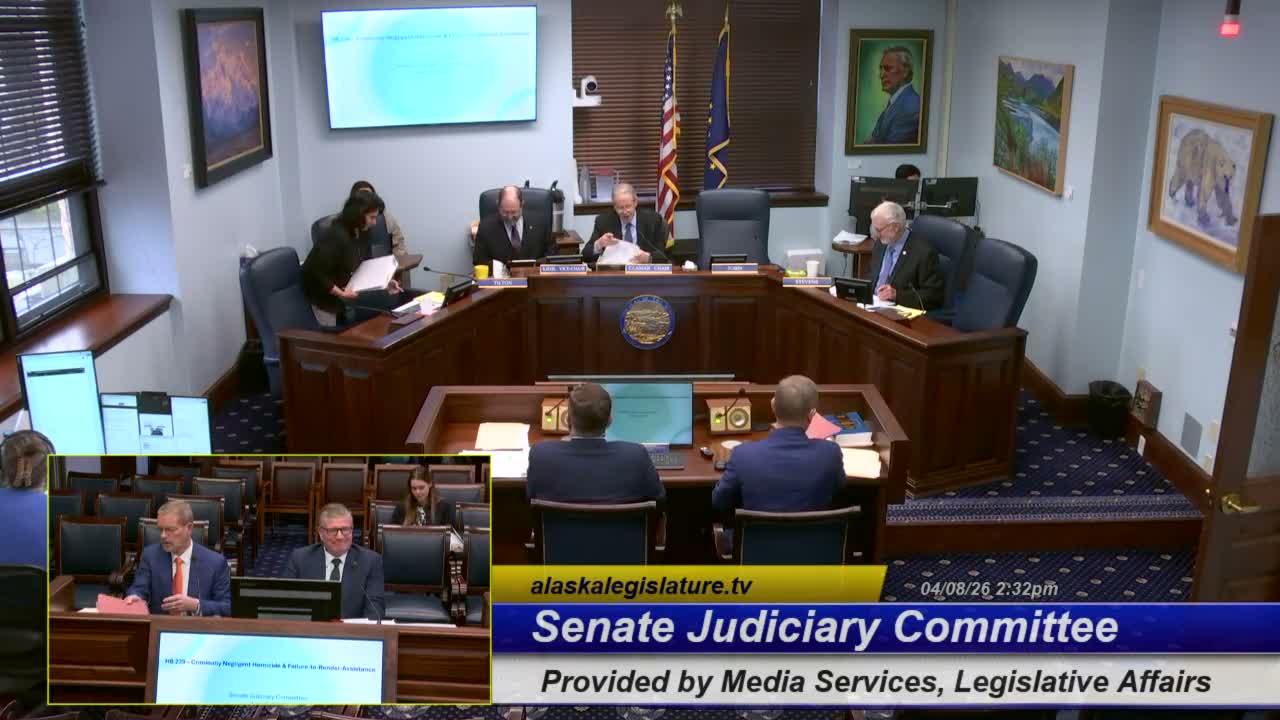
Senate Judiciary Committee hears bill to raise penalties for hit-and-run deaths
Loading...
Summary
At a first hearing on April 8, supporters of House Bill 239 urged the Senate Judiciary Committee to elevate criminally negligent homicide to a higher felony when a driver knowingly flees and fails to render aid, citing rising pedestrian fatalities and cases they said resulted in light sentences. Lawmakers pressed proponents on deterrence, statutory scope and prosecutorial practice.
The Senate Judiciary Committee on April 8 held a first hearing on House Bill 239, which would elevate criminally negligent homicide to a class A felony when a person causes a death with a motor vehicle and then knowingly leaves the scene without rendering aid, proponents told the panel.
Representative Chuck Kopp, the bill’s House sponsor from Anchorage’s House District 10, said the measure does not create new crimes but raises penalties where a driver’s criminal negligence causes a death and the driver then fails to render assistance. “It elevates it from a B felony to an A felony,” Kopp said, explaining that a presumptive sentence for a first-time offender would move from about 1–3 years to roughly 4–7 years.
The bill would also allow some consecutive time when both criminally negligent homicide and failure to render assistance are present, Kopp and his staff said, so that abandonment and the loss of life are reflected in sentencing.
Why it matters
Gary Zapp, staff to Representative Kopp, presented data the sponsor supplied showing rising fatal pedestrian and bicycle crashes in Anchorage and argued that plea negotiations, low presumptive ranges and concurrent sentencing have produced sentences that do not match community expectations. Zapp told the committee Anchorage recorded 94 vehicle-pedestrian-bicycle fatalities since 2015 (an average of almost 10 per year) and that 2024 saw a record 15 fatal pedestrian hit-and-run crashes; since 2021 he said there were 41 such fatalities in the city.
Victim’s family urges action
Kelly Trent, whose son Chase Bowerson was killed in a 2021 hit-and-run on the Glenn Highway, urged lawmakers to pass the bill. Trent described attending multiple court dates and said prosecutors ultimately offered a plea that produced what she called a light effective sentence for the defendant. “The sentence that Chase’s killer received is not justice,” she said, asking the committee to enact stronger penalties so future families would not endure what hers has.
Law-enforcement support and prosecutorial context
Anchorage Police Chief Sean Case, also speaking as president of the Alaska Association of Chiefs of Police, urged the committee to advance the bill. “Leaving the scene of a fatal crash is not just irresponsible. It is criminally inexcusable,” Case said, adding that fleeing can deny victims potentially life-saving assistance and can obstruct investigations. He told senators that plea bargains are commonly used by prosecutors nationwide when evidence or conviction risk makes trial outcomes uncertain.
Senators’ questions
Committee members questioned whether increased maximum penalties would deter hit-and-run behavior absent public education and outreach. Senator Stevens asked whether Alaska’s Good Samaritan protections expose would-be helpers to lawsuits; Kopp and staff said Alaska has robust Good Samaritan defenses but could not categorically prevent any suit. Several senators asked whether the bill’s elevation should apply even when the driving itself did not meet criminal-negligence standards; Chief Case said from a law-enforcement perspective it would be preferable to have a statute making failure to stop criminal regardless of whether the initial driving was negligent, though the current bill ties the elevation to criminally negligent driving.
No votes were taken. Chair Senator Klayman adjourned the committee at 3:11 p.m. and reminded members that any amendments to HB 239 must be submitted electronically by Wednesday, April 15, at 5 p.m.