Licensing director tells Senate committee joining interstate compacts could help preserve $272M in RHTP funding
Loading...
Summary
At a second hearing on SB 281, licensing director Sylvain Raab told the Senate Health and Social Services Committee that joining interstate professional licensure compacts (IMLC, PA compact, PSYPACT) would reduce redundant licensing work, could hold or lower fees and is tied to retaining a $272 million Rural Health Transformation Program award. Senators pressed officials on operational timing, CMS deadlines and public visibility of practitioners.
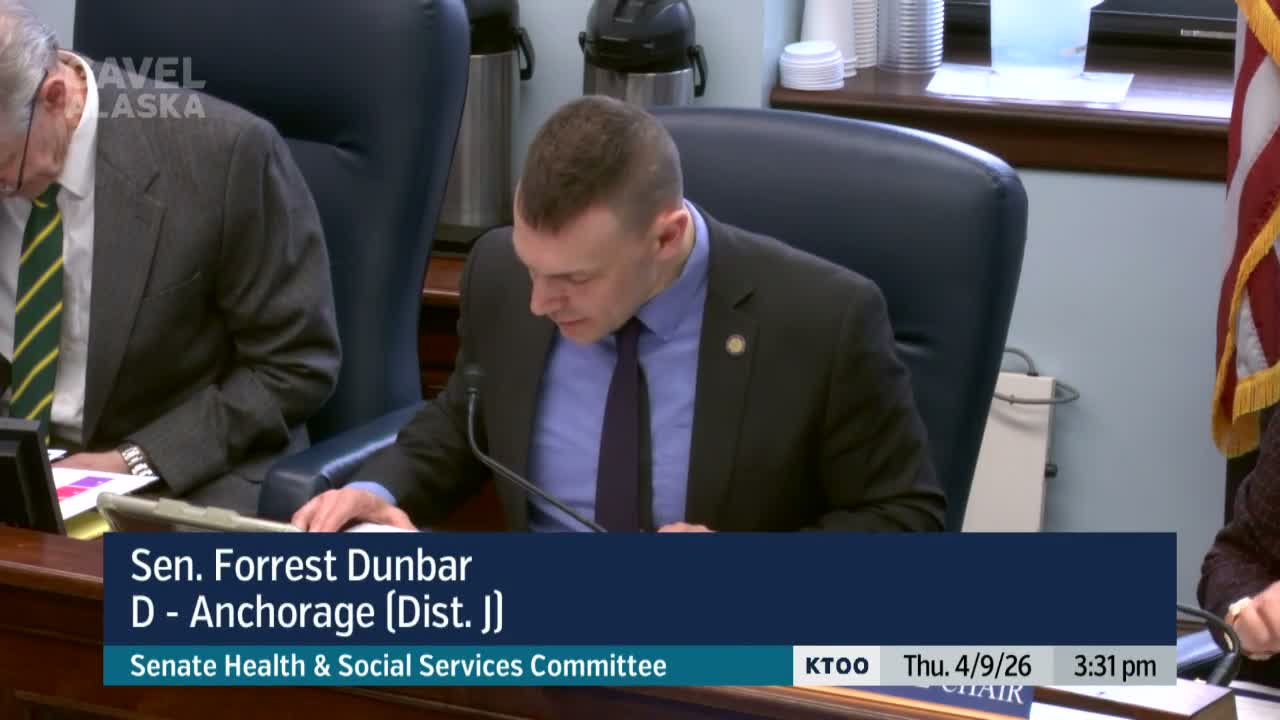
Chair Dunbar convened the Senate Health and Social Services Committee on April 9 for a second hearing on SB 281, a bill that would have Alaska join several interstate professional licensure compacts as part of implementing the Rural Health Transformation Program (RHTP). The committee heard invited testimony from Sylvain Raab, director of the Division of Corporations, Business and Professional Licensing, who framed the compacts as tools to reduce administrative duplication and support workforce flexibility.
"We agree that all of these compacts are important and will benefit the state, the relevant professionals, and the Alaskans they care for," Raab told the committee. He described three compacts in SB 281 — the Interstate Medical Licensure Compact (IMLC), the Physician Assistant licensure compact (PA compact), and the psychology compact (PSYPACT) — and noted that the Nurse Licensure Compact (NLC) is a separate priority for the department tied to keeping a full $272,000,000 federal RHTP award.
Raab said compacts can lower regulatory workload by eliminating redundant credential verifications and that, in many cases, staff-time savings will offset any loss in licensing revenue. He gave the physical therapy compact as a practical example: an examiner who previously worked full time on physical and occupational therapy licensing now divides duties across programs, generating program-level savings that can help hold down fees.
On costs to the state and licensees, Raab said the IMLC carries no state entry fee and is likely to have little or no upward impact on licensing fees. He said the initial IMLC pathway for physicians involves a $700 initial compact-related cost plus standard license fees in a participating state. PSYPACT applicants pay discrete telepsychology and temporary-in-person fees; Raab provided per-item figures for e-passports, certificates and renewals that he described as small compared with annual program costs.
Senators pressed Raab on the PA compact, which he said is enacted in statute where seven states are required for it to operate; although 20 states have passed the PA compact, the compact commission must finalize IT infrastructure and a shared licensure database before practitioners can use compact privileges. "Until that happens ... nobody can get a compact privilege or practice in another state," Raab said, and he told the committee that the PA compact is expected to go live sometime in 2027.
Committee members also raised concerns about whether compacts would make it harder for Alaska to know who is actually practicing in the state. Raab responded that the division already lacks routine data on practitioners' physical practice locations, employers or when and where they practice; compacts show who is authorized to practice, but not necessarily where they are actively seeing patients.
On disciplinary authority, Raab told lawmakers Alaska licensing boards would retain their authority to investigate and take action against practitioners providing care to Alaskans. "If a professional loses their eligibility for an expedited license, practice privilege, or interjurisdictional authorization ... they can still opt to apply for a single-state Alaska license through our standard process," he said, adding that compact systems are designed to share disciplinary actions across states to enhance public safety.
Raab cited limited data from the physical therapy compact, which went live in Alaska last year: 127 physical therapists and 15 physical therapy assistants obtained compact privileges to practice in Alaska, compared with 24 Alaska-licensed therapists and six assistants who sought privileges elsewhere. He cautioned the committee that the division does not track where compact-authorized practitioners actually practice.
Chair Dunbar and several senators requested supporting studies and details; Raab agreed to provide the referenced IMLC study to the committee. The chair also noted the committee will take up the committee substitute for SB 281 at a later date because the CS makes substantive changes, and public testimony on SB 281 was left open.
The committee recessed after Raab's testimony and heard subsequent Department of Health witnesses on RHTP implementation. The committee will reconvene April 14 to continue related business.