House committee hears Fairbanks-backed bill to ease formation and annexation of road service areas
Loading...
Summary
The House Community and Regional Affairs Committee heard testimony on HB 379, which would let second-class boroughs create or consolidate new road service areas after 07/01/2026 and remove the requirement that an existing RSA also vote to accept a joining neighborhood; the measure preserves resident votes to form RSAs and was set aside with an amendment deadline of April 13.
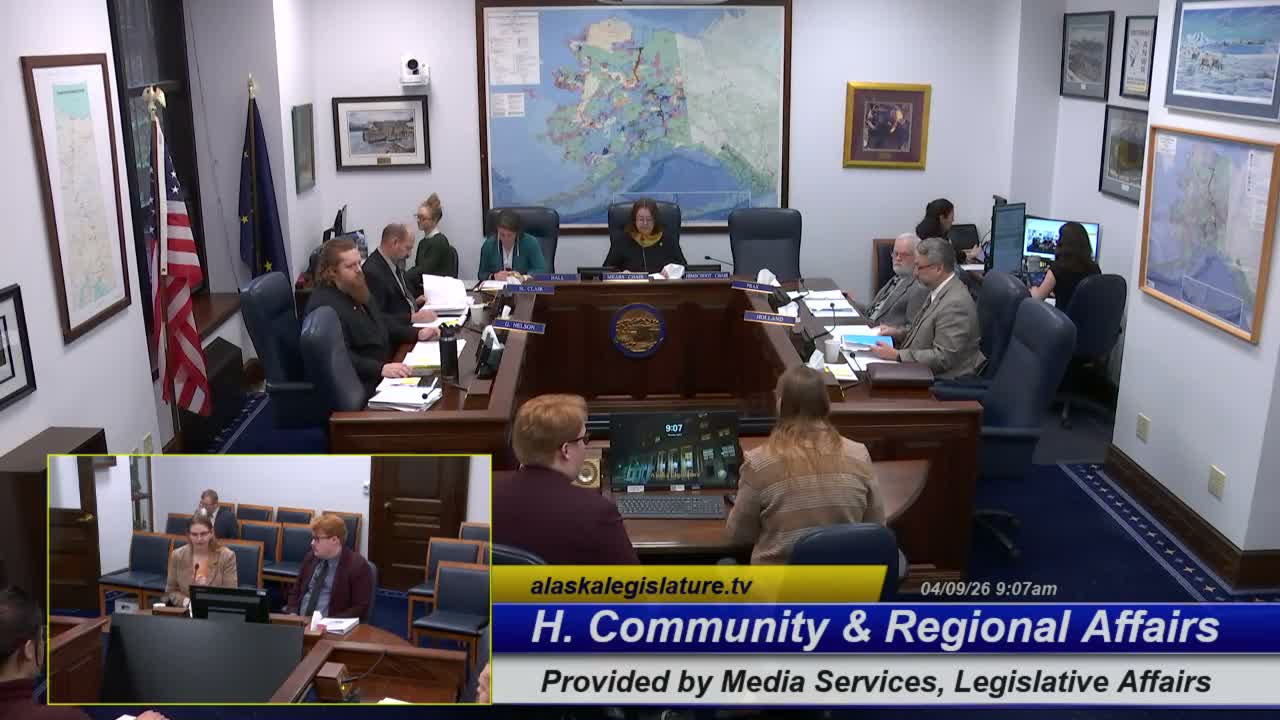
The House Community and Regional Affairs Committee on April 9 heard testimony and questions on House Bill 379, which would change how second-class boroughs create and consolidate road service areas (RSAs). Sponsor Representative Ashley Carrick said the bill aims to streamline RSA creation and annexation while preserving existing RSAs and residents’ control.
Carrick told the committee HB 379 would let second-class boroughs (including Fairbanks North Star Borough) abolish, replace, alter or consolidate RSAs created after the bill’s effective date (07/01/2026) and allow boroughs to create regional RSAs that incoming neighborhoods can join with only a vote of the residents in the incoming area. “If you like your road service area, you can keep it the way it is,” Carrick said, adding the change is intended to reduce the current proliferation of RSAs and improve service delivery.
Mayor Hopkins of the Fairbanks North Star Borough, participating online, told committee members the bill would not permit taxation without representation. “We would not be able to put anybody in a service area without them voting first to approve being put into that service area,” Hopkins said, describing a proposal in which the borough could create a larger regional service area that an interested neighborhood could opt into by resident vote. Hopkins and borough attorney Jill Dolan emphasized that local assemblies would set financial thresholds and road-quality standards for any new or consolidated service area.
Borough attorney Jill Dolan explained how mill rates are calculated and what revenue sources RSAs may use. Dolan said the mill rate for a service area is calculated from its annual budget divided by the net taxable assessed value of properties in the area and may include allocations for insurance, staff time, capital projects, and grant matches.
Representatives on the committee repeatedly questioned how the bill would define “financial viability” and whether removing the requirement that existing RSAs vote to accept a joining neighborhood would deny existing residents a say. Dolan responded that the bill does not change the statute the committee discussed (identified in the hearing as 29 35 4 90 / related code references) requiring a majority of residents in a newly created service area to approve formation; owner consent rules remain in place when no voters reside in an area.
Committee members and witnesses cited an example in Fairbanks — a College/Campus Acres neighborhood that tried to join a long-established nearby RSA but was blocked from holding an election after existing RSA representatives testified against it — to illustrate how the current two-vote process can prevent neighborhoods that seek service from obtaining it. Mayor Hopkins said the change would help bring “orphan roads” into service without repeatedly asking the Legislature for narrow fixes.
The committee set an amendment deadline for HB 379 of Monday, April 13 at noon and took no final action on the bill at the April 9 meeting.