Get Full Government Meeting Transcripts, Videos, & Alerts Forever!
Get email alerts on the HB 1408 topic
No spam. Unsubscribe anytime.
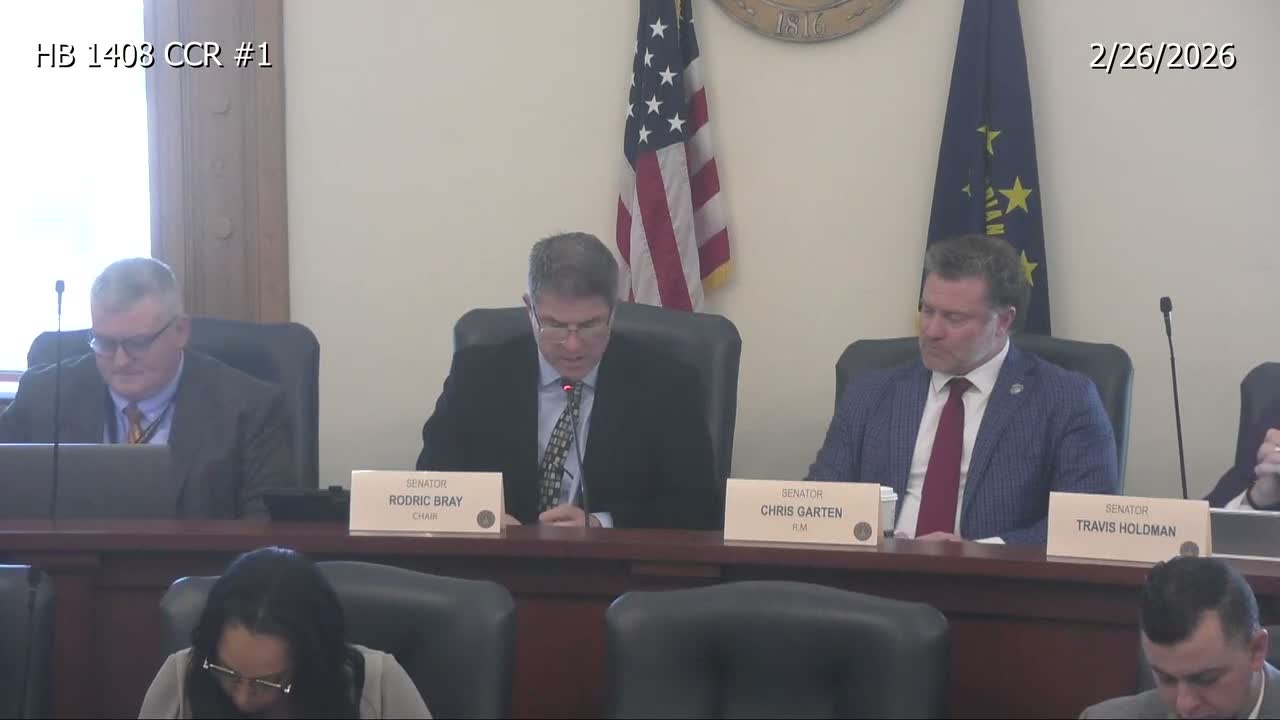
Rules committee advances House Bill 1408 after debate over social-media revenue threshold
Summary
The Rules Committee advanced House Bill 1408, which adds social-media-related language to state law; debate centered on a revenue threshold (over $1,000,000,000) defining affected platforms and whether prominent apps such as Snapchat would be covered.
The Senate Rules and Legislative Procedure Committee voted to advance House Bill 1408 after a brief debate about which social-media companies would be covered by the bill’s language.
Senator Rotz, the sponsor, said HB 1408 incorporates language that originated in Senate Bill 199 but was altered when the House created a new version and passed it. He told the panel the principal substantive change in 1408 is the addition of social-media provisions that were part of the prior Senate proposal.
Senator Hundley questioned the scope of the social-media language and asked who would be included or excluded under the bill’s definitions, noting that earlier consideration raised concerns about Snapchat. Senator Rotz replied the bill applies to companies that “have over $1,000,000,000 in annual revenue,” which is the stated criterion in the committee version.
Senator Garten clarified for the record that Snapchat’s revenue is, in his estimate, about $6,000,000,000, and therefore would likely meet the bill’s revenue threshold unless the text explicitly carved it out.
After discussion, a motion to move the record was made and seconded; the Chair announced the report passed by a roll call vote announced as 8–3. The committee’s review is procedural and does not itself indicate approval or opposition to the bill’s policy content.
The transcript does not record additional detail about any carve-outs or amendments; sponsors indicated the language was placed in 1408 after earlier Senate-House exchanges.