Get AI Briefings, Transcripts & Alerts on Local & National Government Meetings — Forever.
Warner planning board urges selectboard to clarify Class VI road rules ahead of July 1 change
Loading...
Summary
At a Feb. 16 work session the Town of Warner Planning Board discussed RSA 674:41 I(c), concerns about insurance and emergency access for homes on Class VI roads, and agreed to draft a letter recommending selectboard policy updates and subdivision‑regulation changes before the statute takes effect July 1, 2026.
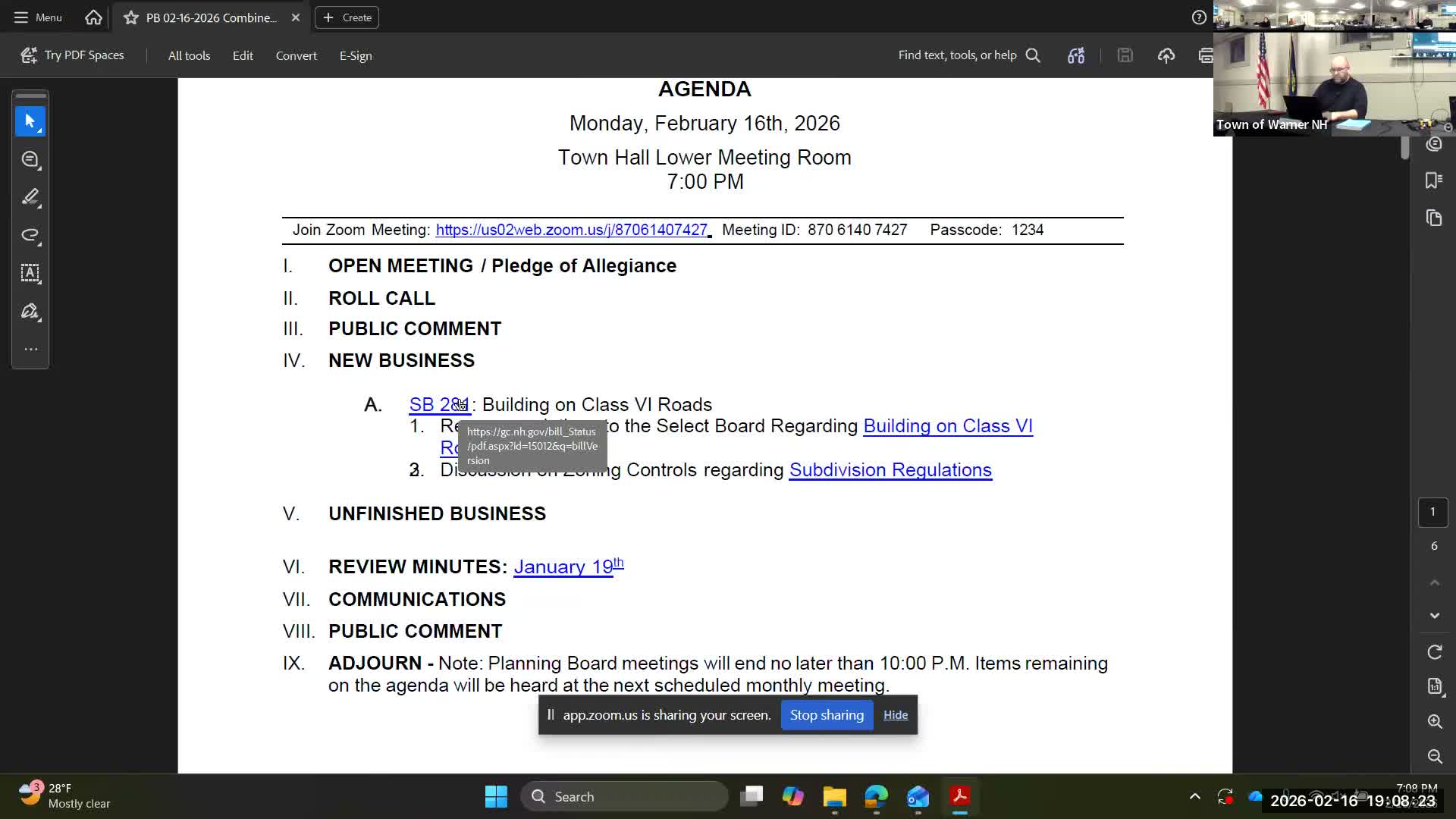
The Town of Warner Planning Board on Feb. 16 agreed to draft a letter to the selectboard asking for clearer local policies to implement RSA 674:41 I(c), a state provision the board said will allow building on Class VI roads beginning July 1, 2026.
Board members said the brief state form requires a recorded waiver that would relieve the town of maintenance obligations and references a requirement that lots be “insurable,” language members said is unclear and could make mortgages difficult to obtain. "The waiver says the town has no responsibility to do a thing for you on the route," a committee member said. John Levitt, who chaired the discussion, emphasized the timeline: "We have no choice," he said, noting the July 1 effective date and the need to act now.
Why it matters: Members warned the combination of a recorded waiver and an ambiguous insurance standard could channel development toward homeowners who can self‑finance, while leaving questions about who pays for plowing, road improvements or emergency access. The board discussed that the selectboard — not the planning board — retains authority to designate a Class VI road as an emergency lane after public notice and hearing, a step that affects whether emergency services routinely respond.
What the board discussed: The planning board explored several practical options for the selectboard and for its own subdivision rules. Recommended items the board agreed to include in a draft letter or regulatory edits are: remove a local clause that requires upgrading to Class V as a condition for building permits; add a clear cross‑reference to RSA 674:41 I(c) in subdivision regulations so applicants are aware of waiver and insurability requirements; define a minimum, measurable standard for emergency access (rather than the vague term "passable"); require that owners who expect town services maintain roads to a standard consistent with emergency access; and consider deed or right‑of‑way dedications where future upgrades are anticipated.
Members also recommended technical review involvement from the fire chief and road personnel for individual proposals and suggested digitizing the town’s road book (currently kept at DPW) to clarify whether lanes are public rights of way. Stormwater and environmental protections were raised as reasons to retain proportionate subdivision requirements: the board noted that subdivision review already allows requiring improvements proportionate to impacts caused by a major subdivision.
Next steps and procedural outcome: The board instructed members to prepare suggested language and a rough draft letter for the selectboard that lists the items above and other considerations (insurance recording requirements, emergency‑service minimum standards, and taxation implications). The planning board also agreed to review its subdivision regulations to insert appropriate references and to recommend staffing or a technical review process for on‑the‑ground assessments. Earlier in the meeting the board approved the Jan. 19 minutes as amended (roll‑call approval with one member recorded as abstaining). The work session ended at about 8:33 p.m.
Quote selection: "The waiver says the town has no responsibility to do a thing for you on the route," a committee member said, summarizing how the state form frames municipal obligations. "We have no choice," John Levitt said, urging prompt action given the incoming effective date.
What is uncertain: The board noted ambiguity in the state's one‑page guidance about whether the requirement is proof of insurability or a certificate of insurance at permit issuance and cautioned that mortgage lenders often refuse loans on properties that cannot be insured; the board said this point will be clarified in the draft letter to the selectboard.
The board did not adopt any formal land‑use ordinance changes at the meeting; it agreed to develop recommended language and to return to the topic at a future session.