Assembly hears hours of testimony on Salmon Falls rezone; conditional amendment fails and decision deferred
Loading...
Summary
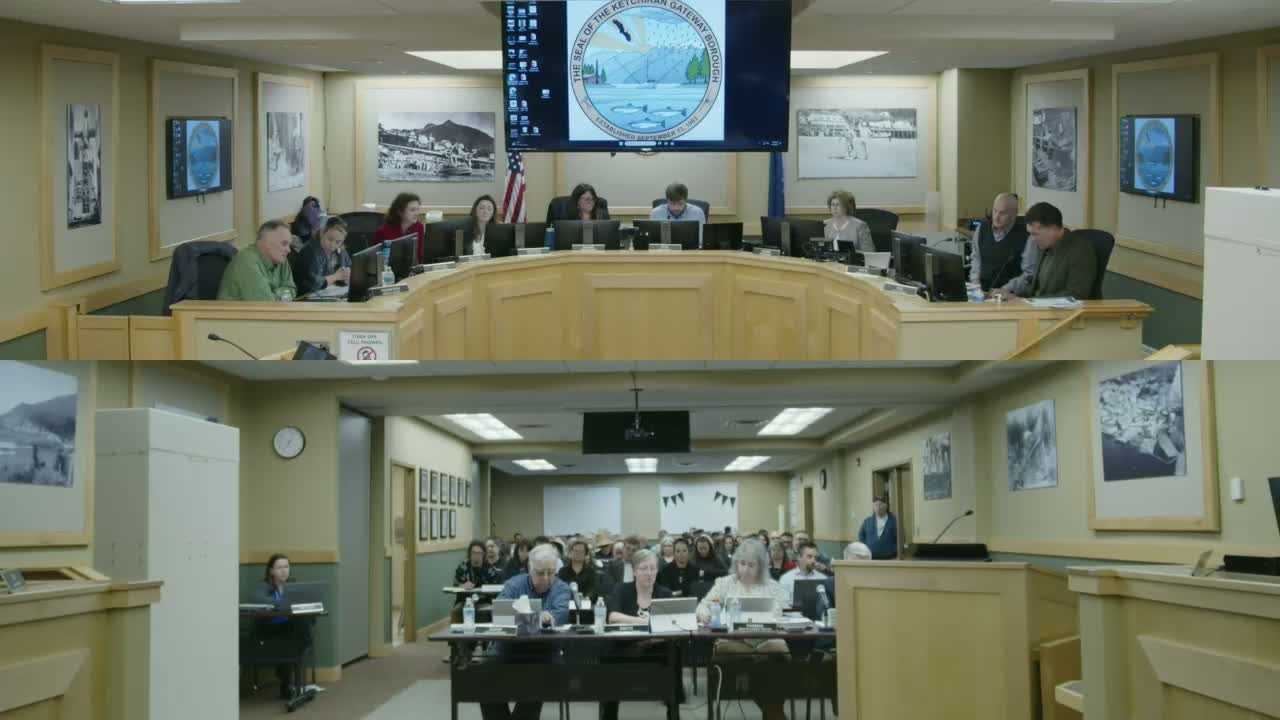
The assembly held a lengthy second public hearing April 6 on Ketchikan Indian Community's Salmon Falls rezone request to general commercial. Staff recommended approval of three parcels, the planning commission recommended denial; a proposed conditional-rezone amendment failed 4—, and the assembly deferred final action to its continuation meeting after extended debate and public testimony.
The Ketchikan Gateway Borough Assembly spent the bulk of its April 6 meeting considering a substitute ordinance to rezone parcels at the former Salmon Falls resort from Future Development (FD) to General Commercial (CG). Planning staff recommended approval for three primary parcels and denial for two RL parcels; the Planning Commission had recommended denial.
Planning Director Frank Maloney told the assembly staff's recommendation reflected the property's documented commercial permit history: "The Planning Commission recommended denial on all five accounts. Staff's recommendation is for approval on the three main parcels and denial of the RL parcels rezone," he said.
The public record produced a wide gulf of views. Ketchikan Indian Community representatives and tribal and regional leaders described the property as uniquely suited for a culturally grounded "healing center" and said the project would expand treatment capacity, workforce development and housing supports. Emily Eden Shaw for KIC summarized the tribe's outreach and compromise: "For months we have heard that we support the healing center, but just not the rezone...Last meeting our president offered a good faith compromise...we can move forward with the three lots that staff has recommended." (Emily Eden Shaw)
Opponents, including Waterfall subdivision residents and private counsel, warned that rezoning to CG would enable a wide range of commercial and institutional uses without further public hearings, and risked so-called spot zoning. Attorney Joe Kovac, representing neighboring property owners, urged denial unless the assembly required a more rigorous evidentiary showing on infrastructure and public-safety impacts: "Approval of this rezoning risks setting a troubling legal precedent for piecemeal land use changes...At a minimum the assembly should require a far more robust evidentiary showing" (Joe Kovac).
North Tongass Fire Chief Jerry Kiefer said his department had reviewed KIC's planned operations and "does not anticipate any significant changes" to call volume if the facility operates as described with 24-hour medical staffing, security and transportation arrangements, but he advised caution if the use changed to higher-acuity detox operations.
During assembly deliberations Assemblymember Dyle offered an amendment to treat the action as a conditional rezone: grant CG to align zoning with historical commercial use but require conditional use permits for any uses beyond previous FD allowances so neighbors would retain public review rights. That amendment was seconded and debated, but failed on a 4— vote after the mayor cast the deciding vote in a 4— tally.
Assemblymember Palmer then moved to adopt the substitute ordinance to rezone the parcels to general commercial and Matson seconded; the motion remained pending as the assembly moved to close and extend the meeting. A separate motion to extend the meeting past 10:30 p.m. failed to achieve the unanimous vote required, and the assembly adjourned to reconvene at 5:30 p.m. the following day, leaving final action on the ordinance for that continuation.
The record from the hearing includes extensive public testimony both supporting and opposing the rezoning, multiple technical questions about septic, insurance and EMS capacity, a formal conflict-of-interest recusal for Assemblymember Thompson, and a written letter from the North Tongass Fire Chief documenting conditional support if KIC adheres to described operational controls.
The assembly will resume consideration of Ordinance 2106 at the continuation meeting; staff and the applicant may return with additional documentation or proposed conditions.