Get Full Government Meeting Transcripts, Videos, & Alerts Forever!
Get email alerts on the Carbon Storage Primacy topic
No spam. Unsubscribe anytime.
Committee advances bill to let Indiana apply for federal Class VI primacy for CO2 storage; opponents raise monitoring and property concerns
Summary
House Bill 1368 would let Indiana apply to the EPA for state primacy over Class VI CO2 injection permits, aligning state law with EPA requirements. Supporters say primacy improves permitting efficiency and competitiveness; opponents urged stronger monitoring, seismic and post‑injection safeguards and questioned DNR readiness.
Chairman Solliday introduced House Bill 1368, which would allow the Department of Natural Resources to apply to the U.S. Environmental Protection Agency for state primacy over Class VI underground injection permits for carbon‑dioxide storage. Proponents told the committee this is primarily a procedural change to align state code with federal Class VI technical standards and to give Indiana a single, predictable permitting point of contact for large carbon management projects.
Stephanie Flitner, general counsel for the Department of Natural Resources, said the DNR has modeled its proposed program on states that have received primacy and pointed to the agency’s existing Class II (oil and gas injection) experience. She told the committee that the DNR has worked with EPA and would fund the program from application and tonnage‑based permit fees. Danae Schneck, DNR’s carbon program coordinator, said there are nine permit applications in the federal queue and that DNR expects to work with applicants and EPA if the state obtains primacy.
Industry testimony from cement, ethanol and fuel producers and associations (including Heidelberg Materials, the Indiana Ethanol Producers Association and POET) emphasized that state primacy can streamline permitting, provide regulatory certainty and support industrial investment. "This establishes a state‑level primacy that can help streamline permitting, improve regulatory clarity, and enhance Indiana's competitiveness," said Wendy Cross of Heidelberg Materials.
Opponents warned of technical safety gaps. Multiple critics urged additional mandatory monitoring (including 4‑D seismic/time‑lapse surveys), more detailed mechanical‑integrity testing, clearer rules on injection depth waivers and stronger post‑injection monitoring timeframes. A critic of a Wabash Valley Resources project described recent incidents and urged the committee not to cede permitting authority without ensuring rigorous safeguards.
Committee members pressed DNR on staffing, funding and technical capability to take on Class VI oversight. DNR responded that permit fees and tonnage charges would establish dedicated funds and that the agency has drawn on existing Class II program experience, but senators repeatedly requested additional details on monitoring capacity and oversight resources before primacy would be final (the state must still apply to and be approved by EPA).
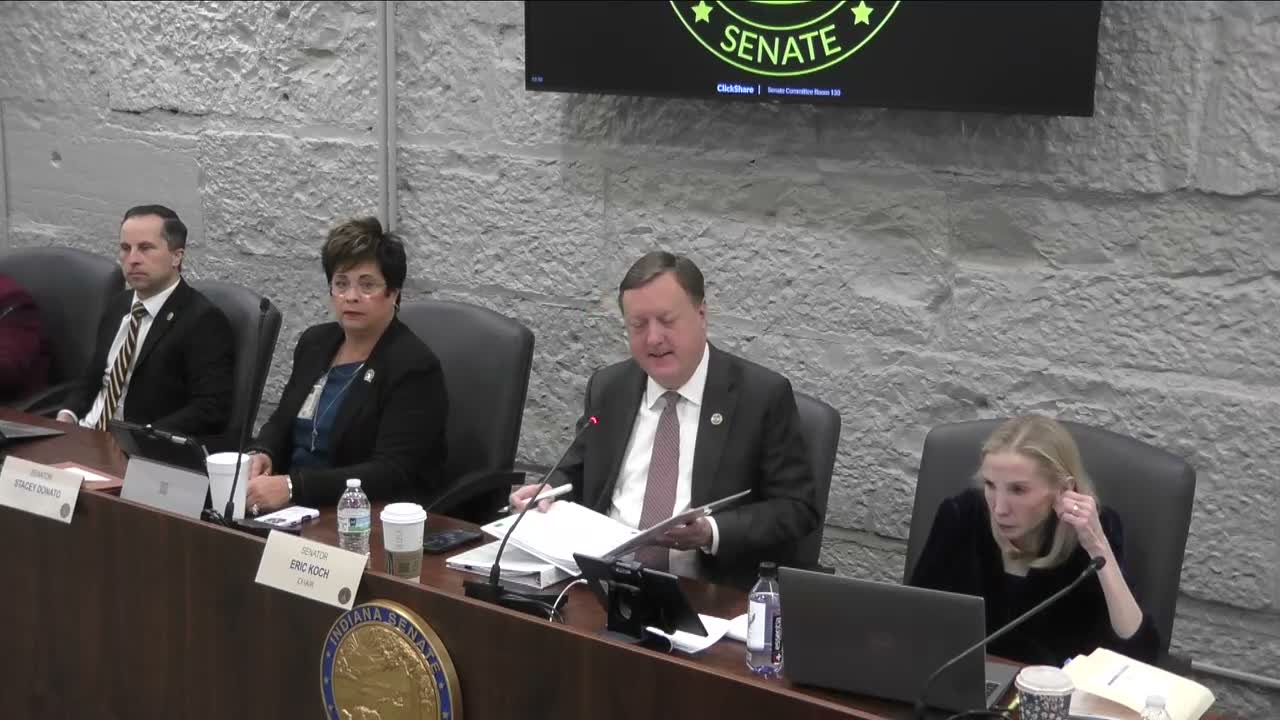
The committee adopted a technical Amendment 3 (EPA‑requested, conforming changes) by consent and later moved HB 1368 as amended. After discussion on eminent domain language, monitoring and oversight, the committee passed the amended bill on a 5–3 recorded vote and the measure advances for further consideration.
If enacted and approved by EPA, primacy would not automatically transfer any pending federal permits; DNR said existing applications already in the EPA process would likely remain under federal review while future applications could be transferred subject to EPA approval and coordination.