Get Full Government Meeting Transcripts, Videos, & Alerts Forever!
Get email alerts on the Climate Commitment Act topic
No spam. Unsubscribe anytime.
City officials say Climate Commitment Act will require choices for municipal gas utility as costs rise
Summary
City Administrator Chris Searcy told the council the Climate Commitment Act (CCA) already applies to the municipal gas utility and could push compliance costs into the hundreds of thousands or more annually; staff asked council for policy guidance and plans to return in May with follow-up information.
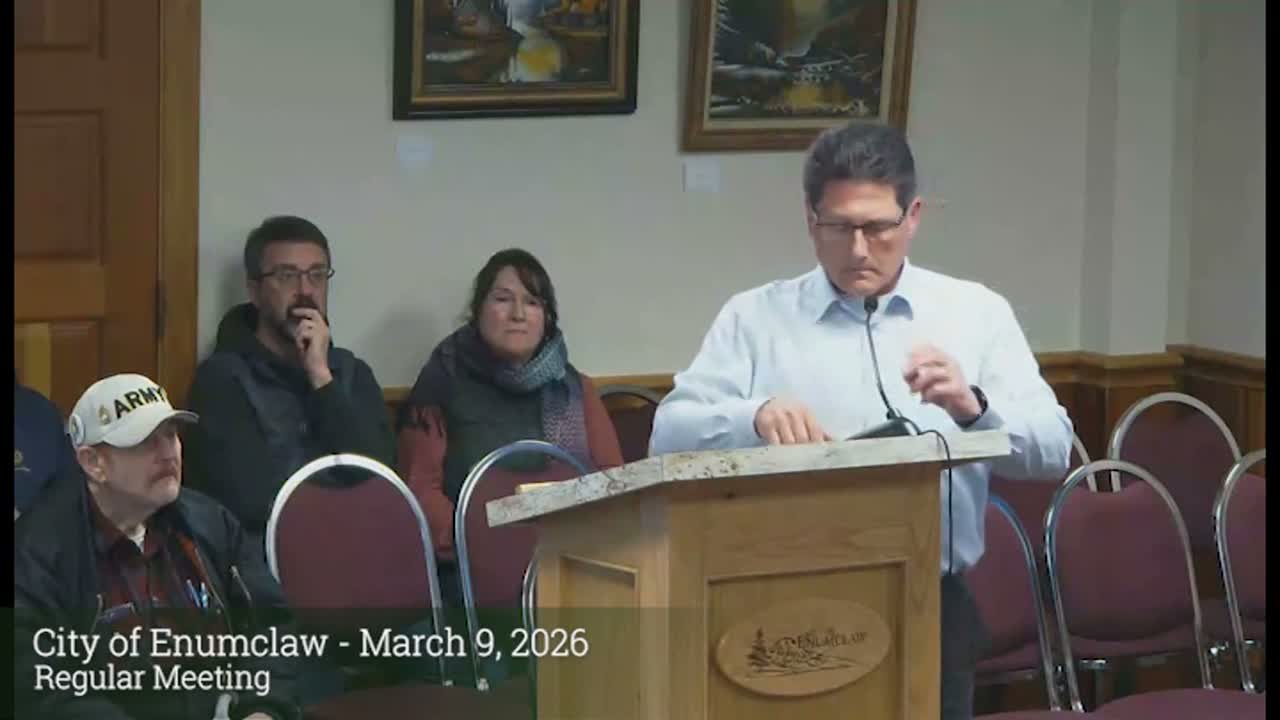
City Administrator Chris Searcy told the City of Enumclaw council on March 9 that the Climate Commitment Act (CCA), Washington's cap‑and‑invest program, already applies to the city's natural gas utility and will require the city to make policy choices to limit future costs.
"It is the law. We must comply with it," Searcy said during a presentation meant to inform new council members. He said the utility's average emissions for 2023–25 were "a little over 25,000 metric tons," which narrowly places the municipal utility above the CCA's coverage threshold.
Why it matters: being a "covered entity" under the CCA means the utility must obtain carbon allowances equal to its emissions and may need to buy allowances at quarterly Department of Ecology auctions. Searcy explained that the city initially received substantial no‑cost allowances but that those allocations decline each year, increasing the portion that must be bought on the open market.
Searcy gave council rough cost figures and customer impacts to illustrate scale: the city's first-year CCA cost was about $250,000; recent years rose toward several hundred thousand dollars and could exceed $1 million in later years depending on carbon prices and market linkage. He described the mechanics that produce two different customer charges: legacy customers (connected before July 25, 2021) receive some offset from auction proceeds and historically saw a CCA charge of roughly 6–7¢ per 100 cubic feet (CCF), while newer "non‑legacy" customers pay a larger, straight conversion that Searcy said has been estimated near 23–33¢ per CCF.
Searcy also told council that the city's compliance status can fluctuate with weather (colder winters increase gas use) and that Ecology can retain entities that are within 10% of the threshold; he said the city's practical target would be to reach about 22,500 metric tons to create a buffer below the 25,000‑ton threshold.
Policy choices discussed included pursuing full cost recovery for new development, designing programs to reduce customer gas load (for example, incentives for heat‑pump conversion), or pursuing an alternative compliance approach with the state that Ellensburg and municipal utilities have explored. Searcy said municipal utilities have limited staff capacity for large customer‑engagement efforts and would likely need additional personnel or technical resources to manage a decarbonization program.
Searcy described ongoing uncertainty about the program's future market dynamics, including a possible linkage with California's cap‑and‑trade system and pending legal matters: he noted Initiative 2066 (a voter initiative intended to protect access to natural gas) is the subject of a court challenge now before the Washington Supreme Court.
What happens next: no decisions were requested at the March 9 meeting. Searcy asked council members to discuss the issue with constituents and colleagues and said staff will bring the topic back to the council in May with more information and potential policy options.
A note on sources: the presentation and cost estimates were provided by city staff during the workshop and were described by Searcy as preliminary; Searcy said staff can provide more granular projections and historic CCA accounting on follow‑up.
Ending: Council accepted the workshop for discussion and requested further information before any policy action.