Get Full Government Meeting Transcripts, Videos, & Alerts Forever!
Get email alerts on the Grants And Budget topic
No spam. Unsubscribe anytime.
Grant committee hears more than two dozen nonprofit pitches, questions staff screening and starts fiscal-sponsorship pilot
Summary
The Ketchikan Gateway Borough Grant Committee heard FY2027 requests from more than two dozen nonprofits on March 9, 2026, debated a staff decision that left one cancer-support applicant off the committee agenda, and reviewed a pilot allowing fiscal sponsors to submit multiple projects with caps intended to expand access to borough funds.
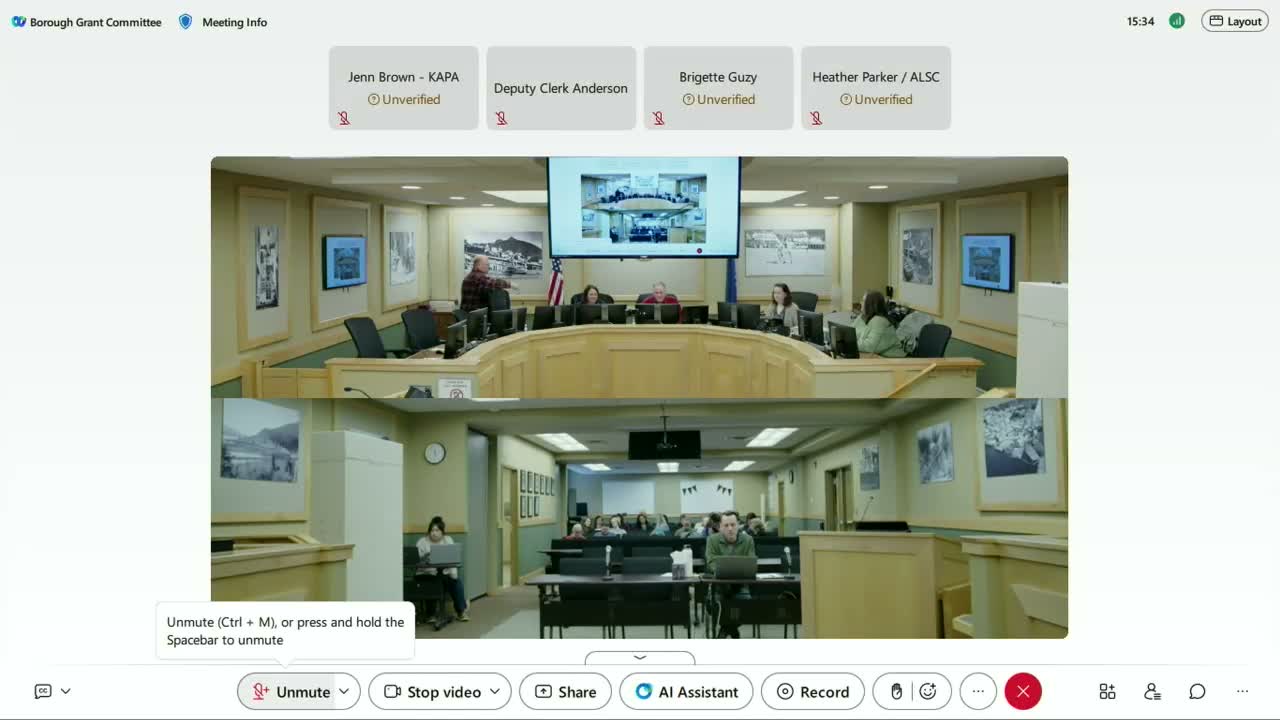
On March 9 the Ketchikan Gateway Borough Grant Committee met for a daylong run of FY2027 grant presentations from local nonprofits and community groups. Committee members heard program summaries from Alaska Legal Services, Catholic Community Services, First City Players, the Ketchikan Agricultural Producers Association (CAPA) and more, set scoring timelines and discussed a staff-level screening and appeal process that left one applicant excluded from committee review.
The meeting opened at 12:30 p.m.; the body confirmed a quorum, appointed a chair by unanimous consent and then proceeded through presentations. Heather Parker, supervising attorney for Alaska Legal Services’ Southeast offices, described the Elder and Family Legal Advocacy Project and said the program provided assistance to 19 Ketchikan Gateway Borough residents between July 2024 and June 2025, aiming to serve 15–20 local cases a year under the requested borough support. "We provide free civil legal services to low-income Alaskans," Parker said, noting work on housing, benefits appeals and elder protections.
The session’s most pointed exchange concerned a local cancer-support applicant that staff had deemed ineligible under the grant's "transportation" category and therefore did not forward to the recommending committee. Committee member Bailey criticized that decision, saying the application "was well written and was clearly shown a need for our residents fighting cancer" and lamenting that the committee would not have the chance to review or attempt to amend the application. Grants staff, identified in the meeting as Peter Amblin, replied that applicants were given an opportunity to appeal the staff decision but did not file within the one-day window tied to the timing of the submission. "They were given an opportunity to appeal staff's decision to not move that forward," staff said, calling the exclusion procedural and based on the appeal deadline.
Committee members and staff agreed to monitor whether the appeals process needs revision, but no immediate policy change was made. Chair explained the intent of staff screening is to confirm basic eligibility (filings, tax returns, financial statements) so the committee can focus on program merit.
A separate, framed policy change discussed in the meeting was a pilot allowing fiscal-sponsorship arrangements: under the pilot, an umbrella organization may submit multiple applications on behalf of programs or smaller groups. Grants staff described caps that limit additional fiscal-sponsorship funding to $25,000 per single project and impose a $50,000 cap on such funding overall for a sponsoring organization in this first-year trial.
Several applicants highlighted operational details and specific funding gaps. Jen Brown, executive director of the Ketchikan Agricultural Producers Association, described two initiatives: a turnkey automated ice vending unit for the waterfront (a used, cold-weather–configured machine identified in Washington state) and a technical-assistance curriculum for aspiring food entrepreneurs. Brown said switching to a low-maintenance vending unit raised the total project cost above existing commitments and left an "about $11,000" shortfall to cover equipment, freight and installation to get the unit operational before the fishing season. "The request here is a small stop gap to get the project that's otherwise fully funded and ready to go across the finish line," Brown said.
Other presenters emphasized local reach and outcomes: Bridget Guzzi of Catholic Community Services outlined senior-nutrition work (about 45 home-delivered meals daily and congregate services) and the importance of those programs as Ketchikan's senior population grows; Elizabeth Nelson of First City Players described arts education, outreach and scholarships and said borough support is roughly 7% of the organization's budget; Margaret Cloud summarized Ketchikan Community Cats’ trap-neuter-return and pet-food pantry operations that have expanded to outlying communities.
The committee described next steps: members will complete scoring sheets over the next weeks; staff will compile results; and the recommending committee will reconvene on April 3 at 12:30 p.m. to finalize grant recommendations for assembly consideration as part of the FY2027 budget process. Chair adjourned the meeting without objection.
What to watch next: whether staff and the committee revise the appeal timeline or screening criteria in response to Bailey's concerns, and whether CAPA secures the roughly $11,000 gap that would allow the waterfront ice vending project to be installed before fishing season.