Get Full Government Meeting Transcripts, Videos, & Alerts Forever!
Get email alerts on the Tax And Fiscal Policy topic
No spam. Unsubscribe anytime.
Senate committee debates major rewrite of local income tax structure, aims to delay LIT changes for one year
Summary
Lawmakers and municipal groups spent hours on Senate Bill 238, a sweeping proposal to reallocate local income tax caps, move portions of the fire/EMS rate to municipal control, modify business personal property exemptions and delay implementation of SEA 1 LIT changes by one year while DOR data are gathered.
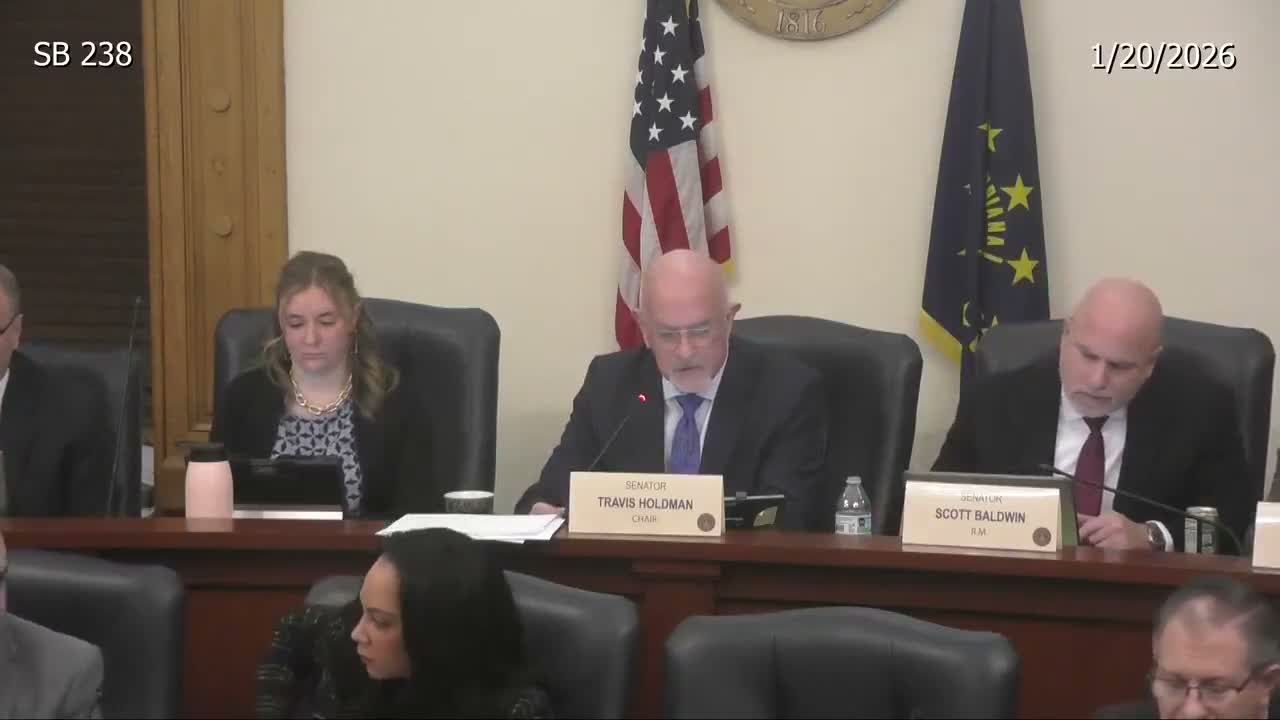
The Senate Tax and Fiscal Policy Committee on Thursday held a lengthy hearing on Senate Bill 238, a package of changes that would alter how Indiana’s local income tax (LIT) is distributed and delay the law’s full implementation by one year.
Senator Rogers, sponsor of the measure, told the committee the bill is “a work in progress” designed to make the LIT framework enacted in last session’s SEA 1 workable for municipalities, counties and school corporations. Among the principal changes Rogers described were reducing the county services cap from 1.2% to 0.7% and reallocating 0.5 percentage points to the municipal services cap (raising it to 1.9%), moving 0.2 percentage points of the fire/EMS rate to municipalities, and changing the business personal property de‑minimis threshold from $2,000,000 to $1,000,000 with the first $1,000,000 exempt.
“The intent is not to increase total taxpayer exposure,” Rogers said, “it is to redistribute authority so local governments can remain financially stable under the new structure and avoid unintended budget shocks.”
Why it matters: SEA 1 remade Indiana’s local tax architecture and shifted revenue away from property tax toward income tax. Committee members and local governments reported that, without adjustments, many cities and towns would face significant revenue losses beginning in 2028. Sponsors said the delay and technical fixes would give agencies time to assemble municipal-level data and to adjust implementation so community budgets are not upended.
Municipal and school officials offered mixed responses. Jenna Bentley of AIM (Association of Indiana Municipalities) said the bill “finds the right balance” to keep most cities whole while preserving a statewide 2.9% cap on total LIT exposure. Campbell Ricci of AIM explained the mechanics and urged lowering the population threshold for municipal opt‑in from 3,500 to 2,000 so more towns have the option to adopt a municipal rate.
Local officials gave concrete examples of impact. Kevin Beatty, town manager in Clarksville, said his town stands to lose a combined $7.5 million in revenues under the original SEA 1 structure and that, even with SB238’s changes, Clarksville still projects a shortfall exceeding $1 million. School finance advocates likewise supported the bill’s one‑year delay: Scott Bowling of the Indiana Association of School Business Officials said the extra year is “critical” to allow districts to plan for the largest impacts in 2028.
County leaders pushed back. Jamie Bolser of the Association of Indiana Counties warned SB238’s reallocation could leave counties underfunded for constitutionally required services such as courts, jails, public health and emergency management, and urged preserving county flexibility and the 1.2% county cap in some form.
What was decided: Committee members did not move SB238 to the floor in this session; sponsors and stakeholders agreed to continue negotiations. Lawmakers repeatedly requested additional municipal-level data from the Department of Revenue before taking final action.
The committee’s next step is additional bill drafting and cross‑chamber coordination; sponsors said they expect to seek a delayed implementation and other technical amendments before any final vote.